

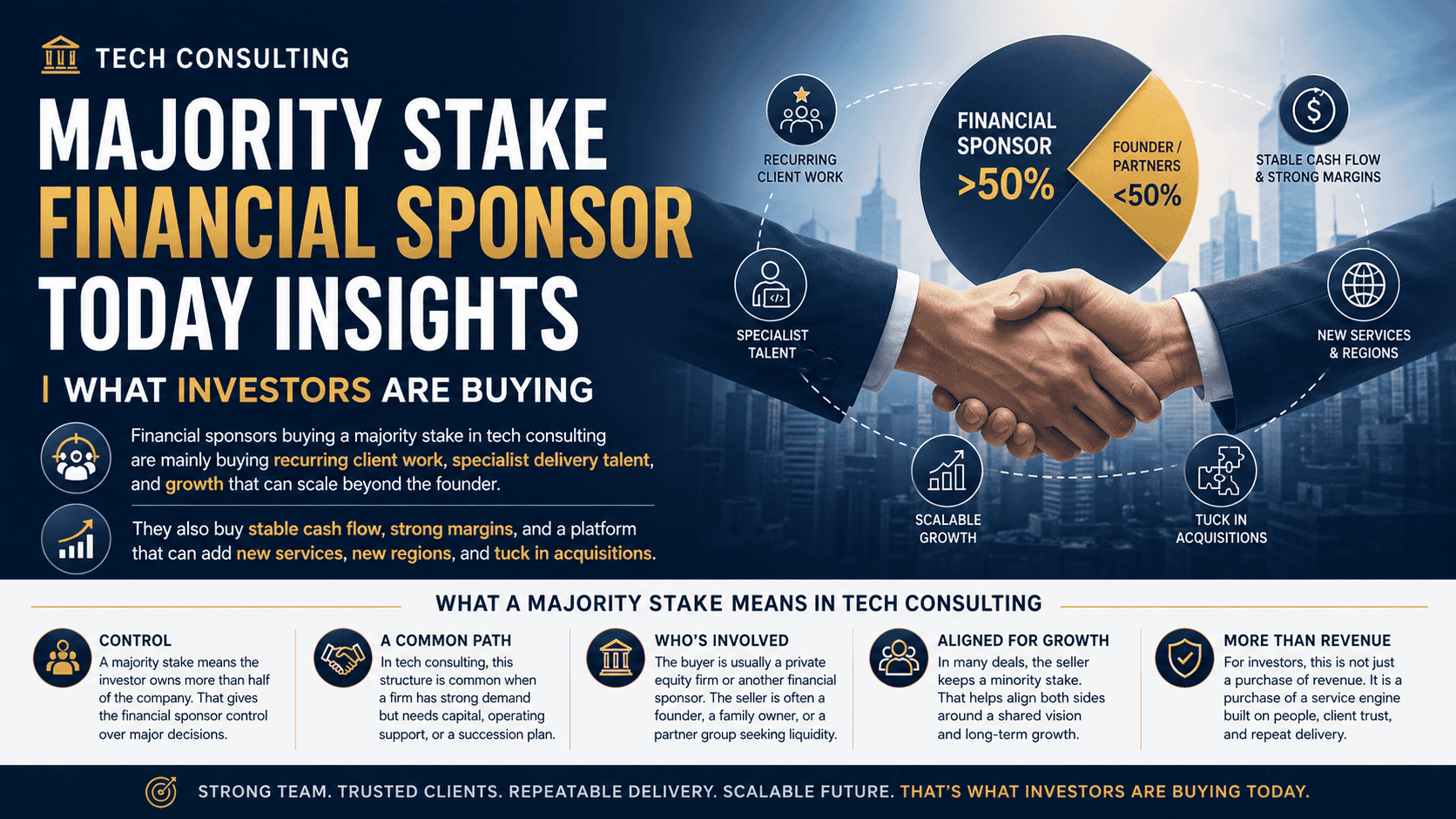

Financial sponsors buying a majority stake in tech consulting are mainly buying recurring client work, specialist delivery talent, and growth that can scale beyond the founder.
They also buy stable cash flow, strong margins, and a platform that can add new services, new regions, and tuck in acquisitions.
What A Majority Stake Means In Tech Consulting
A majority stake means the investor owns more than half of the company. That gives the financial sponsor control over major decisions. In tech consulting, this structure is common when a firm has strong demand but needs capital, operating support, or a succession plan.
The buyer is usually a private equity firm or another financial sponsor. The seller is often a founder, a family owner, or a partner group that wants partial liquidity. In many deals, the seller keeps a minority stake. That helps align both sides around growth.
For investors, this is not just a purchase of revenue. It is a purchase of a service engine. The business usually depends on people, client trust, and repeat delivery. That makes the quality of the team and client base as important as the numbers on paper.
Why Financial Sponsors Target Tech Consulting
Tech consulting attracts buyers because the demand is broad and still growing. Companies need help with cloud migration, cybersecurity, enterprise software, data, automation, digital transformation, and AI adoption. Many clients do not want to build all of that in house.
Financial sponsors like sectors that have a mix of recurring demand and fragmentation. Tech consulting often has many small and mid sized firms. That creates room for consolidation. A sponsor can buy one platform company, then add smaller firms around it.
These buyers also like companies that are not tied to one product. A consulting firm can serve many vendors and many industries. That reduces dependency on a single technology cycle, although client concentration still matters.

What Investors Are Buying
| What investors buy | Why it matters | What strong firms show |
|---|---|---|
| Recurring client relationships | Gives revenue stability | Multi year contracts, repeat projects, renewals |
| Specialist expertise | Supports premium pricing | Cloud, AI, data, security, ERP, industry focus |
| Delivery team | Protects service quality | Low turnover, strong leadership, training depth |
| Scalable processes | Helps growth after the deal | Repeatable project methods, tools, standard reporting |
| Cross sell potential | Expands revenue per client | Multiple services sold to the same accounts |
| Acquisition platform | Supports roll up strategy | Systems that can absorb smaller firms |
| Cash flow | Helps debt support and reinvestment | Clean margins, low working capital needs |
The most important thing is usually not only revenue size. Investors want a business they can improve. That means they look for a company with room to grow, better manage costs, and add more services.
Revenue Quality Matters More Than Raw Revenue
In tech consulting, investors prefer high quality revenue over fast but weak growth. They look closely at how the revenue is built.
They favor revenue from repeat clients, subscriptions tied to services, managed services, and long running transformation work. They also like work that happens under framework agreements or preferred vendor status.
They worry about one time projects that end quickly. They also worry when a few clients make up too much of sales. If one customer leaves, the business can weaken fast.
A sponsor will usually ask these questions.
- What share of revenue comes from the top five clients?
- How much work is recurring?
- How many contracts renew each year?
- How long does it take to win a new client?
- How much of growth comes from existing accounts?
These questions matter because they show whether the business can continue after the deal closes.
Talent Is A Core Asset
Tech consulting depends heavily on people. Investors buy the skills, relationships, and leadership inside the firm. They pay close attention to consultants, architects, project managers, and the people who bring in new business.
They want a leadership team that can stay after the transaction. They also want clear bench strength below the founders. If the company is too dependent on one or two rainmakers, the risk rises.
Talent retention is a major part of deal value. Strong sponsors often add retention bonuses, new incentive plans, and career paths for key staff. That helps reduce turnover after closing.
Investors also study hiring pipelines. A firm that can recruit and train consultants consistently has a stronger future than one that depends on expensive lateral hires.

Margins And Delivery Discipline
Tech consulting can produce attractive margins when delivery is disciplined. Investors know this. They look for firms that manage utilization, rate cards, project scope, and overhead carefully.
They also examine how the company handles offshore teams, nearshore teams, and onshore client work. A healthy mix can improve margins. But quality must stay high, because bad delivery damages the brand quickly.
Sponsors like businesses that use standardized delivery methods. They also like firms that track project health in a clear way. That makes results easier to forecast and reduces surprises.
A good margin story usually includes:
consistent utilization, controlled salary growth, strong project governance, and low rework.
The Service Areas Buyers Prefer
Financial sponsors do not buy all tech consulting firms equally. Some service lines attract more interest because they are more durable or more tied to long term corporate needs.
These areas often stand out.
| Service area | Why buyers like it |
|---|---|
| Cybersecurity | Ongoing need, high urgency, steady spend |
| Cloud services | Large migration and optimization market |
| Data and analytics | Strong demand across many industries |
| AI and automation | Growing enterprise demand and cross sell potential |
| ERP and systems integration | Sticky client relationships and repeat work |
| Managed services | More recurring revenue and better visibility |
| Industry specific consulting | Strong niche position and pricing power |
Firms with a niche can be especially attractive. For example, a consulting company focused on healthcare systems, financial services platforms, public sector transformation, or industrial technology often looks more defensible than a generalist firm.
Why Platform Companies Matter
Many financial sponsors buy a majority stake in a tech consulting business because they want a platform. A platform is a company they can grow through further acquisitions.
The platform should have clean systems, strong leadership, and a brand that smaller firms can join. It should also have enough infrastructure to absorb new teams without losing service quality.
This is one of the main reasons sponsors pay for control. A majority stake gives them the ability to shape the company into a larger group. They can add specialist boutiques, expand into new cities, and deepen service coverage.
A good platform company usually has:
clear reporting, dependable leadership, strong client references, and enough back office support to handle growth.
How Investors Value The Business
Valuation in tech consulting usually depends on growth rate, margin profile, client quality, and whether the business is a platform or a niche add on.
Sponsors often pay more for:
strong recurring revenue, deep vertical expertise, a stable management team, and cross sell potential. They may also pay more when the company has a clear path to expand through acquisitions.
They pay less when:
revenue is volatile, margins are weak, client concentration is high, or the founder is hard to replace.
Deal structure also matters. A sponsor may use a mix of equity and debt. The amount of debt depends on cash flow strength and business stability. The cleaner the numbers, the more flexible the structure can be.
Many sponsors also rely on strong financial planning methods like Startup Booted Financial Modeling to test growth assumptions, valuation ranges, and long term cash flow stability before acquiring a majority stake.

What Due Diligence Usually Focuses On
Before buying a majority stake, sponsors look at the business in detail. In tech consulting, due diligence often focuses on people, contracts, delivery, and financial controls.
Key areas include:
- Client concentration and retention
- Consultant utilization and attrition
- Contract terms and renewal patterns
- Quality of pipeline and sales process
- Project margins and billing rates
- Dependence on founders or key rainmakers
- Legal and compliance risks
- Tax, accounting, and working capital quality
They also want to see whether reported growth is real and repeatable. That means they compare sales booked, revenue recognized, and cash collected.
| Due diligence area | Main investor concern |
|---|---|
| Clients | Can revenue continue after closing |
| People | Will key staff stay |
| Delivery | Can the firm execute consistently |
| Financials | Are margins and cash flow reliable |
| Contracts | Are terms favorable and renewable |
| Compliance | Are there hidden legal or tax issues |
Common Risks For Buyers
Tech consulting can look attractive, but sponsors still face real risk. The biggest risk is key person dependence. If one founder owns the client base, the value can drop after the sale.
Another risk is weak integration. If the sponsor buys several firms too fast, culture can break and delivery can suffer. Clients notice that quickly.
Pricing pressure is also important. Some consulting markets are crowded. If the company has no niche, it may struggle to protect margins.
A sponsor also watches for technology shifts. A firm that depends too much on one platform or one service line can lose relevance if client demand changes.
What Makes A Target More Attractive
A strong target usually has a balanced mix of growth, margin, and control. It is not only about size.
The most attractive tech consulting companies often have:
clear market focus, repeat clients, strong leaders below the founder, clean financial records, and enough scale to absorb investment.
Buyers also like companies that already show signs of institutional maturity. That means they use proper forecasting, track KPIs, and manage operations in a professional way.
The best targets do not just sell hours. They sell expertise that clients trust and return to.
What Sellers Should Expect In A Majority Stake Deal
Sellers should expect a financial sponsor to look beyond headline revenue. The investor will study how the business works day to day, who owns the client relationships, and how much growth can continue after closing.
They should also expect a deep focus on governance. Majority ownership means the investor will want stronger reporting, tighter processes, and a clearer management structure.
In many cases, the sponsor will keep the founder involved for a transition period. That helps protect client confidence and maintain continuity.
A seller who wants the best result usually prepares the business in advance. Clean financials, documented processes, strong second line leadership, and a clear growth story all matter.
Today Insights On What Investors Are Buying
Today, investors are not just buying tech consulting revenue. They are buying dependable client demand, scarce specialist talent, and a structure that can grow through acquisition.
They want businesses with strong cash flow, repeatable delivery, and a clear place in the market. The best targets combine expertise with stability. That is what makes a majority stake valuable in this sector.
They are also buying resilience. A tech consulting firm that can keep winning work across cycles, retain talent, and expand into new services has a far better case than a firm that only looks good for one year.
For modern financial sponsors, the ideal purchase is a business that can become larger, more organized, and more valuable after control changes hands.
Industry research tools such as Roarbiznes Financial Infoguide by Riproar are also used to compare consulting sector benchmarks, margin trends, and acquisition patterns across similar tech services firms.