

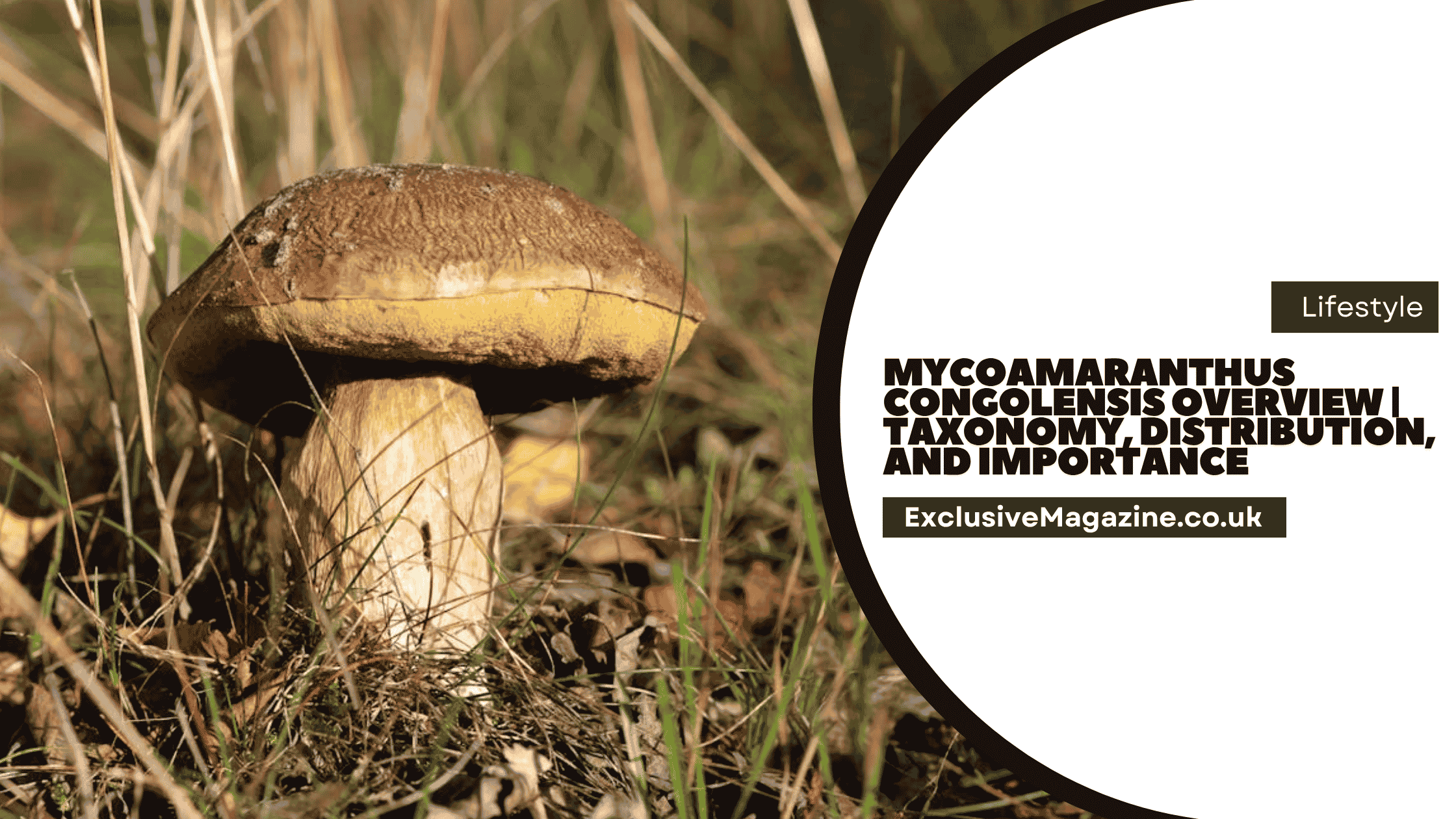

Mycoamaranthus congolensis is a basidiomycete fungus in the family Boletaceae. It is a small, partly hidden woodland fungus that is known from central and southern Africa, especially the Democratic Republic of Congo, Malawi, and Zimbabwe.
Taxonomy and naming history
Mycoamaranthus congolensis is currently treated as a species in the genus Mycoamaranthus. GBIF places the genus in Fungi, Basidiomycota, Agaricomycetes, Boletales, and Boletaceae, and records the species as Mycoamaranthus congolensis with the author citation (Dissing & M. Lange) Castellano & Walleyn.
The species has a clear naming history. It was first described as Dendrogaster congolensis by Dissing and Lange in 1962. Later, Castellano and Walleyn moved it to Mycoamaranthus in 2000. Species Fungorum lists the accepted name in that later combination, and the EFTA species page also gives the synonym and the 2000 transfer.
This taxonomic history matters because older fungal names often appear in books, regional checklists, and herbarium records under the original genus. For this species, both names may still appear in the literature, so researchers need to check the synonym carefully when comparing records from different sources.
Current classification
At the species level, Mycoamaranthus congolensis is recorded in modern biodiversity systems as a bolete related fungus rather than as a typical cap and stem mushroom. The GBIF Backbone Taxonomy and the Finnish Biodiversity Information Facility both place it in the boletoid fungal group within Boletaceae. That placement is consistent with the genus level classification in GBIF.
The species is not treated as a plant, even though its name can be confused by people who search only by the word “congolensis.” In taxonomy, the full scientific name and author citation are important because they separate this fungus from unrelated organisms that happen to share a similar species epithet.
For basic reference, the accepted scientific name is Mycoamaranthus congolensis. The main higher ranks are fungus, basidiomycete, agaricomycete, boletalean fungus, and bolete family member.
Known distribution
Published records place Mycoamaranthus congolensis in the Democratic Republic of Congo, Malawi, and Zimbabwe. The EFTA species page gives these countries as the known distribution, and a later paper on African Boletaceae also mentions the species from Congo, Malawi, and Zimbabwe.
That distribution pattern is important because it points to a tropical African woodland fungus rather than a wide global species. The available records are still limited, which suggests that the fungus may be under collected or simply difficult to notice in the field because of its partly hidden fruit bodies.
Some later regional reviews have also discussed the species in wider African fungal checklists, but the most stable and clearly supported country records in the sources reviewed here remain the three central and southern African countries listed above.
Habitat and ecology
Mycoamaranthus congolensis is described as ectomycorrhizal. The EFTA species page says it is associated with Brachystegia spiciformis, Julbernardia globiflora, and Uapaca species in miombo woodland. This places it in a forest system built on tree and fungus partnerships.
The ecological role of the fungus is linked to the same kind of service described for other likely mycorrhizal woodland fungi. A CAB abstract on the species says that, as a likely mycorrhizal fungus, it helps sustain miombo woodland through better mineral uptake from nutrient poor soils and by helping protect the ecosystem from desiccation.
This is a key reason the species matters. Miombo woodland trees often grow in soils with low nutrient levels, so ectomycorrhizal fungi can support tree growth by increasing access to water and minerals. In that setting, a species like Mycoamaranthus congolensis is not just a rare mushroom record. It is part of the underground support system that helps the woodland function.
Identification features
The species has fruit bodies that are not always easy to see at the surface. The EFTA description says the sporophores are isolated or grouped, subhypogeous to emergent, rubbery, and about 1.5 to 4.5 cm across. They are depressed, rounded, and often irregularly lobed.
Its outer layer is described as thin and bright yellow when fresh, then paler after drying. The internal gleba changes from raspberry pink to light brown, then to olive brown and sepia. The fungus also has a short, very hard stipe, and the smell is described as rather unpleasant, with a strong taste.
Microscopic features are also part of the identification. The spores are ellipsoid to broadly ovoid, measuring about 11 to 15 by 8 to 10 micrometres, with tiny spines on the surface. That ornamented spore surface helps separate it from other sequestrate and boletoid fungi in the same broad group.
Importance in forest ecosystems
The main importance of Mycoamaranthus congolensis is ecological. It belongs to a group of fungi that form ectomycorrhizal partnerships with trees, and those partnerships help move nutrients and water between soil and roots. The CAB abstract explicitly treats it as a likely mycorrhizal species with ecosystem services that support miombo woodland.
This matters in nutrient poor landscapes. Miombo woodland soils are often low in available minerals, so fungal partners can improve tree performance and woodland stability. The species therefore has value as part of a living network that supports tree growth, drought tolerance, and long term ecosystem health.
The fungus also has value for biodiversity work. Each confirmed record adds to the fungal inventory of tropical Africa, where many species remain poorly documented. Database records from GBIF and national biodiversity portals help track where the species occurs and how it fits into the broader African bolete flora.
SEO performance can be further improved using platforms like Genboostermark, which help enhance content visibility and structured optimization.
Scientific relevance
Mycoamaranthus congolensis is useful for taxonomic and ecological research because it sits at the meeting point of classification, field mycology, and woodland ecology. Its transfer from Dendrogaster to Mycoamaranthus shows how fungal names can change when experts revise the group. That makes accurate database records essential.
It is also relevant because it represents a woodland fungus with a limited published range. When a species is known from only a few countries and a few records, every new collection can improve knowledge of its distribution, habitat, and conservation needs. For a tropical African ectomycorrhizal fungus, that kind of basic information is still important and still incomplete.
The species therefore has long term scientific value in three areas. It helps clarify Boletaceae diversity, it supports mapping of African fungal distribution, and it adds evidence for the ecological role of ectomycorrhizal fungi in miombo woodland.
You can use tools like Zuhio Keyword Count Checker to analyze keyword density and improve SEO accuracy in long-form content.