

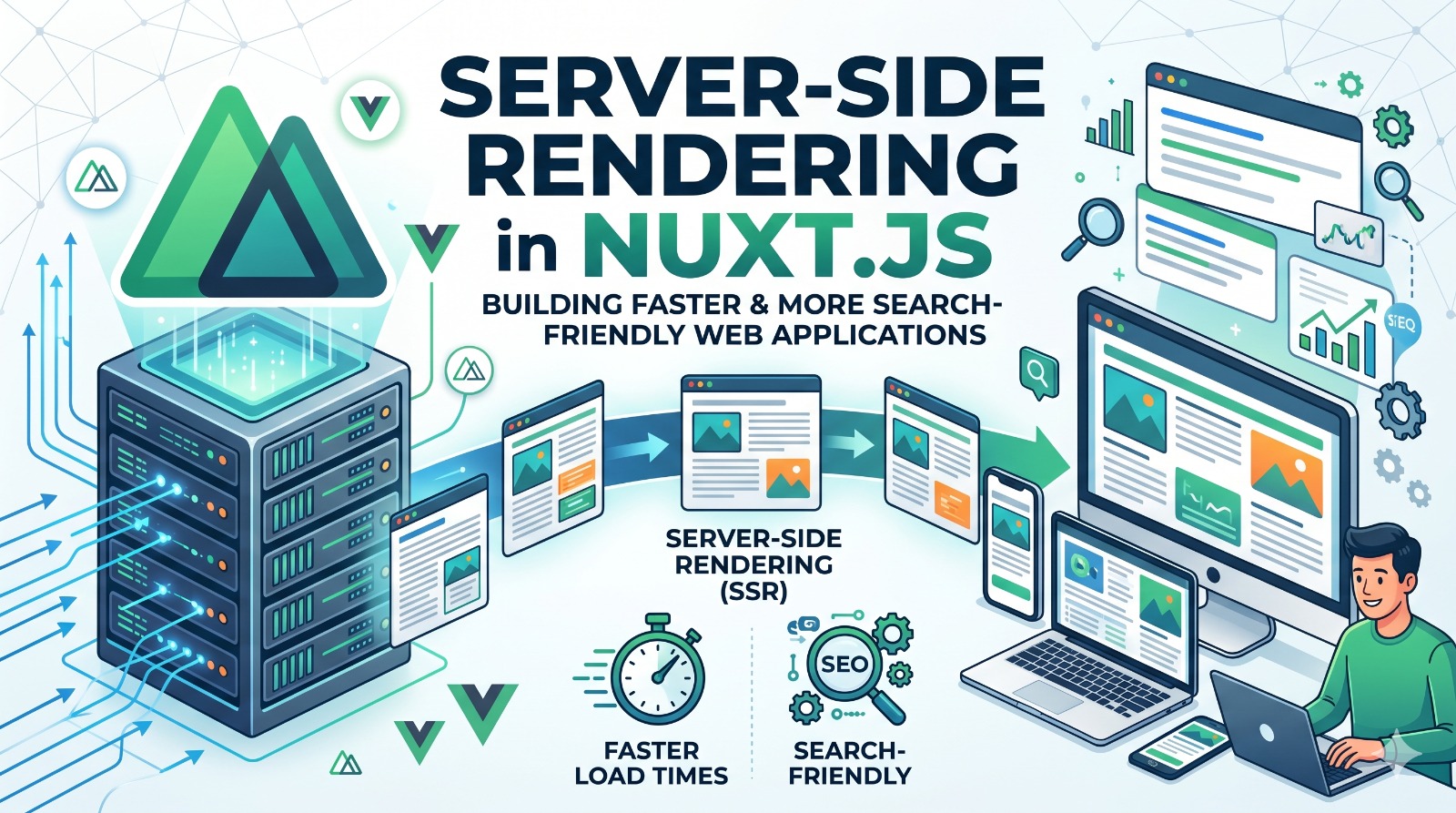

Modern web applications are expected to offer fast load times, smooth interactions, and strong visibility across search engines. As user expectations continue to increase, businesses need architectures that improve both performance and discoverability without adding unnecessary complexity. Rendering strategy plays a key role in achieving these outcomes. Instead of relying entirely on browser-side execution, many teams are moving toward server-driven approaches that send ready-to-use content instantly. Understanding Server-Side Rendering in Nuxt.js helps development teams create applications that respond faster, stay consistent across devices, and meet search engine indexing requirements more effectively.
How Rendering Strategy Directly Affects Performance
Performance is not just about speed metrics—it directly influences how users perceive and interact with an application.
Client side rendering means the browser has to download JavaScript, process it, and then build the interface. This can slow down the first meaningful interaction, especially on slower networks or entry level devices.
Server-rendered applications change this flow by preparing the page on the server before delivering it. Users receive fully structured content immediately, which reduces loading friction and improves perceived responsiveness.
Teams working with nuxt js application development services often use this approach to stabilize performance across different environments while improving Core Web Vitals metrics such as first contentful paint and time to interactive.
Why Pre-Rendered Pages Improve Search Visibility
Search engines rely heavily on structured HTML to understand and rank content effectively.
Applications that depend on heavy client-side rendering may introduce delays in indexing because bots need to process JavaScript before accessing meaningful content. This can affect how quickly pages appear in search results.
With Server Side Rendering in Nuxt.js, content is ready before it reaches the browser. Metadata, headings, and page layout are available instantly, helping search engines to crawl and index pages correctly.
This approach is particularly useful for platforms that depend on organic traffic, where faster indexing and consistent visibility play a critical role in growth.
User Experience Gains from Server Rendering
User experience improves significantly when content is visible as soon as a page loads.
Immediate Content Availability
Users can engage with meaningful information right away instead of waiting for scripts to execute.
Reduced Drop-Off Rates
Faster rendering reduces frustration and encourages users to continue exploring the application.
Stronger Mobile Performance
Server-rendered pages perform better on unstable or slow networks, making them more reliable for mobile users.
In modern frontend ecosystems, using SSR with vue js application development services helps teams stay adaptable while keeping performance consistent across devices and screen sizes.
Server-Side vs Client-Side Rendering: A Practical Perspective
Choosing between rendering strategies depends on the nature of the application and its goals.
Client-Side Rendering
- Relies on browser execution
- Slower initial load time
- Greater dependency on device capability
Server-Side Rendering
- Delivers ready-to-display HTML
- Faster first interaction
- Better compatibility with search engines
This comparison highlights why server-driven approaches are preferred for content-heavy applications where speed and visibility are critical.
Architectural Advantages Beyond Performance
Server-side rendering contributes to a more scalable and efficient application architecture.
Pre rendered pages can be cached and delivered through content delivery networks, which reduces repeated processing and improves response times worldwide. This makes it easier to handle traffic spikes without impacting performance.
Additionally, SSR allows varied rendering approaches, so teams can mix static and dynamic content based on specific use cases. This works well for applications that grow over time.
Organizations combining SSR with progressive web app development company strategies often create systems that balance performance, reach, and accessibility effectively.
Where Server Rendering Creates the Most Value
Server-side rendering is particularly beneficial in scenarios where speed and discoverability are essential.
It is commonly used for:
- Content-rich platforms
- E-commerce websites
- Marketing and landing pages
- High-traffic web applications
In these environments, faster page delivery and better indexing directly improve user engagement and business outcomes.
Challenges That Come with SSR
While SSR offers clear advantages, it also introduces additional considerations that teams must plan for.
Increased Server Load
Rendering pages on the server requires more processing power compared to client-side approaches.
Caching Complexity
Effective caching strategies are essential to maintain performance at scale.
Development Overhead
SSR adds extra layers of logic, especially when handling data fetching and state synchronization.
With proper planning and the right technical approach, these challenges can be handled, making SSR a practical choice for many applications.
The Future of Rendering in Web Development
Web development is steadily moving toward hybrid rendering models that combine multiple approaches. Instead of relying on a single method, modern applications use a mix of server-side rendering, static generation, and client-side updates to offer optimal performance. Within this evolving landscape, Server-Side Rendering in Nuxt.js continues to play an important role in building applications that are both fast and adaptable.
Conclusion
Creating modern web applications requires a careful balance between performance, scalability, and user experience. Rendering strategy sits at the center of this balance, influencing how quickly content is served and how effectively it is discovered. Server-driven approaches provide a clear advantage by reducing load times and improving search engine accessibility. They also create a more consistent experience across devices and network conditions. For teams aiming to deliver reliable and scalable digital platforms, Server-Side Rendering in Nuxt.js remains a strong architectural choice that backs long-term performance, visibility, and user engagement.