

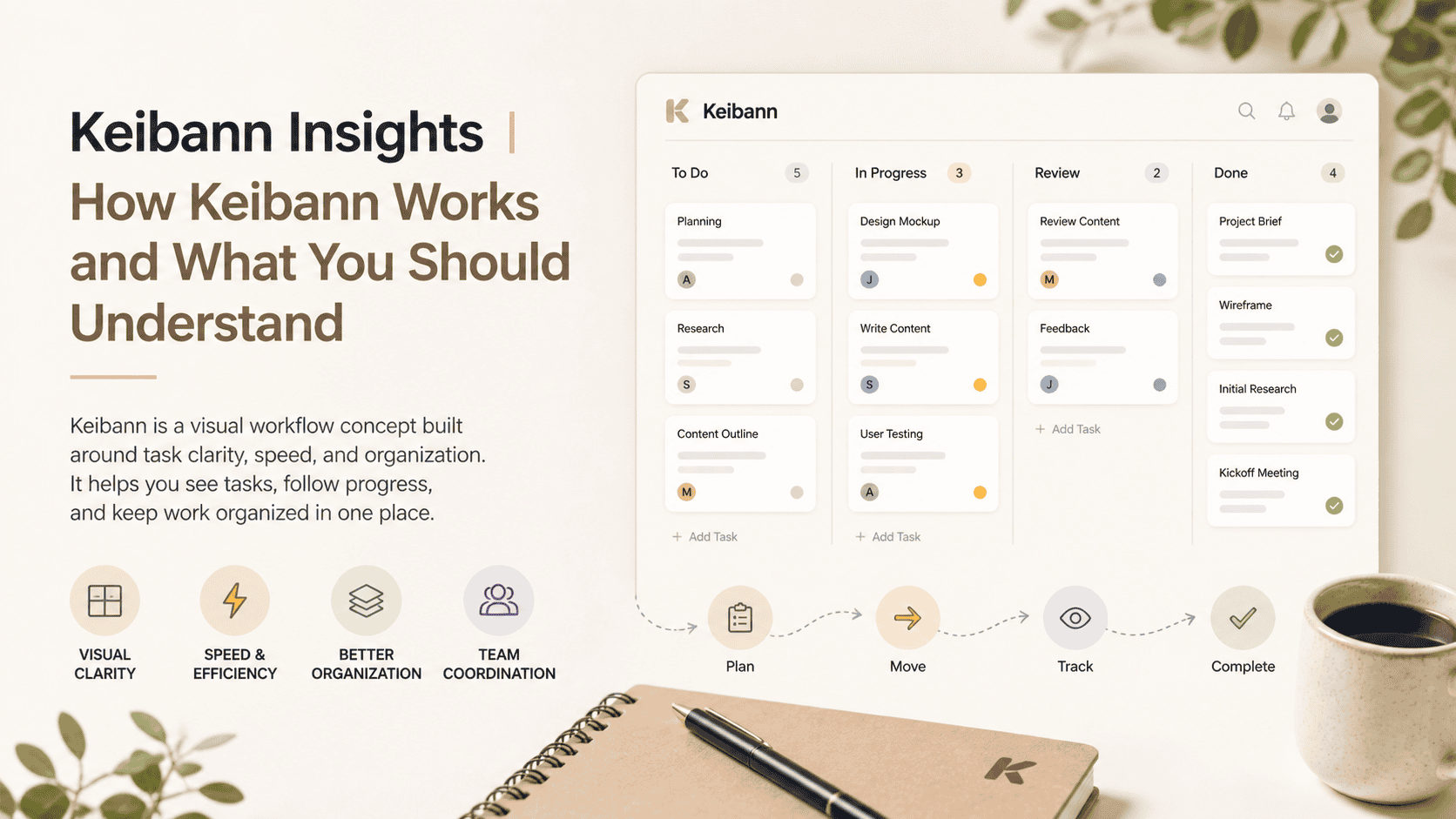

Keibann is described online as a visual workflow concept built around task clarity, speed, and organization.
What you should understand is that public references do not show one single official definition, so most explanations treat Keibann as an emerging productivity idea.
What Keibann Means
Keibann is commonly presented as a modern system for managing work in a clearer way. The public pages I found describe it as a framework that helps people see tasks, follow progress, and keep work organized in one place. Many of these pages connect Keibann with visual boards, workflow tracking, and better team coordination.
That means Keibann is usually understood less as a single product and more as a working method. In that sense, the term points to a system that supports planning, movement of tasks, and shared visibility. The strongest repeated ideas in the public material are efficiency, simplicity, and structure.
You can learn more about Jememôtre and its related concepts in our detailed guide on Jememôtre, where we explain its structure and practical use in modern workflows.
How Keibann Works
Keibann works by turning work into a visible flow. Tasks are shown in an organized format, often as cards, stages, or board sections. This makes it easier to see what is ready, what is in progress, and what still needs attention. Public descriptions also stress that updates should happen in real time or as close to real time as possible.
The basic logic is simple. First, work is broken into clear tasks. Next, tasks are placed into visible stages. Then team members update progress as work moves forward. This reduces confusion because people do not need to guess where a task stands. Several public sources describe Keibann in exactly this way, with a focus on transparency and smoother execution.
Key Parts of a Keibann System
A Keibann system usually includes a few basic parts that make the workflow easy to follow. These parts are simple, but they matter because they give the system structure.
| Part | What it does | Why it matters |
|---|---|---|
| Task view | Shows each item of work | Helps people see the full workload |
| Status stages | Shows where work stands | Makes progress easy to track |
| Shared updates | Lets teams change task details | Keeps everyone aligned |
| Visual order | Organizes work clearly | Reduces confusion and missed steps |
| Review flow | Supports checking and adjusting work | Keeps the system useful over time |
These parts reflect the main patterns repeated in public Keibann articles, which describe it as visual, flexible, and easy to update.
Why Keibann Gets Attention
Keibann gets attention because modern work often moves fast and changes often. Public descriptions link it to startups, digital teams, remote work, and lean operations. In those settings, people need a simple way to follow tasks without extra confusion.
The idea also fits well with broader trends such as digital coordination and visual planning. Several sources describe Keibann as useful because it reduces scattered communication and gives teams one shared place to look. That makes the term attractive in content about efficiency and workflow control.
What You Should Understand Before Using Keibann
The most important thing to understand is that Keibann does not appear to have one fixed, official meaning in the public material available today. Instead, the term is used across recent pages in a similar way, mostly around workflow, visual task management, and productivity. That means readers should be careful and check the exact context where the word appears.
You should also understand that the term is still loosely defined in public sources. Because of that, the value of Keibann depends on how clearly the process is set up. A visual system only helps when the steps are simple, current, and easy to follow. If the board or workflow becomes crowded or outdated, it loses much of its purpose.
Another point is that Keibann works best when people use it consistently. Several public pages stress regular updates, clear training, and simple design. Those ideas matter because a workflow tool is only useful when people trust it and keep it active.
Keibann and Traditional Project Management
Keibann is often presented as more flexible than traditional project management methods. Traditional methods can rely on fixed steps, formal reporting, and slower updates. Keibann is described as more visual and more adaptive, which helps teams react quickly when work changes.
| Feature | Traditional project management | Keibann style workflow |
|---|---|---|
| Visibility | Often limited to reports | Usually shown in a visual board |
| Flexibility | More fixed | More adaptable |
| Communication | Can be fragmented | More centralized |
| Tracking | Often manual | Often visual and dynamic |
| Team alignment | Needs more follow up | Easier to keep shared |
This comparison matches the way public Keibann pages describe the concept, especially when they focus on visibility, collaboration, and live progress tracking.
A related concept often compared with Keibann is Messeregge, which focuses on structured system flow and task organization methods.
Common Misunderstandings About Keibann
One common misunderstanding is that Keibann is a single software tool. The available public pages do not support that clearly. They describe it more like a concept, method, or system of workflow organization.
Another misunderstanding is that Keibann is complex. The public descriptions point in the opposite direction. They repeatedly connect the term with simplicity, clarity, and ease of use. That means the idea is meant to reduce friction, not add more.
A third misunderstanding is that Keibann only fits large teams. The public material often mentions startups, smaller digital teams, and lean environments. That suggests the concept is meant to scale from small groups to larger operations, as long as the workflow stays clear.
Where Keibann Fits Best
Keibann fits best in work environments where people need shared visibility. It is most useful when tasks change often, many people work on the same project, or progress needs to stay easy to see. Public pages place it in digital workspaces, startup planning, and team coordination settings.
It also fits teams that value quick updates over long reports. If a team wants a simple picture of what is happening now, a Keibann style workflow makes that easier. If a team needs strict formal approval layers, the system may need extra structure to stay useful. That last point is an inference based on the public emphasis on flexibility and visibility.
What to Look For in a Good Keibann Setup
A good Keibann setup should be easy to read at a glance. It should show tasks clearly, keep stages simple, and make updates quick. Public sources repeatedly stress that the system should not become too crowded or too complicated.
A good setup should also stay current. Old task data can make any workflow system less useful. When updates happen regularly, the board or system becomes a real working tool rather than a static page. That matches the advice repeated in the public articles I found.
Practical Points to Remember
- Keibann is best understood as a visual workflow idea, not as a fixed definition.
- Its main purpose is to help people see work clearly and move tasks forward with less confusion.
- Its value depends on simple structure, regular updates, and shared use.