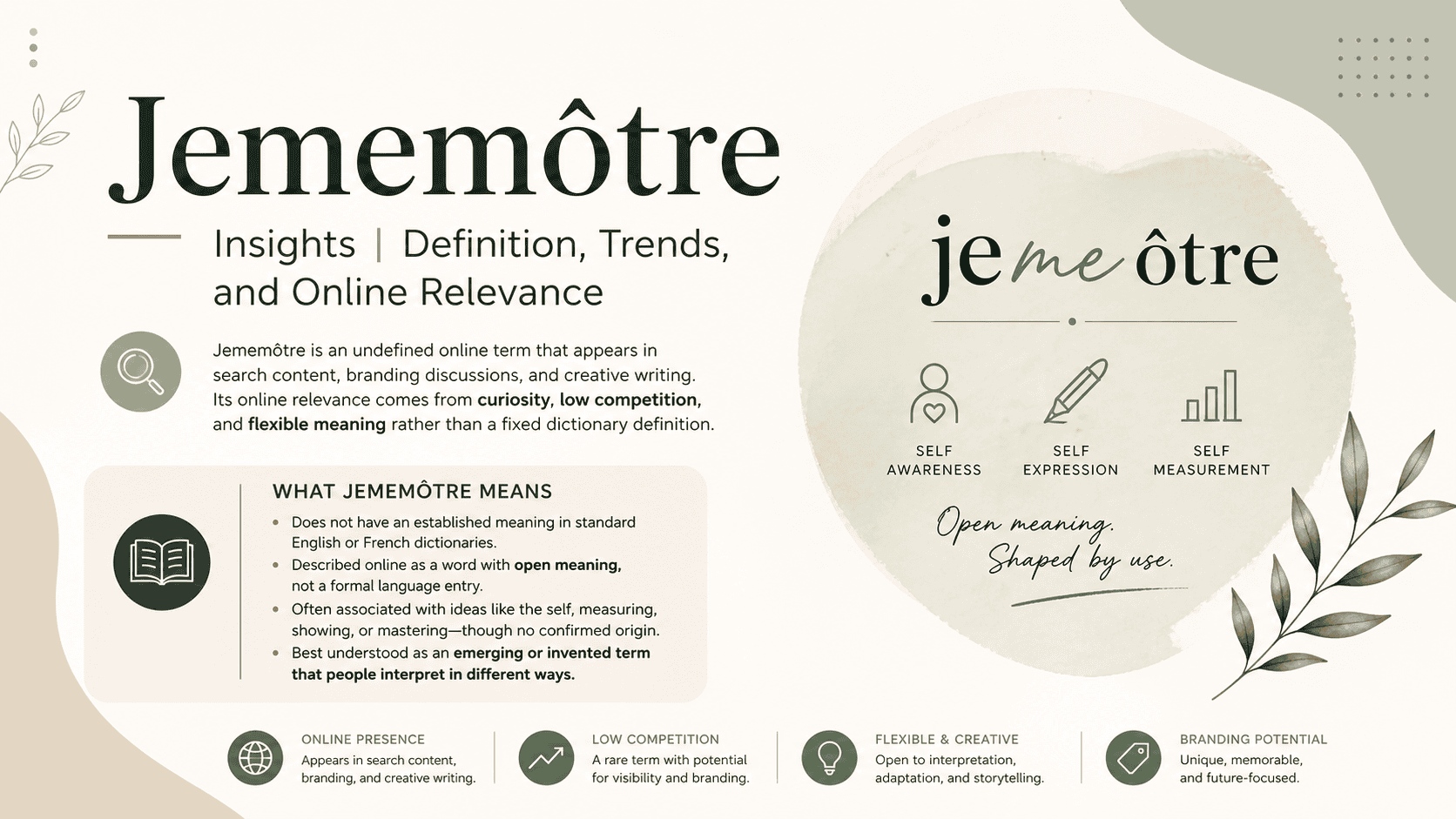

Jememôtre is an undefined online term that appears in search content, branding discussions, and creative writing. Its online relevance comes from curiosity, low competition, and flexible meaning rather than a fixed dictionary definition.
What Jememôtre Means
Jememôtre does not have an established meaning in standard English or French dictionaries. The online pages that discuss it describe it as a word with open meaning, not as a formal language entry. Several writers connect it to French sounding parts such as “je me,” which suggests the self, and to endings that evoke ideas like measuring, showing, or mastering. That said, none of the pages found provide a confirmed linguistic origin.
Because of that, the safest definition is simple. Jememôtre is an emerging or invented term that people interpret in different ways. Some pages describe it as self awareness, self expression, or self measurement. Others treat it as a creative keyword with no fixed dictionary meaning. In online writing, this kind of word is often shaped by use rather than by formal language rules.
Why Jememôtre Is Appearing Online
The term shows up online because unusual keywords attract attention. Search results from 2026 show multiple pages trying to explain it, which is a sign that user interest and content creation are both driving its visibility. The available pages also describe it as a floating keyword, meaning a search term that exists in search engines without a stable or official meaning.
This kind of term often spreads for a few reasons. First, people search for unfamiliar words because they want a clear meaning. Second, content sites publish pages around rare terms because low competition words are easier to rank for. Third, a word can become more visible simply because several websites repeat it and frame it in different ways. The web pages found on Jememôtre follow exactly that pattern.
Another reason is branding. A rare word can be useful for a username, project title, blog name, or niche concept because it is memorable and less crowded in search results. The pages that discuss Jememôtre repeatedly point to identity, creativity, and branding potential as reasons the word is gaining attention.
Core Trends Around Jememôtre
The first clear trend is meaning by interpretation. Since the term has no official dictionary entry, writers fill the gap with their own readings. Some explain it as self reflection. Some treat it as self mastery. Others link it to self measurement or self expression. This broad range of explanations shows that the term is still forming its identity online.
The second trend is French style wording. More than one page notes that the spelling feels French inspired, especially because of the “je me” start and the accented “ô.” That visual style gives the word a polished and artistic feel, even though the pages also say it is not a standard French word. This matters because many modern online terms are built to sound elegant, unique, or brand friendly.
The third trend is digital curiosity. The web pages describe Jememôtre as a term that gains traction because people want to understand strange or new words. This is common online. A term can trend simply because it looks important, sounds meaningful, or feels mysterious. Once people start writing about it, the word becomes even more visible in search.
The fourth trend is flexible use. The pages found do not limit the term to one topic. They connect it to identity, reflection, memory, branding, and even content strategy. That flexibility is part of why the term has online value. A flexible word can fit different audiences without needing one strict definition.
You can also explore how Serlig is shaping modern digital terminology and influencing niche content trends in online spaces.
Online Relevance for SEO and Content
Jememôtre is relevant online because rare terms can attract search traffic. When a keyword has little competition, a page can rank more easily if it explains the term clearly and consistently. The sources found on this topic describe Jememôtre as a useful example of a sandbox keyword, meaning a term used to test search behavior and content response.
For SEO, this kind of keyword has three main uses. It can support early ranking tests. It can help measure how search engines handle a new or unfamiliar term. It can also build a content cluster around a niche idea if the word begins to gain real user interest. The pages found on Jememôtre make all three points in different ways.
The term also matters for branding. A unique word can work as a blog title, product name, creative alias, or concept label because it is easy to own in search results. That is one reason unusual words often appear in modern digital branding. In the case of Jememôtre, the available pages describe it as memorable, open ended, and adaptable to different creative uses.
It is also relevant for online identity. Words like this often become part of how people present themselves on the internet. A name that does not carry a fixed meaning can leave room for personal style, brand voice, or community use. The sources found on Jememôtre repeatedly connect the term to identity and self expression, which is why it fits well in discussions about online naming and digital presence.
For a deeper look into structured legal content and digital publishing practices, Cnlawblog offers useful insights into how information is organized and presented online.
How Writers and Brands Should Handle the Term
Writers should treat Jememôtre carefully and clearly. Since it has no confirmed formal meaning, it should not be presented as a standard dictionary word. The best practice is to explain it as an emerging or invented term and then define how the article is using it. That approach keeps the writing accurate and trustworthy.
Brands should use the term only if they want a distinct and unusual name. Because the word is open ended, it may work well for creative projects, experimental content, or identity based branding. It also works best when the surrounding message is simple. Readers should quickly understand whether the term refers to self reflection, a brand idea, or a search trend.
For SEO content, clarity matters more than mystery. Pages about Jememôtre should use the term in the title, opening lines, and key headings, but they should also define it in plain English. Since search users are likely looking for meaning first, a direct explanation helps the page satisfy intent faster. The sources found on this topic show that people already want a plain answer, so content should lead with definition before moving into interpretation.
What Readers Usually Want to Know
Readers who search for Jememôtre usually want a few basic things. They want to know whether it is a real word. They want to know where it came from. They want to know why it appears in search results. They also want to know whether it has value for branding or content writing. The available web pages show that these are the main questions people ask, and most of them are answered in the same way. Jememôtre is best understood as an emerging digital term with flexible meaning and strong online curiosity around it.
In simple terms, the term matters because it sits between language and search behavior. It is not a standard dictionary word, but it still carries meaning in online use. That is why it keeps showing up in articles, naming ideas, and SEO discussions. The word has value mainly through attention, interpretation, and reuse, which is a common pattern for many modern internet terms.