

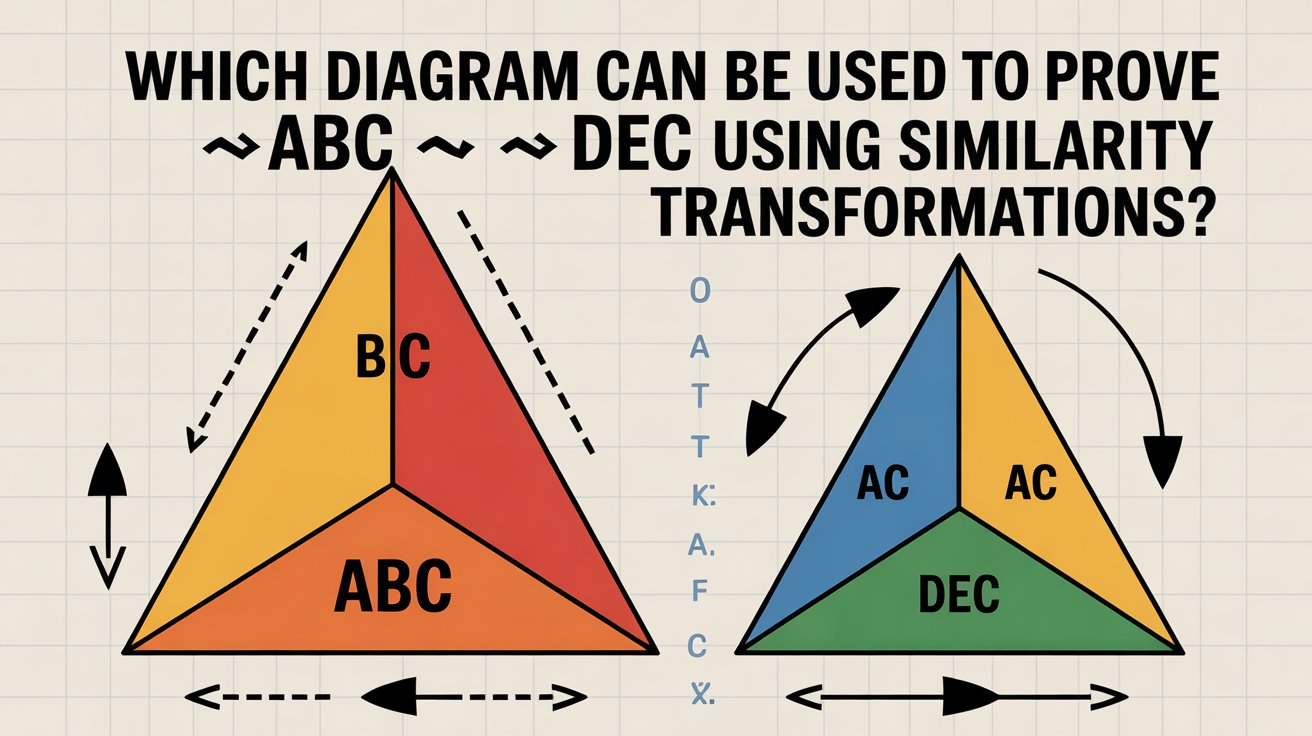

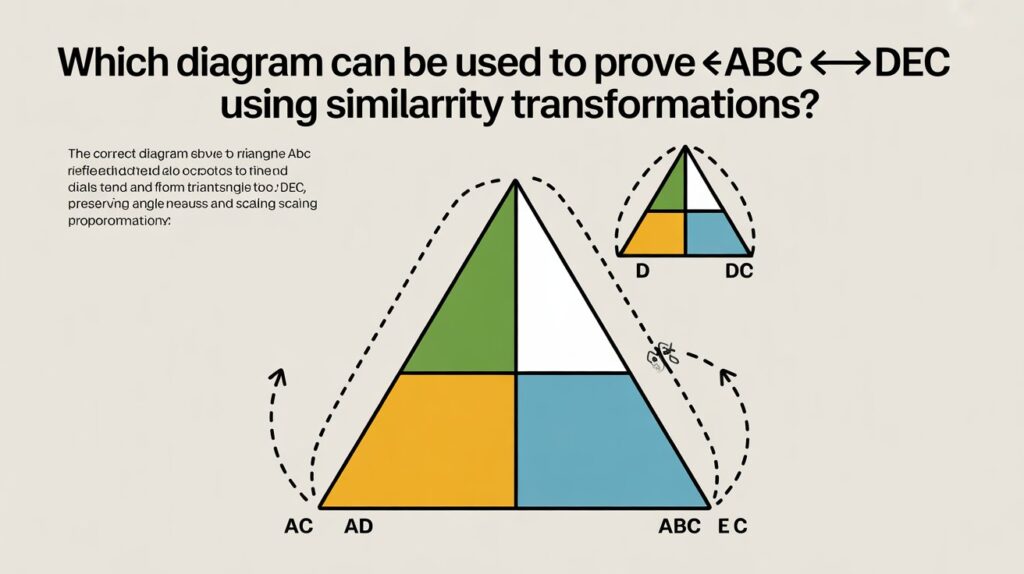
The correct diagram is the one where triangle ABC is reflected across side AC and then dilated to form the smaller triangle DEC. This transformation keeps the angles equal and scales the sides proportionally, which proves that △ABC is similar to △DEC.
Understanding Triangle Similarity with Transformations
Triangle similarity means that two triangles have the same shape but may have different sizes. Their corresponding angles are equal and their corresponding sides are proportional.
In geometry, similarity can be proven through similarity transformations. These are geometric operations that change position or size while keeping the shape consistent.
The most common similarity transformations are:
| Transformation | What It Does |
|---|---|
| Translation | Moves the figure without rotating or resizing |
| Rotation | Turns the figure around a point |
| Reflection | Flips the figure across a line |
| Dilation | Resizes the figure while keeping the shape |
A combination of these transformations can map one triangle onto another similar triangle.
What the Statement △ABC ~ △DEC Means
The notation △ABC ~ △DEC means triangle ABC is similar to triangle DEC.
This tells us three important facts:
| Property | Meaning |
|---|---|
| Equal angles | ∠A = ∠D, ∠B = ∠E, ∠C = ∠C |
| Proportional sides | AB / DE = BC / EC = AC / DC |
| Same shape | Triangles have identical shape but different sizes |
The order of letters also shows which vertices correspond.
| Triangle ABC | Triangle DEC |
|---|---|
| A | D |
| B | E |
| C | C |
So the triangles share vertex C and match in that order.
Why Transformations Prove Similarity
Similarity transformations preserve angle measures and scale side lengths by the same ratio.
If a triangle can be moved, flipped, rotated, or resized to exactly match another triangle, the two triangles are similar.
Two transformations are especially important here.
Reflection
Reflection flips a figure across a line.
Important properties remain unchanged:
- Angle measures stay the same
- Shape remains identical
- Orientation is mirrored
If triangle ABC is reflected across line AC, the triangle flips over that line.
Dilation
Dilation changes the size of a figure but keeps the shape the same.
Key properties:
- Angles remain equal
- Side lengths change proportionally
- Shape remains unchanged
A dilation with center at point C can shrink triangle ABC to produce triangle DEC.
The Correct Diagram for the Proof
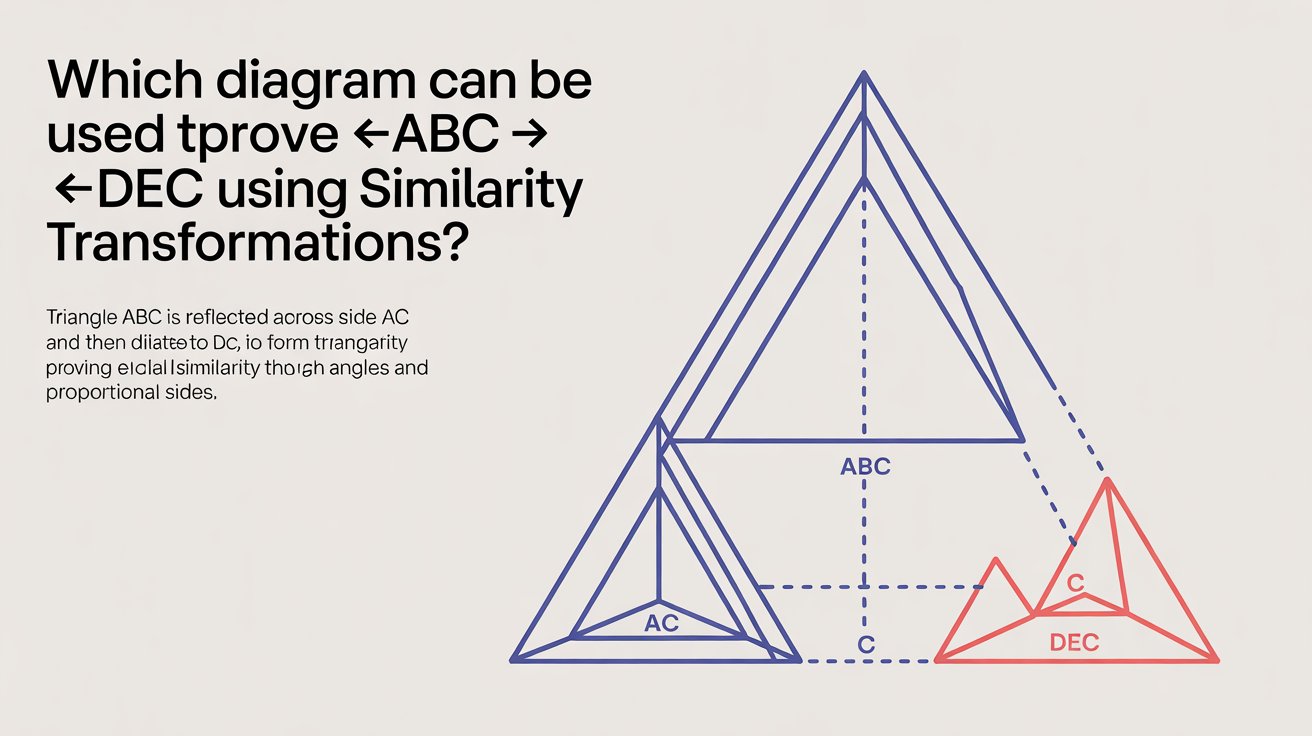
The correct diagram shows the following sequence:
- Triangle ABC is reflected across line AC
- The reflected triangle is then dilated
- The resulting triangle matches triangle DEC
This diagram visually demonstrates the similarity.
| Step | Transformation | Result |
|---|---|---|
| Step 1 | Reflection across AC | Triangle flips across side AC |
| Step 2 | Dilation from point C | Triangle becomes smaller |
| Step 3 | Alignment | Triangle matches DEC |
Because reflection preserves angles and dilation keeps proportional sides, the triangles remain similar.
Visual Structure of the Correct Diagram
In the correct diagram, several geometric clues appear.
Key elements include:
| Feature | Meaning |
|---|---|
| Shared point C | Both triangles meet at vertex C |
| Line AC | Reflection line |
| Smaller triangle | Result of dilation |
| Matching angles | Corresponding angles are equal |
These features make it possible to apply similarity transformations clearly.
Step by Step Reasoning for the Similarity
Step 1 Identify Corresponding Points
The corresponding vertices are:
| Triangle ABC | Triangle DEC |
|---|---|
| A | D |
| B | E |
| C | C |
Point C remains fixed.
Step 2 Reflect Triangle ABC
Reflect triangle ABC across line AC.
After reflection:
- Point B moves to the opposite side of AC
- Points A and C remain unchanged
This step aligns the orientation with triangle DEC.
Step 3 Apply Dilation
Next apply a dilation centered at C.
The dilation scale factor is less than 1, meaning the triangle becomes smaller.
| Original side | New side |
|---|---|
| AC | DC |
| BC | EC |
| AB | DE |
Each side is scaled by the same ratio.
Step 4 Compare Angles
Reflection and dilation both preserve angle measures.
So the following equalities hold:
| Angle in ABC | Angle in DEC |
|---|---|
| ∠A | ∠D |
| ∠B | ∠E |
| ∠C | ∠C |
Equal angles confirm triangle similarity.
Step 5 Verify Side Ratios
Side lengths change proportionally through dilation.
| Side ratio | Relationship |
|---|---|
| AB / DE | Constant |
| BC / EC | Constant |
| AC / DC | Constant |
This confirms similarity using geometric transformations.
Why Other Diagrams Do Not Work
Some diagrams cannot prove similarity.
Common incorrect cases include the following.
Different Angle Measures
If the diagram shows different angles in the triangles, similarity is impossible.
Similarity requires all corresponding angles to be equal.
Different Shapes
If the triangles look different in shape, the transformation cannot map one triangle onto the other.
This means they are not similar.
No Clear Transformation
Some diagrams simply place two triangles near each other without showing any geometric transformation.
Without reflection, rotation, translation, or dilation, similarity cannot be proven.
Similarity Rules in Geometry
In addition to transformations, geometry also uses similarity criteria.
The three standard similarity rules are:
| Rule | Requirement |
|---|---|
| AA Similarity | Two pairs of equal angles |
| SAS Similarity | Two proportional sides and included angle |
| SSS Similarity | All three sides proportional |
In transformation geometry, these relationships appear naturally after applying reflection and dilation.
Example of Similar Triangles Through Dilation
Consider a simple example.
Triangle ABC has sides:
| Side | Length |
|---|---|
| AB | 6 |
| BC | 8 |
| AC | 10 |
If a dilation with scale factor 0.5 is applied, the new triangle becomes:
| Side | Length |
|---|---|
| DE | 3 |
| EC | 4 |
| DC | 5 |
The ratio of sides remains constant.
| Ratio | Value |
|---|---|
| AB / DE | 2 |
| BC / EC | 2 |
| AC / DC | 2 |
This demonstrates triangle similarity.
Readers who also explore detailed product breakdowns can visit our guide on The Ordinary Niacinamide 10% + Zinc 1% Product Info And Reviews, which explains ingredients, skincare benefits, and real user feedback.
Geometric Importance of Point C
Point C plays a critical role in this problem.
It serves as:
- A shared vertex
- The center of dilation
- A reference point for reflection
Because point C remains fixed during the transformation, it helps maintain the relationship between the two triangles.
Key Properties Preserved by Similarity Transformations
When similarity transformations are applied, several geometric properties remain unchanged.
| Property | Preserved |
|---|---|
| Angle measures | Yes |
| Shape | Yes |
| Parallel lines | Yes |
| Side ratios | Yes |
However, absolute lengths change because of dilation.
| Property | Changed |
|---|---|
| Side length | Yes |
| Perimeter | Yes |
| Area | Yes |
Despite size changes, the triangles remain similar.
How Students Identify the Correct Diagram
When solving this type of geometry question, follow a simple checklist.
Look for Shared Points
A shared vertex often indicates the center of rotation or dilation.
Check Angle Markings
Matching angle marks indicate possible similarity.
Observe Orientation
If one triangle appears flipped relative to another, reflection may be involved.
Check Size Difference
If one triangle is a scaled version of the other, dilation is likely used.
The correct diagram will clearly show these relationships.
If you are looking for quick help with mobile services, you can also check our guide on Verizon Wireless Customer Service Phone Number 24 Hours to find the correct support contact and assistance options.
Summary of the Correct Transformation Sequence
The valid diagram must demonstrate this sequence.
| Order | Transformation |
|---|---|
| 1 | Reflect △ABC across line AC |
| 2 | Dilate the reflected triangle from point C |
| 3 | Produce triangle DEC |
This sequence guarantees that:
- Angles remain equal
- Sides remain proportional
- Shapes remain identical
Therefore the triangles satisfy the definition of similarity.
Quick Reference Table
| Feature in Diagram | Reason It Proves Similarity |
|---|---|
| Reflection across AC | Preserves angles |
| Dilation from C | Maintains proportional sides |
| Shared vertex C | Ensures alignment |
| Smaller triangle DEC | Result of scaling |
Because these transformations map triangle ABC directly onto triangle DEC, the diagram proves that:
△ABC ~ △DEC using similarity transformations.