

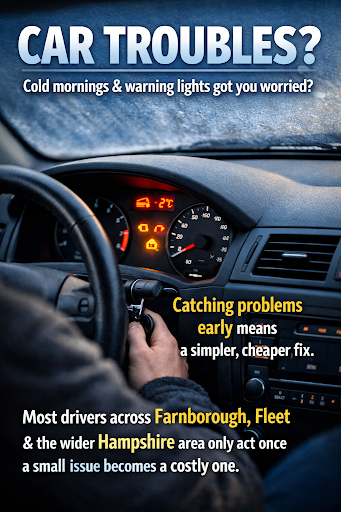

Every driver knows that feeling. You turn the key on a cold morning, something feels slightly off, and that knot forms in your stomach before you have even left the driveway. Whether it is a warning light, a strange noise, or a car that simply will not start, most of these moments are more common than you think, and far less catastrophic than they first appear.
The good news is that catching problems early almost always means a simpler, cheaper fix. The trouble is, most drivers across Farnborough, Fleet, and the wider Hampshire area only act once a small issue has quietly become a costly one.
1. Flat or Failing Battery
A flat battery is the single most common cause of roadside breakdowns in the UK. The RAC consistently lists battery-related callouts at the top of its breakdown data year after year, with a sharp spike every winter. If you mostly drive short trips around Ash Vale, North Camp, or through Aldershot town centre, your battery may never get the sustained run it needs to recharge properly.
Signs Your Battery May Be Failing
- The engine cranks slowly or sounds sluggish on startup
- Headlights appear noticeably dimmer than usual
- The battery warning light appears on the dashboard
- Electrical features such as windows, radio, or central locking behave erratically
- The car clicks but does not turn over at all
Most car batteries last between three and five years. If yours is approaching that age and showing any of the above signs, get it tested before it leaves you stranded on a cold morning.
What to Do
A jump start using jump leads or a portable jump starter pack can get you moving in the short term. However, if the battery keeps going flat, the root cause may not be the battery itself. A faulty alternator, a parasitic electrical drain, or corroded terminals could all be responsible, and only a proper charging system check will confirm which.
The simplest prevention is a longer drive every now and then. Even twenty to thirty minutes at a steady speed gives the alternator enough time to put a healthy charge back into the battery.
2. Worn Brake Pads and Discs
Your brakes are the single most important safety system on your car. Yet worn brake pads are one of the most commonly ignored warning signs on UK roads, usually because drivers mistake the early squealing sound for something minor and put off getting it checked.
That delay is where the real damage happens.
The Difference Between a Squeal and a Grind
| Squealing | Grinding | |
| What it sounds like | A high-pitched squeal or squeak when braking | A harsh scraping or grinding noise under braking |
| What is causing it | The wear indicator tab making contact with the disc: a deliberate warning built into the pad | Metal on metal: the pad has worn through completely and the backing plate is contacting the disc directly |
| How serious is it | A clear warning sign that needs attention soon | Urgent: disc damage is likely already occurring |
| What happens if ignored | Pads wear through entirely, leading to disc damage | Disc replacement on top of pad replacement, significantly higher repair cost |
| What to do | Book a brake check in Aldershot promptly | Stop driving if possible and seek immediate professional attention |
The squealing sound is your car communicating with you. The grinding sound means that conversation has gone on too long without a response. Always act on the squeal, do not wait for the grind.
Other Warning Signs to Watch For
- A spongy or soft feeling when you press the brake pedal
- The car pulling to one side under braking
- Vibration or pulsing through the pedal
- The brake warning light appearing on the dashboard
- A longer stopping distance than usual
Drivers who regularly navigate the stop-start traffic around Farnham and Tongham will naturally wear through brake pads faster than those doing mostly motorway miles. Heavier vehicles, steeper hills, and aggressive braking all accelerate wear further.
Do not wait for the grind. If your brakes are squealing, book them in sooner rather than later.
3. Engine Management Light
Few things cause more unnecessary panic, or more dangerous complacency, than the engine management light. It is one of the most misunderstood warning signals on a car dashboard, and drivers tend to react in one of two ways: they either ignore it completely, or they assume the worst and stop driving altogether.
The truth sits somewhere in the middle.
What It Actually Means
The engine management light comes on when your car’s onboard computer detects a fault somewhere in the engine or emissions system. That fault could be something as minor as a loose fuel cap, or something that genuinely needs prompt attention such as a failing oxygen sensor, a misfiring spark plug, or a catalytic converter issue.
The key distinction is this:
Steady light: continue driving with caution, but book a diagnostic check as soon as possible. Do not ignore it and hope it goes away.
Flashing light: this signals an active fault that could cause further engine damage. Stop driving when it is safe to do so and get the car looked at immediately.
It is also worth knowing that a lit engine management light is an automatic MOT failure. If your test is coming up and the light is on, get a diagnostic scan done beforehand. Understanding the difference between an MOT and a service can help you decide which appointment your car actually needs.
Common Triggers
- A loose or damaged fuel cap
- A faulty oxygen sensor
- Worn or failing spark plugs
- A damaged catalytic converter
- A mass airflow sensor fault
- Low oil pressure or coolant temperature issues
Many of these are straightforward to resolve when caught early. The longer they are left, the more they tend to escalate, a misfiring engine, for example, can cause catalytic converter damage that turns a modest repair into a significantly larger one.
If the light comes on while driving through Ash or Fleet, find a safe place to pull over, check that your fuel cap is properly secured, and then make a judgment based on whether the light is steady or flashing.
4. Tyre Wear and Pressure Problems
Tyres are the only part of your car in contact with the road. Everything else, your brakes, your steering, your suspension, depends on four patches of rubber no bigger than your hand to actually work as intended. Yet tyre condition is one of the most consistently overlooked areas of car maintenance among UK drivers.
According to DVSA data, tyres account for nearly 60% of all dangerous defects found during MOT tests. That is a striking figure, and most of those failures are entirely avoidable.
The 20p Tyre Tread Test
The legal minimum tread depth in the UK is 1.6mm across the central three-quarters of the tyre. A simple way to check yours takes about ten seconds.
- Take a 20p coin and insert it into the main tread groove
- If the outer band of the coin is hidden, your tread is above the legal limit
- If you can see the outer band clearly, your tyres may be at or below the legal minimum
- Check several points around the tyre, not just one spot
- Repeat on all four tyres, including the spare if you carry one
Why Uneven Wear Matters
Uneven tyre wear is not just a tyre problem, it is usually a symptom of something else. Misaligned wheels, worn suspension components, or incorrect tyre pressure can all cause one side of a tyre to wear faster than the other. If you notice uneven wear, getting a wheel alignment check done promptly can save you from replacing tyres far sooner than necessary.
Hampshire is ranked among the worst counties in the UK for pothole prevalence. Drivers regularly travelling between Farnborough, Tongham, and Ash Vale will know this firsthand. A single significant pothole strike can cause an immediate tyre blowout, a slowly developing sidewall bulge, or instant wheel misalignment, none of which always make themselves obvious straight away.
Tyre Pressure
Check your tyre pressure at least once a month and always before a long journey. The correct pressure for your vehicle is printed on a sticker inside the driver’s door frame or in the owner’s manual.
Underinflated tyres wear unevenly, reduce fuel efficiency, and reduce grip, particularly on wet roads during a Hampshire autumn or winter. Overinflated tyres affect ride comfort and braking performance. Neither extreme is safe, and both are easy to avoid with a monthly check at any petrol station.
5. Overheating Engine
An overheating engine is one of those problems that can go from manageable to catastrophic surprisingly quickly. Unlike a flat battery or a squealing brake, an engine that is running too hot will not give you many chances to ignore it before serious damage sets in.
The cooling system in your car works hard every single journey. When any part of it fails, whether that is a coolant leak, a broken thermostat, a faulty water pump, or a blocked radiator, heat builds up inside the engine faster than it can be dispersed. Left unchecked, that heat can warp cylinder heads, destroy gaskets, and in the worst cases, cause complete engine failure.
Warning Signs to Watch For
- The temperature gauge creeping into the red zone
- A warning light shaped like a thermometer appearing on the dashboard
- Steam rising from under the bonnet
- A sweet or unusual smell coming from the engine bay
- The heater suddenly blowing cold air despite being set to hot
What to Do If Your Engine Overheats
- Turn off the air conditioning immediately to reduce engine load
- Pull over safely as soon as possible and switch the engine off
- Do not open the bonnet straight away, let the engine cool for at least twenty minutes
- Never, under any circumstances, open the radiator cap while the engine is hot. The pressurised coolant inside can cause serious burns
- Once cooled, check the coolant reservoir level carefully
- If the coolant is at a safe level but the problem persists, the car needs professional attention before being driven further
Regularly checking your coolant level takes less than two minutes and costs nothing. It is one of the simplest checks any driver can do, open the bonnet, locate the coolant reservoir (usually a translucent plastic tank with MIN and MAX markings), and confirm the level sits between the two.
Drivers covering longer commutes out of North Camp or Fleet towards the motorway network are particularly at risk during hot summer months, when cooling systems are under the most sustained pressure. If your car has not been serviced recently, having the cooling system inspected as part of a routine check is a straightforward precaution.
6. Suspension and Knocking Noises
Your suspension system does a job most drivers never think about until something goes wrong. It absorbs the impact of every bump, pothole, and uneven surface your car passes over, keeping your tyres in contact with the road and your steering stable. When it starts to wear, the signs are usually felt before they are seen.
Given that Hampshire consistently ranks among the worst counties in England for pothole damage, suspension wear is a particularly relevant issue for drivers in and around Aldershot, Farnham, and North Camp. The RAC attended over 7,900 pothole-related breakdowns in just the first quarter of 2024 alone, a figure that underlines how significant road surface damage has become for everyday drivers across the country.
Common Signs Your Suspension Needs Attention
- A knocking or clunking sound when driving over bumps or through corners
- The car feeling floaty, unstable, or slow to respond to steering inputs
- Excessive bouncing after going over a speed bump or pothole
- Uneven tyre wear, particularly on the inner or outer edges
- The car sitting noticeably lower on one corner than the others
The Simple Bounce Test
Park your car on level ground and press down firmly on each corner of the vehicle. When you release, the car should return to its normal ride height and settle immediately. If it continues to bounce two or three times before settling, the shock absorbers are likely worn and need inspection.
Suspension problems are among the second most common reasons for MOT failures in the UK, accounting for a significant proportion of defects identified during testing. Many of these faults develop gradually and go unnoticed precisely because drivers adapt to the changing feel of the car without realising it.
If you notice any of the above signs, particularly after hitting a pothole on a route through Ash or Tongham, get the suspension inspected sooner rather than later. Worn suspension does not just affect ride comfort, it affects braking distances, tyre wear, and overall vehicle control.
7. Clutch Problems
The clutch is one of those components that wears so gradually, most drivers do not notice the deterioration until it becomes a real problem. In the UK, where manual gearboxes remain far more common than in most other countries, clutch wear is a routine workshop issue, and stop-start driving through busy town centres accelerates that wear considerably.
Drivers making daily trips through Aldershot, Farnborough, or along congested routes into Fleet will put significantly more strain on their clutch than someone covering open road miles. Frequent hill starts, heavy traffic, and the habit of resting a foot lightly on the clutch pedal all contribute to faster wear over time.
Signs Your Clutch May Need Attention
- The clutch pedal feels higher or lower than it used to before it engages
- The engine revs rise when you accelerate but the car does not pick up speed to match, this is known as clutch slip
- A burning smell, similar to scorched rubber, particularly after a hill start or heavy traffic
- Difficulty selecting gears smoothly, or gears crunching when changing
- A spongy, stiff, or vibrating feeling through the clutch pedal
Clutch slip is the clearest warning sign. If your engine is clearly working harder than the car’s speed suggests, the clutch is no longer transferring power efficiently and needs professional assessment.
The important thing with clutch wear is not to leave it too long. A worn clutch that is caught early is a straightforward repair. One that has been driven past its limits can cause damage to the flywheel, turning a manageable job into a significantly more involved one.
When Should You Get Your Car Checked?
A common mistake drivers make is treating a car service and an MOT as the same thing, they are not, and confusing the two can leave genuine problems undetected.
As a general rule, most cars benefit from a service once a year or every 12,000 miles, whichever comes first. An MOT is a legal requirement for any car over three years old and checks that your vehicle meets minimum road safety standards. A service goes further, addressing wear and tear before it becomes a failure.
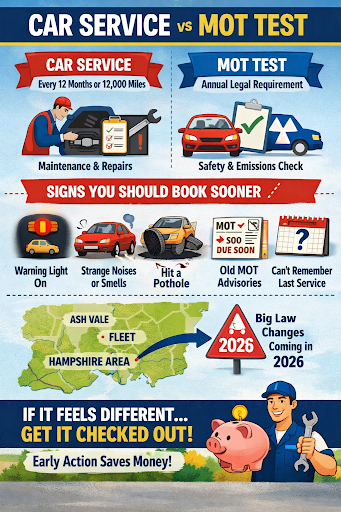
Signs You Should Book Sooner Rather Than Later
If any of the following apply, do not wait for your next scheduled appointment:
- A warning light has appeared on the dashboard and has not cleared after a day or two
- You have noticed a new noise, smell, or handling change that was not there before
- Your car has recently been through a significant pothole strike
- Your MOT is due within the next few weeks and you have outstanding advisories from last year
- You cannot remember the last time the car was properly serviced
Drivers across Ash Vale, Fleet, and the surrounding Hampshire area should also be aware of the major driving law changes coming in 2026 that may affect vehicle requirements and road compliance, another reason to keep your car in good condition now rather than later.
The simplest advice is this: if something feels different, trust that instinct. Cars do not develop new noises, smells, or behaviours without a reason. Acting early is almost always cheaper than acting late.
Final Thoughts
Most common car problems do not appear without warning. They announce themselves gradually, a sound that was not there last week, a light that flickers on and then off, a pedal that feels slightly different underfoot. The cars that end up with the biggest repair bills are almost always the ones where those early signals were noticed but not acted on.
The drivers who avoid costly surprises are not necessarily more mechanically minded. They are simply more attentive, and quicker to book their car in when something feels off.
Whether you drive daily through North Camp, commute from Farnham, or make occasional runs across Hampshire, keeping your car in good condition is not just about avoiding breakdowns. It is about staying safe on roads that, frankly, are not always kind to vehicles.
If anything in this guide sounds familiar, that is probably your car trying to tell you something. Listen to it sooner rather than later.
Frequently Asked Questions
What is the most common car problem in the UK?
A flat or failing battery is the most frequently reported car problem in the UK. Battery failure is the leading cause of roadside breakdown callouts year on year, particularly during winter months when cold temperatures reduce battery efficiency and short urban journeys do not give the alternator enough time to recharge it fully.
What does the engine management light mean?
It means your car’s onboard computer has detected a fault somewhere in the engine or emissions system. This can range from something minor such as a loose fuel cap, to something more significant like a failing sensor or catalytic converter issue. A steady light means book a diagnostic check soon. A flashing light means stop driving when it is safe to do so.
Can potholes damage my car?
Yes, and more significantly than most drivers realise. A single pothole strike can cause tyre sidewall damage, wheel misalignment, and worn suspension components, sometimes all at once. With Hampshire roads among the worst in England for pothole prevalence, drivers in Farnborough, Tongham, and Ash should check their tyres and steering response after any significant impact.
How do I know if my brake pads need replacing?
The clearest early sign is a squealing or squeaking sound when you apply the brakes. This is the wear indicator built into the pad doing exactly what it is designed to do. If that sound progresses to a grinding or scraping noise, the pads have worn through entirely and the discs may be damaged too. At that stage, the repair becomes more involved and more costly, so act on the squeal, not the grind.