



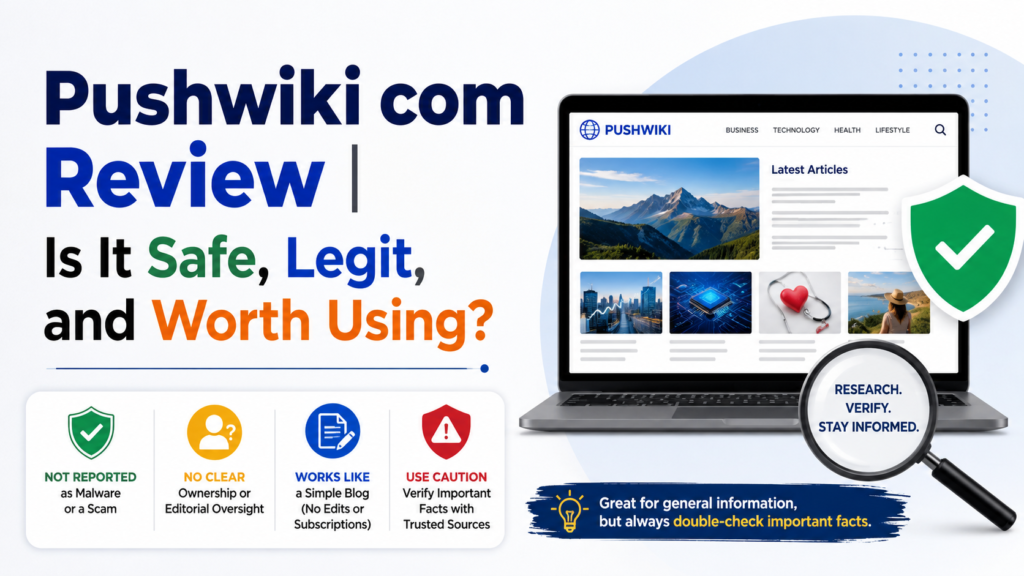
Pushwiki com is a multi-topic content website that publishes free informational articles on subjects like business, technology, health, and lifestyle. It is not reported as malware or a scam, but it also has no clear ownership or editorial oversight. In practice Pushwiki works like a simple blog (no user edits or subscriptions), so readers should use it cautiously and always verify important facts with trusted sources.
What Pushwiki com Is and How It Works
Pushwiki com launched in March 2023 and calls itself a “collaborative knowledge platform,” but it functions more like a straightforward content blog. The site’s writers (identified only by first names on the pages) produce original guides and explainers on varied topics. For example, Pushwiki features articles on technology, business, finance, health, education, travel, and lifestyle. Each article is written in clear, beginner-friendly language and broken into short paragraphs with headings, making it easy for general readers to scan and understand.
Visitors can access all content freely: there are no registration requirements or paywalls. The homepage simply lists the latest posts, and users can click on categories or search to find specific topics. Typical posts range from practical how-to guides to explanatory overviews. The site is designed to be lightweight and easy to navigate, with a clean layout that loads quickly (it uses a standard WordPress theme). Notably, Pushwiki does include some affiliate or referral links in its articles (for example, links to service providers or loan companies), which is common for monetized blogs but is a point for readers to be aware of.
Ownership, Domain Registration, and Policies
Pushwiki com offers no “About Us” or company information on the site. An email address (emeliehyde@gmail.com) is listed at the bottom, but there is no team page, no listed headquarters, and no privacy policy or terms of service. According to domain registration records, Pushwiki com was registered on March 5, 2023 through NameCheap using WHOIS privacy protection. This means the public WHOIS entry lists only NameCheap’s details, not an individual owner or corporate entity. In other words, ownership is opaque.
This setup (private registration and no about page) is common among small independent blogs and content sites, but it also means readers cannot verify who is behind the information. No business registry or LinkedIn profile was found for “Pushwiki,” and analysts note that Pushwiki domains often mask their owner details. For example, one mirror of the site mentions an author name (“Martin”) without any verifiable background. In short, the people running Pushwiki com remain unnamed to the public.
Security and Safety Considerations
From a technical standpoint, Pushwiki com appears benign: the site uses HTTPS (SSL/TLS) encryption and loads normally in browsers without warnings. In testing and security databases, no reports of malware, phishing scams, or hacking incidents were found for the domain. The site does not request any user login, payment, or sensitive personal data. It focuses purely on content consumption: you land on an article page and can read it immediately.
However, the lack of transparency raises typical caution flags. Pushwiki com shows no clear data privacy disclosures or third‑party certifications. The only hint of ownership is a NameCheap privacy registration, meaning contact details are hidden. Analysts have pointed out risk signals such as “lack of clear ownership information” and “unclear privacy handling” on such sites. Visitors are advised not to download any files or submit personal information on the site. Also, because some articles contain affiliate links, users should be aware that parts of the content could be influenced by sponsors.
In summary, no direct security threats have been identified on Pushwiki com, so general browsing is likely safe. Nevertheless, best practice (as with any independent website) is to stay cautious: do not click on suspicious ads or pop-ups, keep your browser updated, and verify any advice or facts found on the site.
Content Quality and Credibility
Pushwiki aims to present information in plain English, and its articles are generally readable and well-structured. Many readers find the simplified language and clear formatting convenient for quick overviews. For instance, Pushwiki’s posts use short paragraphs and clear subheadings to break down topics step-by-step. The range of subjects is broad (from tech guides to lifestyle tips), so one site visit can cover multiple interests. All content is in “evergreen” style: it’s not news or constantly updated; instead it reads like general encyclopedia-type articles.
On the other hand, several content analysts have flagged limitations in Pushwiki’s approach. Importantly, most articles on Pushwiki lack citations to authoritative sources. They are written in a generic style by in-house writers (named on the site as “Devin Haney” or “Shivi Hyde”) but with no credentials or references provided. In one analysis, experts noted that Pushwiki content generally carries “no named author or verifiable editorial history”. There is also no visible editorial review process or fact-checking. In practice, this means the accuracy of Pushwiki’s information can vary; readers cannot easily verify the facts from the article itself.
Because of this, Pushwiki’s articles should be treated as informal summaries. They may be useful as a starting point or quick introduction to a topic, but important claims should always be cross-checked with primary or expert sources. For example, the Pushwiki review by FastestVPN explicitly advises: “users must verify any information found on the website before using them entirely,” especially for critical areas like health or finance. Similarly, one SEO analysis warns that Pushwiki is best used only as a “low-stakes starting point” for basic definitions, and not cited as a reliable source in business or security decisions.
In terms of reputation, there is very little direct user feedback. We did not find any Pushwiki reviews on consumer sites like Trustpilot or discussions on major forums. The information available comes almost entirely from SEO blogs and security sites (like those cited above). None of those sources allege fraud, but they stress the site’s unknown status. One reviewer did note that Pushwiki com can be considered “a legal website” and “not a fraudulent website,” based on general user reviews. This suggests it is legitimate as a business entity – meaning it appears to operate within legal norms.
Comparison with Other Knowledge Resources
It helps to compare Pushwiki with established information platforms to gauge its trust level:
| Feature / Aspect | Pushwiki com | Wikipedia |
|---|---|---|
| Domain & Branding | Private content site; privacy WHOIS; part of content network (several similar domains exist) | Single transparent domain; run by nonprofit (Wikimedia) |
| Editorial Model | Staff-written articles (no user edits or community contributions) | Collaborative wiki: volunteer editors can add/edit content |
| Named Authors | No clear author bios; site uses a few pen names | All edits are logged under user accounts; editing history visible |
| Citations & Sources | Articles typically contain no citations or footnotes | Articles require citations; many verified references in each article |
| Ownership Transparency | Owner hidden; no company info or “About” page | Open: Wikimedia Foundation is public, policies disclosed |
| Content Scope | Variety of general topics (tech, health, business, etc.) | Very broad general knowledge (entire encyclopedia of topics) |
| Trustworthiness | Low (unknown team, limited transparency) | High (community oversight, editorial standards) |
(Table: A summary comparison of Pushwiki com with a trusted reference site.)
This comparison shows that Pushwiki com lacks many trust signals that are standard in established references. It does not have the transparent review system or source attribution that sites like Wikipedia, Investopedia, or medical sites have. As one analysis succinctly put it: Pushwiki “lacks the editorial accountability, sourcing, and single-domain consistency that make Wikipedia… trustworthy references”.
Summary of Findings
In summary, Pushwiki com is a functioning informational website with original content on many topics. It is real and accessible, not a phishing trap or scam. Browsing the site is safe from a cybersecurity standpoint. The material is written in plain language and can be handy for casual or initial research.
However, the site’s legitimacy and authority are unverified. There is no clear owner, no bylines with credentials, and no evidence of editorial review. As a result, experts advise treating Pushwiki’s content as a general guide rather than definitive knowledge. It is not recommended to rely on Pushwiki alone for serious decisions or in-depth research. Instead, if you use Pushwiki, do so to get quick, introductory information, and always confirm critical details with more authoritative sources.
Sources: This review is based on examining Pushwiki com directly and consulting expert analyses and reports, which highlight the site’s features, domain history, and trust considerations. Each source is cited in context.