


Ponadiza is presented online as a travel and exploration platform built around guides, cultural insights, backpacking routes, and practical trip tools. Other pages describe the word as an invented or placeholder term, so its meaning is not fixed across the web.
What Ponadiza Is in 2026
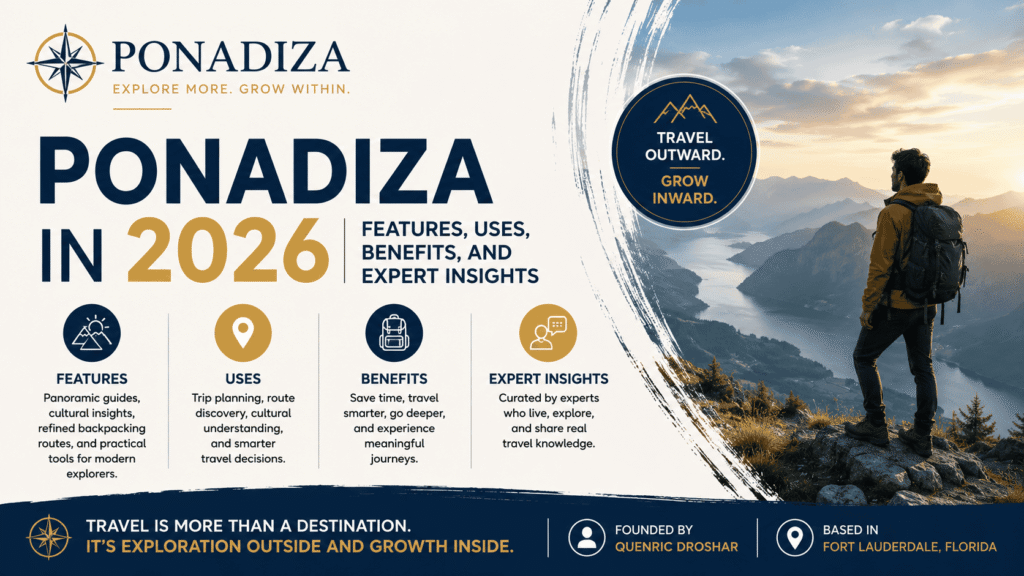
On its official site, Ponadiza says it is founded by Quenric Droshar and based in Fort Lauderdale, Florida. The site describes its mission as making travel clearer through panoramic guides, cultural insights, refined backpacking routes, and practical tools for modern explorers. That makes Ponadiza look less like a single product and more like a travel content brand with several connected content areas.
The same site also frames travel as more than movement from one place to another. It presents travel as a mix of outer exploration and inner growth, which gives the platform a strong editorial identity. This matters because a clear content identity helps readers understand what kind of information they can expect and helps a site stay consistent over time.
Key Features
Ponadiza is organized around a set of named content sections. The main categories shown on the official site include Cultural Experience Overviews, Diza Backpacking Routes, Hidden Gems, Horizon Headlines, Panoramic Travel Guides, and Savvy Packing Tips. These sections show that the site is built to cover both inspiration and practical travel planning.
Cultural Experience Overviews focus on traditions, local lifestyles, authentic cuisine, and immersive experiences. Diza Backpacking Routes focus on scenic trails, travel tips, budgets, and lesser known spots. Hidden Gems points to quieter destinations and less crowded places. Horizon Headlines covers emerging travel trends and stories. Panoramic Travel Guides aim to give broader regional context, while Savvy Packing Tips focus on space saving methods, essential travel hacks, and organized packing.
Ponadiza also includes practical tools. The homepage shows a travel budget calculator that lets users choose a destination, trip length, number of travelers, hotel type, and extra costs such as flights, food, tours, shopping, and insurance. It also highlights an Asteroid Tracking Tool, which the site describes as a resource for curious explorers and amateur astronomers. That combination shows that the platform is not limited to articles only. It also includes utility features.
Travelers who rely on digital tools can also explore Tech Crusader for insights into technology trends, software solutions, and practical guides that support modern travel experiences.
Main Uses
Ponadiza can be used as a travel planning resource. Readers can use it to study destinations, compare routes, look for hidden spots, and understand local culture before a trip. Because the site separates content into different travel focused sections, it gives readers a simple way to move from broad inspiration to more specific planning.
It can also support backpackers and budget conscious travelers. The route content and budget calculator suggest that the platform is designed for people who want more structure before they travel. A person can use the site to estimate trip costs, think through packing needs, and review the kind of destination details that often affect real travel decisions.
Ponadiza is also positioned for readers who care about cultural context. The official site says it values local wisdom, cultural exchange, and travel writing with context. Its writer page says the platform wants grounded, thoughtful contributors who write with clarity, restraint, and rhythm. That makes the site useful for readers who want more than quick lists or shallow summaries.
Benefits for Readers and Travelers
One clear benefit of Ponadiza is organization. Many travel sites mix too many topics together, which makes them hard to read. Ponadiza divides content into distinct travel groups, so users can find inspiration, planning support, and practical tips without much effort. That kind of structure is useful for readers who want quick access to the right type of information.
Another benefit is depth. The official site does not present travel as a simple checklist. Instead, it pairs destination ideas with cultural insight, route context, packing advice, and trip budgeting. That gives readers a fuller picture of a place and helps them prepare with more confidence.
A third benefit is the balance between inspiration and usefulness. Some sections are designed to spark interest in travel, while others are clearly built to solve common problems such as packing, budgeting, and route planning. That balance is important because readers often want both ideas and action steps in the same place.
There is also a branding benefit. Even though some online sources treat Ponadiza as an unclear or invented word, the official site gives it a strong identity through repeated themes such as travel, culture, guidance, and thoughtful exploration. In practice, that helps the name feel tied to a specific subject instead of floating without context.
Readers who regularly manage travel budgets and digital payments may also find RBLcashrbl useful for understanding online banking features, account services, and financial management tools.
Expert Insights
From an editorial and SEO point of view, Ponadiza is built around evergreen search topics. Travel guides, cultural overviews, backpacking routes, packing tips, hidden places, and budget planning are all subject areas that people keep searching for across seasons and years. That makes the site structure suitable for long term content, because it focuses on recurring travel needs rather than one time news only. This is an inference based on the site’s category structure and content themes.
The platform also shows a clear topic cluster model. Its sections do not sit alone. They support one another. A reader who comes for packing advice may also need route ideas. A reader who comes for a destination overview may also need budget planning. A reader who comes for cultural context may later read about hidden gems. That kind of internal structure usually helps a site stay useful and easy to navigate. This is another inference from the way the site is arranged.
Another useful insight is that Ponadiza appears to mix content and utility. The budget calculator gives the site a practical edge, while the travel articles give it editorial depth. The Asteroid Tracking Tool adds an unusual extra layer, which suggests the site is trying to serve curious readers with a broader sense of exploration. Even so, the travel sections remain the clearest and strongest part of the brand.
The term itself also has a naming challenge. One secondary source says Ponadiza does not have a formal dictionary definition and is often treated as a placeholder word or invented online term. That means the brand or keyword needs context to be understood. Without that context, readers may not know whether they are seeing a brand name, a test term, or a travel site.
For that reason, clear page titles, strong section names, and direct topic labeling matter a lot for Ponadiza. The official site already does this well by using descriptive category names such as Cultural Experience Overviews and Savvy Packing Tips. Those names tell readers what each section is for before they click.
The strongest practical use of Ponadiza in 2026 is simple. It works best as a travel information hub for readers who want culture, planning, and route based guidance in one place. Its value comes from structure, clarity, and useful travel coverage, not from hype.