

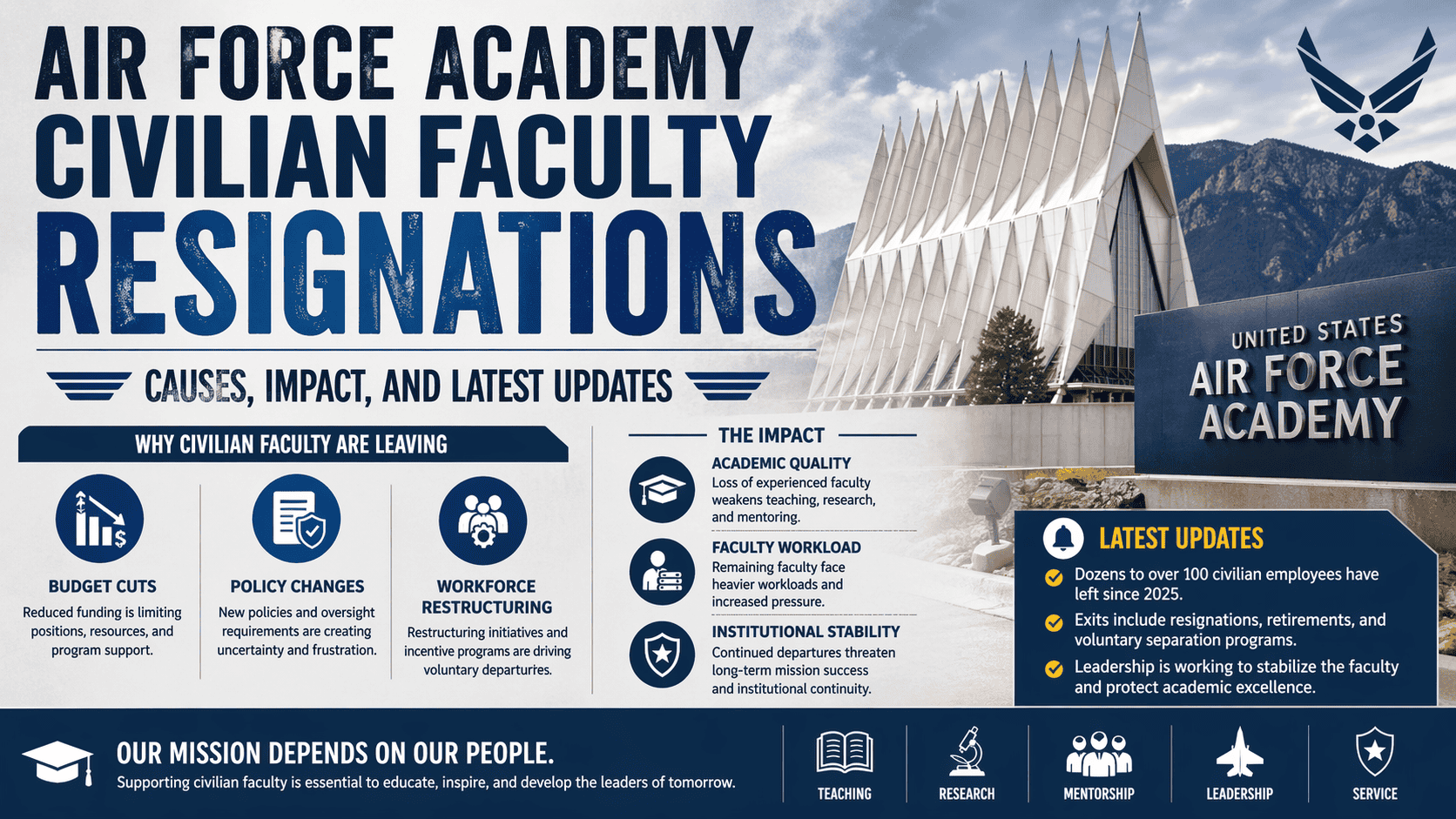

Air Force Academy civilian faculty resignations are mainly caused by budget cuts, policy changes, and workforce restructuring. These departures are affecting academic quality, faculty workload, and long-term institutional stability.
Overview of Civilian Faculty Resignations
The United States Air Force Academy has faced a noticeable reduction in civilian faculty since 2025. Reports confirm that dozens to over 100 civilian employees left through resignation, retirement, or voluntary separation programs.
A large portion of these exits came from structured programs such as the Deferred Resignation Program and early retirement options introduced by the Department of the Air Force.
Civilian faculty include professors, researchers, and academic staff. Many of them hold PhDs and provide long-term academic continuity.
Scale of the Resignations
The number of resignations is higher than early official estimates.
| Category | Data |
|---|---|
| Total civilian positions targeted | About 140 |
| Employees who left or planned to leave | Over 100 |
| Faculty and academic roles affected | More than 50 positions |
| Workforce reduction percentage | Around 15% in some reports |
Some departments experienced deeper losses. In certain cases, projections showed major reductions in engineering and technical fields.
Main Causes of Faculty Resignations
Budget Cuts and Financial Pressure
A key reason behind the resignations is financial restructuring.
The academy faced a funding gap in civilian compensation. This led to plans to reduce positions and limit hiring.
When positions are removed or frozen, faculty members often choose to leave instead of waiting for uncertain outcomes.
For a related case of federal funding changes affecting institutions, see our detailed report on Interior Department RBFF Grant Cancellation and its wider impact on public programs.
Federal Workforce Reduction Policies
The Department of Defense introduced programs to reduce civilian staff across multiple units.
These programs included voluntary resignation and early retirement incentives.
Although voluntary, these policies encouraged many experienced educators to exit within a short period.
Shift Toward Military Instructors
There has been a policy shift toward increasing the number of uniformed military instructors.
This reduced reliance on civilian faculty in some departments.
As a result, civilian roles became less stable, leading to resignations.
Decline in Job Stability
Uncertainty about contract renewals and long-term employment has been widely reported.
Faculty members prefer stable academic careers. When job security weakens, resignations increase.
Workload and Burnout
Remaining faculty often take on extra responsibilities after colleagues leave.
This includes teaching more courses and handling administrative work.
Over time, this leads to burnout and further resignations.
Limited Academic Freedom
Civilian professors in military institutions work under stricter rules compared to traditional universities.
Curriculum decisions and research topics may require approval.
This limitation affects job satisfaction and can influence decisions to leave.
Cultural Differences Between Military and Civilian Staff
There is a structural difference between military leadership and civilian academic culture.
Military systems focus on command and discipline, while academic systems value independence and debate.
This gap creates friction in daily operations.
Leadership and Organizational Changes
Leadership transitions and policy changes have also played a role.
Changes in priorities and management style can directly affect faculty morale.
For insight into regulatory and organizational challenges in another sector, read our coverage of the Edward Jones Kingsview Advisors Lawsuit and what it reveals about institutional accountability.
Impact on Academic Programs
Reduced Course Availability
Some internal discussions suggested that certain majors and minors might be reduced or removed due to staff shortages.
When departments lose multiple professors, maintaining full programs becomes difficult.
Increased Class Sizes
With fewer instructors, class sizes may increase.
This reduces individual attention for cadets and changes the learning experience.
Loss of Specialized Expertise
Civilian faculty often bring deep subject expertise, especially in STEM fields.
Their departure creates gaps that are difficult to fill quickly.
Lower Research Output
Civilian professors contribute significantly to research and academic publications.
Fewer faculty members mean reduced research activity.
Impact on Faculty and Staff
Higher Workload
Remaining faculty must cover additional courses and responsibilities.
This leads to stress and affects teaching quality.
Decline in Morale
Surveys and reports show a clear drop in morale among faculty members.
Low morale can reduce productivity and increase turnover.
Recruitment Challenges
Replacing experienced professors is not easy.
Candidates may hesitate to join an institution facing instability.
Impact on Cadets
Reduced Mentorship
Civilian faculty often provide long-term mentoring.
Frequent turnover makes it harder for cadets to build strong academic relationships.
Changes in Learning Quality
Consistency in teaching is affected when instructors change frequently.
Cadets may experience differences in course quality.
Pressure on Academic Standards
If faculty shortages continue, maintaining academic standards becomes more challenging.
Accreditation and Institutional Risk
Civilian faculty play a key role in meeting accreditation standards.
Concerns have been raised that large-scale departures could affect compliance with academic requirements.
Accreditation bodies review faculty qualifications, program stability, and academic outcomes.
Latest Updates and Developments
Accreditation Review
The Higher Learning Commission has opened a review related to faculty cuts and academic capacity.
This indicates growing concern about long-term academic stability.
Leadership Changes
Recent leadership transitions have taken place within the academy.
These changes aim to address organizational and cultural issues.
Ongoing Workforce Adjustments
The academy continues to adjust staffing levels.
Some vacant positions remain unfilled, and restructuring is still ongoing.
Government Attention
Lawmakers have raised concerns about funding and staffing levels.
Discussions include possible financial support to stabilize operations.
Comparison Between Civilian and Military Faculty Roles
| Aspect | Civilian Faculty | Military Faculty |
|---|---|---|
| Tenure | Long-term | Rotational |
| Expertise | Deep academic specialization | Operational experience |
| Research role | High involvement | Limited involvement |
| Stability | High | Moderate |
| Teaching continuity | Strong | Variable |
This comparison shows why civilian faculty are important for academic consistency.
Long-Term Outlook
The situation depends on several factors:
- Future funding decisions
- Hiring strategies
- Balance between civilian and military faculty
- Policy adjustments at the Department of Defense level
If vacancies remain unfilled, academic pressure may continue.
If hiring improves and policies stabilize, the academy may restore balance over time.


