

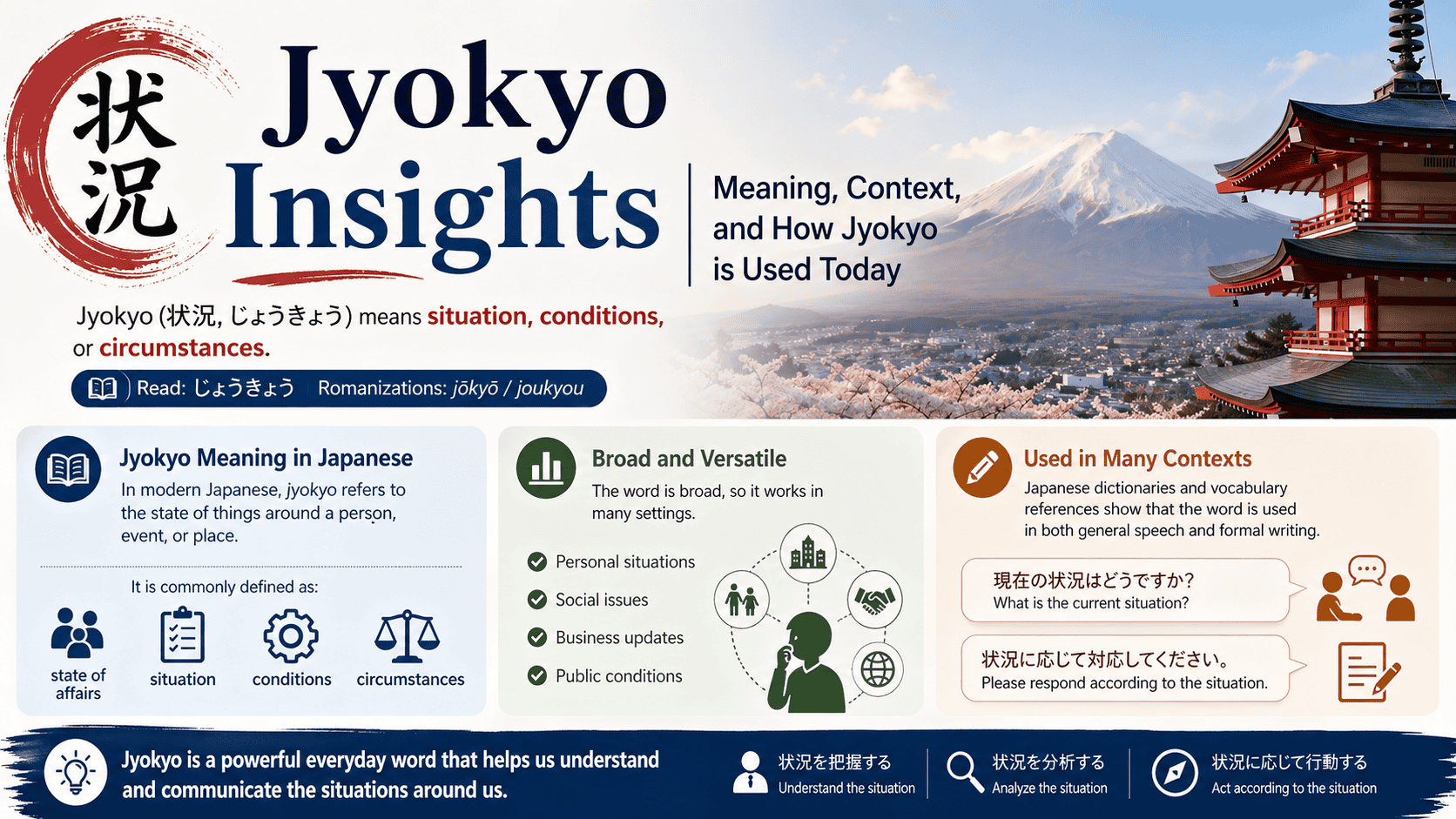

Jyokyo is a Japanese word that means situation, conditions, or circumstances. It is usually written as 状況 and read じょうきょう, with romanizations such as jōkyō or joukyou.
Jyokyo Meaning in Japanese
In modern Japanese, jyokyo refers to the state of things around a person, event, or place. Standard dictionary sources define it as “state of affairs,” “situation,” “conditions,” or “circumstances.” Kotobank’s dictionary entry also explains that it can describe how a time, place, or event is changing, or the conditions a person is living in.
The word is broad, so it works in many settings. It can describe a small personal situation, a social issue, a business update, or a larger public condition. Japanese dictionaries and vocabulary references show that the word is used in both general speech and formal writing.
You can understand related cultural and language terms better in the article on Cumhuritey, which explains its meaning and usage in modern context.
How Jyokyo Is Written and Read
The most common written form is 状況. The reading is じょうきょう, and many romanization systems write it as jōkyō or joukyou. Some dictionaries also list the alternate spelling 情況, which appears in older or formal usage.
The two kanji give a helpful clue to the meaning. 状 carries the sense of status, form, or condition, while 況 carries the sense of condition or situation. Together, they point to the idea of “how things stand.” Dictionary entries for each kanji support this reading.
| Form | Reading | Basic meaning |
|---|---|---|
| 状況 | じょうきょう | situation, circumstances, conditions |
| 情況 | じょうきょう | alternative spelling, same general meaning |
| 状況によって | じょうきょうによって | depending on the situation |
| 状況報告 | じょうきょうほうこく | situation report, status report |
What Jyokyo Means in Daily Use
In everyday Japanese, jyokyo is used when someone needs to describe what is happening right now. It often appears when people ask for an update, explain a problem, or describe changing conditions. A common example is 「状況をお知らせください」, which means “Please let me know the status.”
The word also appears in phrases that show dependence on changing conditions. For example, 「状況によって」 means “depending on the situation,” and this pattern is widely recorded in dictionary sources. That makes jyokyo a flexible word for both writing and speech.
Because the word is so general, it can describe almost any visible or practical state of affairs. It is not limited to emergencies or serious topics. It can refer to work progress, a personal case, a school matter, traffic, or a public event, as long as the speaker wants to describe the current conditions.
Common Contexts Where Jyokyo Appears
Jyokyo appears often in formal and semi formal language. One clear example is 状況報告, which means situation report or status report. Another is 状況判断, which means judgment based on the situation. These are natural word combinations in Japanese and are listed in dictionary and vocabulary references.
It also appears in public, business, and media language. A report may describe the 現況, or current situation, and then compare it with the wider 状況. Dictionary sources show related forms such as 現況, 状況報告, and 状況によって, which confirms that the word belongs to practical modern usage, not only textbook Japanese.
In written Japanese, jyokyo is often the better choice when the writer wants a neutral and clear term. It works well in reports, notices, summaries, and explanations because it describes facts without adding emotion. That neutral tone is one reason the word stays useful in long-term, everyday communication.
Simple Usage Examples
The following examples show how jyokyo works in real Japanese expressions. The meanings here follow dictionary definitions and standard phrase usage.
| Japanese phrase | Simple English meaning | Use |
|---|---|---|
| 状況を確認する | to check the situation | work, daily life, planning |
| 状況を説明する | to explain the situation | reports, meetings, messages |
| 状況によって変わる | it changes depending on the situation | general speech and writing |
| 状況報告 | situation report | business, office, operations |
| 状況判断 | situational judgment | decision making, formal discussion |
A sentence such as 「状況を見て決めます」 means “I will decide after seeing the situation.” That use fits the dictionary sense of jyokyo as the present state of affairs or surrounding circumstances.
Another common pattern is 「今の状況」, which means “the current situation.” This is a direct, plain way to talk about present conditions, and it matches the dictionary meaning of 状況 as the current state of things.
Jyokyo and Similar Japanese Words
Jyokyo is close in meaning to several other Japanese words, but it is not always the same as them. Dictionaries and vocabulary references show related terms such as 状態, 事情, 事態, 現況, 情勢, and 実況. These words overlap, but each one has its own focus.
状態 usually points to a condition or state. 事情 often refers to circumstances or reasons behind something. 事態 often means a situation or affair, usually when something has developed or changed. 状況 is broader and often works well when speaking about the whole surrounding condition of an event or person.
現況 is a close related term for “current situation,” and dictionary sources define it that way directly. 実況 points more toward the real or live state of things, such as live reporting. These related words help show why jyokyo is useful as a general, flexible term.
Jyokyo in Modern Writing
Today, jyokyo remains a useful word in modern Japanese because it is clear, formal enough for reports, and simple enough for daily use. Dictionary sources classify it as a common noun and connect it with modern expressions such as status reports, depending on the situation, and current conditions.
In practical writing, jyokyo works well when the goal is to describe facts without extra detail. A sentence can use the word to explain progress, conditions, or the current state of a matter. That makes it useful in office messages, news summaries, instructions, school communication, and general updates.
The word also fits structured language. Because it is neutral and broad, writers can pair it with many verbs and nouns, such as confirm, report, explain, judge, or change. This flexibility is shown in the many dictionary examples and compound forms that use 状況.
A deeper look at digital and contextual terminology can be found in the guide on Hypackel, which breaks down its practical use in online systems and language structure.
Why Jyokyo Matters for Readers and Learners
For Japanese learners, jyokyo is important because it appears often and carries a wide meaning. It helps readers understand reports, updates, and everyday explanations. Vocabulary references also place it at a common intermediate level, which makes it a useful word to learn early.
For writers and editors, jyokyo is valuable because it gives a clean and professional way to describe conditions. It does not force the writer into a narrow meaning, and it works across many topics. That is one reason it continues to appear in modern Japanese text, especially where clear communication matters.