

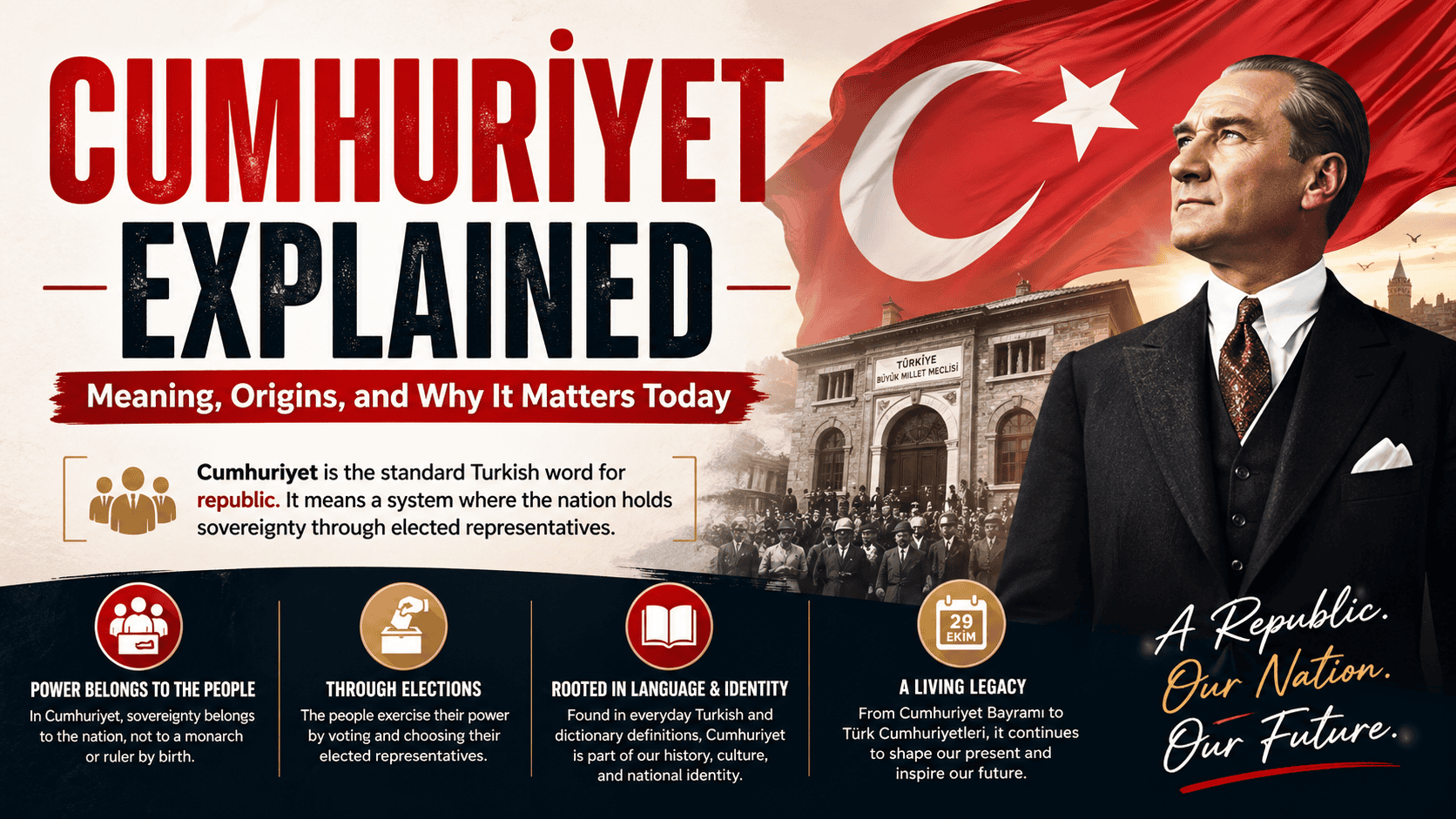

Cumhuriyet is the standard Turkish word for republic. It means a system where the nation holds sovereignty through elected representatives.
What Cumhuriyet Means
In modern Turkish, Cumhuriyet refers to a form of government in which power does not belong to a monarch or ruler by birth. It belongs to the people, and the people use that power through voting and elected institutions. The Turkish Language Association defines it in exactly this political sense.
The word also appears in everyday Turkish with other fixed uses. The same dictionary lists phrases such as Cumhuriyet Bayramı and Türk Cumhuriyetleri, which shows that the word is not limited to law or politics alone. It is part of public language, history, and national identity.
Where the Word Comes From
The Turkish dictionary records the origin of Cumhuriyet as Arabic, written as cumhūriyyet. That makes the word a borrowed term that entered Turkish through long contact with Arabic and Ottoman language traditions. Its form changed over time, but its core political meaning stayed stable.
The root idea behind the term is tied to public rule and collective authority. In Turkish, the word became the accepted term for a republic, so it now carries both a language history and a state history. That is why it matters in grammar, politics, and cultural memory at the same time.
Why the Word Became Historic in Turkey
The word Cumhuriyet gained major historical weight on 29 October 1923, when the Turkish Grand National Assembly proclaimed the Turkish Republic. On that same day, Gazi Mustafa Kemal Pasha was elected President of the Republic. The Ministry of Culture and Tourism lists this date clearly in its official 1923 chronology.
That date matters because it marks the formal shift to a republican state structure in Turkey. The event was not only symbolic. It changed the legal and political direction of the country and became one of the most important dates in modern Turkish history.
Why Cumhuriyet Matters Today
Cumhuriyet still matters because it names a system of government that shapes daily public life. In a republic, citizens matter through elections, public law, representative institutions, and equal political rights under the state framework. The dictionary meaning points directly to this system, so the word remains useful in any discussion about governance and citizenship.
It also matters because it connects language with national history. In Turkey, the word is linked to the founding date of the republic, the office of the president, and the official celebration of Republic Day. This gives the term strong long term importance in education, public memory, and civic life.
For a better understanding of modern digital platforms that support structured communication and public interaction, you can also explore Kompama.
How It Is Used in Daily Turkish Language
Cumhuriyet is used in formal and informal Turkish whenever people refer to the republic as a state form, a national day, or a historic period. The dictionary even lists established compounds such as Cumhuriyet Bayramı, which is Republic Day, and Türk Cumhuriyetleri, which refers to Turkish republics. These fixed expressions show that the word has a broad and stable place in modern Turkish.
In news writing, school books, official speeches, and state documents, Cumhuriyet often signals more than a legal system. It can point to the whole era that began after 1923. That is why the term is common in political language, national holidays, and historical discussion.
The Difference Between the Word and the Idea
The word Cumhuriyet is the Turkish label for the idea of a republic. The idea is older and broader than the Turkish word itself. A republic is a state in which power comes from the people rather than from hereditary rule, and Turkish uses Cumhuriyet to express that idea in a specific national and historical context.
This difference matters because one word can carry both a general meaning and a local meaning. In general political language, republic is a type of government. In Turkish history, Cumhuriyet is also the name of a major turning point in the national story. The same word serves both roles clearly.
Why the Word Is Important in Education
Cumhuriyet is important in schools because it helps explain the structure of the Turkish state and the history of modern Turkey. Students need the word to understand basic civics, constitutional language, and the founding of the republic in 1923. The official historical record and the dictionary definition together make the term easy to teach and easy to verify.
It is also important for language learning because it shows how Turkish adopts and reshapes words from other languages. The dictionary form includes the Arabic origin, which is useful for students of Turkish vocabulary, etymology, and historical linguistics. The term is therefore useful in both language study and history study.
Why Cumhuriyet Is Still Seen in Public Life
Cumhuriyet remains visible in public life because it appears in official holiday names, state language, and institutional memory. The Ministry of Culture and Tourism’s chronology shows how central 29 October 1923 is to the national story, and the dictionary confirms that Cumhuriyet is tied to that historical framework through common compounds and standard usage.
The word also stays relevant because republics depend on active public participation. When people discuss elections, representation, sovereignty, or constitutional order in Turkish, Cumhuriyet is one of the first words they use. That practical use keeps the term current, even though its historical roots go back much further.
Main Facts About Cumhuriyet
Cumhuriyet is the Turkish word for republic. It comes from Arabic as cumhūriyyet, and the Turkish dictionary defines it as a system where the nation holds sovereignty through elected representatives. The word is strongly tied to 29 October 1923, when the Turkish Republic was proclaimed and Mustafa Kemal Pasha was elected president.
It is also used in established expressions such as Cumhuriyet Bayramı and Türk Cumhuriyetleri, which shows that the word is deeply rooted in modern Turkish public language. That makes it both a political term and a cultural term with long lasting importance.