

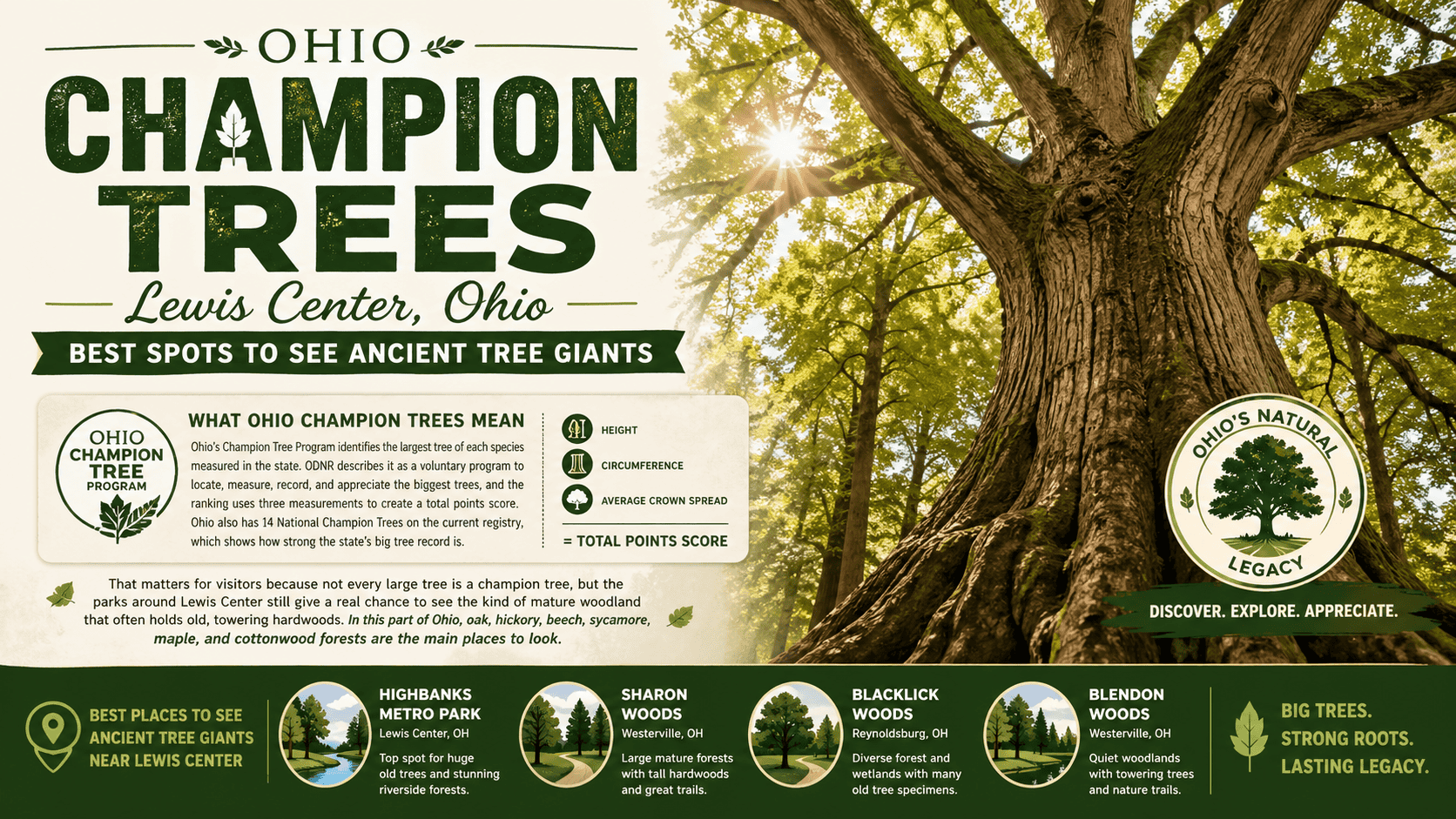

The best place in Lewis Center to see huge old trees is Highbanks Metro Park. Nearby parks in central Ohio also offer strong mature forest settings, including Sharon Woods, Blacklick Woods, and Blendon Woods.
What Ohio Champion Trees Mean
Ohio’s Champion Tree Program identifies the largest tree of each species measured in the state. ODNR describes it as a voluntary program to locate, measure, record, and appreciate the biggest trees, and the ranking uses three measurements to create a total points score. Ohio also has 14 National Champion Trees on the current registry, which shows how strong the state’s big tree record is.
That matters for visitors because not every large tree is a champion tree, but the parks around Lewis Center still give a real chance to see the kind of mature woodland that often holds old, towering hardwoods. In this part of Ohio, oak, hickory, beech, sycamore, maple, and cottonwood forests are the main places to look.
You can also explore Ohio Champion Trees Delaware County USD Lewis Center for detailed local tree records and verified champion listings in the Lewis Center and Delaware County area.
Best Spots Around Lewis Center
| Spot | Why it stands out | Best for |
|---|---|---|
| Highbanks Metro Park | Located in Lewis Center, with forest trails, deep ravines, and river scenery | The closest place for a big tree feel |
| Sharon Woods Metro Park | Towering oak, hickory, and beech trees, plus a state nature preserve | Large hardwoods and shaded trails |
| Blacklick Woods Metro Park | One of the best remaining beech-maple forests in central Ohio, with a canopy walk | Dense mature forest and canopy views |
| Blendon Woods Metro Park | Stream-cut ravines and beech-maple and oak-hickory forests | Classic central Ohio woodland scenery |
| Inniswood Metro Gardens | Woodlands and streams inside a scenic preserve | A quieter walk with trees and gardens |
This mix gives visitors several good options without leaving the central Ohio area. Highbanks is the most direct Lewis Center choice, while the other parks expand the search for large, older trees within a short drive.
Highbanks Metro Park
Highbanks sits in Lewis Center and is the strongest single stop for this topic because it combines location, mature woods, and river bluffs. Metro Parks says the park is named for its massive 100 foot shale bluff above the Olentangy State Scenic River. It also has deep ravines, forested trails, and routes that pass through woods and along the river.
For tree hunters, the most useful part is the trail network. The Dripping Rock Trail goes through forest and passes steep ravines. The Scenic River Trail goes through forest beside the Olentangy River. The Sycamore Trail winds through a forest of sycamore, buckeye, and cottonwood. These settings are strong signs of mature riparian woodland, which is where many large trees thrive.
Metro Parks also says forests in Highbanks are recognized by the Old Growth Forest Network. That makes Highbanks especially relevant for anyone looking for older forest structure rather than only landscaped park trees.
Sharon Woods
Sharon Woods is a useful second stop because the park has towering oak, hickory, and beech trees, plus a preserve inside the park. Metro Parks says the Edward S. Thomas State Nature Preserve sits within the park, and the Edward S. Thomas Trail passes large burr oaks. That is exactly the kind of setting that fits a champion tree search.
The trail layout is also helpful. The park’s forest and field mix gives visitors several chances to compare tree size and canopy shape across different habitats. The park is also listed by Metro Parks as one of the forests recognized by the Old-Growth Forest Network.
Blacklick Woods
Blacklick Woods is one of the strongest mature forest sites in central Ohio. Metro Parks says it features 652 acres of woods, fields, seasonal swamp ponds, a small prairie, and one of the best remaining beech-maple forests in central Ohio. It also has a buttonbush swamp and a canopy walk that crosses the tree canopy 40 feet above ground.
The trail system gives direct access to the best tree viewing areas. The Beech Trail passes through a beech-maple forest. The Buttonbush Trail runs through a hardwood swamp forest. The Maple Trail traverses a hardwood forest and passes a small wetland. This variety makes Blacklick Woods a strong place to see large, mature trees in more than one habitat type. Metro Parks also lists Blacklick Woods among its forests recognized by the Old-Growth Forest Network.
Blendon Woods
Blendon Woods is another excellent stop because it has stream-cut ravines and forests dominated by beech-maple and oak-hickory trees. Metro Parks describes it as a 653 acre park with wooded ravines and a wildlife refuge, which makes it a good place for visitors who want older forest structure and a quieter natural setting.
The forest character here matters more than any single feature. Ravines often protect trees from heavy clearing and farming, so parks like this often keep mature canopy cover longer than open land. Metro Parks also highlights a special older forest area near Blendon Woods in its blog content, which strengthens its value for tree viewing.
What Tree Species to Look For
In central Ohio, the most impressive large trees are often oaks, beeches, hickories, maples, sycamores, cottonwoods, and tulip trees. The parks above feature several of these groups directly in their official trail and park descriptions. That is useful because champion trees are often found among long lived hardwood species that can keep growing for many decades.
If the goal is to spot the biggest trees, focus on thick trunks, wide crowns, and trees that stand apart from younger growth. ODNR’s champion tree method uses circumference, height, and crown spread to calculate a total points score, so the biggest trees are usually easy to notice once you know what to look for.
How to Read a Champion Tree Site
A true champion tree site is not just a scenic forest. It is a place where the tree is large enough to stand out at the species level. ODNR’s registry exists to record the largest measured trees in the state, and its national champion listings show that Ohio has trees at the top of the record for several species.
For visitors, that means two different experiences matter. First, there is the official champion tree record. Second, there is the on the ground view of old forests and big canopies. Lewis Center and the nearby Metro Parks are stronger for the second experience, while ODNR’s registry is the right place for the official statewide record.
Best Time To Visit
Morning and late afternoon are the most useful times for tree viewing because the light is softer and the canopy shape is easier to see. On wooded trails, angled light also helps reveal trunk texture, branch spread, and the size difference between old trees and younger trees nearby. Parks like Highbanks, Sharon Woods, and Blacklick Woods each have trail systems that support slow, close viewing rather than quick drive by sightseeing.
Season also changes the experience. In leaf season, the canopy shows full size and color. In winter, trunks, bark patterns, and branching structure stand out better. The parks listed here are open year round, so the tree experience changes without losing value.
Simple Route For A Tree Viewing Day
Start at Highbanks in Lewis Center, since it is the most relevant local stop and has river forest trails plus ravines. Then add Sharon Woods or Blacklick Woods to compare different mature forest types. Finish with Blendon Woods for ravines and beech-maple or oak-hickory woodland. This gives a clear, practical look at central Ohio’s best tree country without adding unnecessary travel.
What Makes These Spots Strong For Old Trees
These parks stand out because they protect mature woodland, not just open green space. Highbanks has river bluffs and forest trails. Sharon Woods has towering hardwoods and large burr oaks. Blacklick Woods has one of the best remaining beech-maple forests in central Ohio. Blendon Woods has ravines and broad forest cover. Together, they form the best practical answer for people searching for Ohio Champion Trees in and around Lewis Center, Ohio.
Visitor Notes
Park names and trail access can change, so it is smart to check each park’s official page before a visit. The Metro Parks system maintains current directions, trail details, and trail difficulty information for Highbanks, Sharon Woods, Blacklick Woods, Blendon Woods, and Inniswood. ODNR also keeps the Champion Tree program and tree registry information on its official site.
For readers interested in digital tools and app related topics, Parallel Space Akun Berganda explains how multiple accounts can be managed on one device in a simple way.