



The OtterSec lawsuit is a dispute over who controlled the company, its assets, and its brand after the death of co founder Sam Chen and the later dissolution of OtterSec LLC. The case also includes trademark, contract, fiduciary duty, and related tort claims, and it was still active on the docket in May 2026.
What the OtterSec lawsuit is about
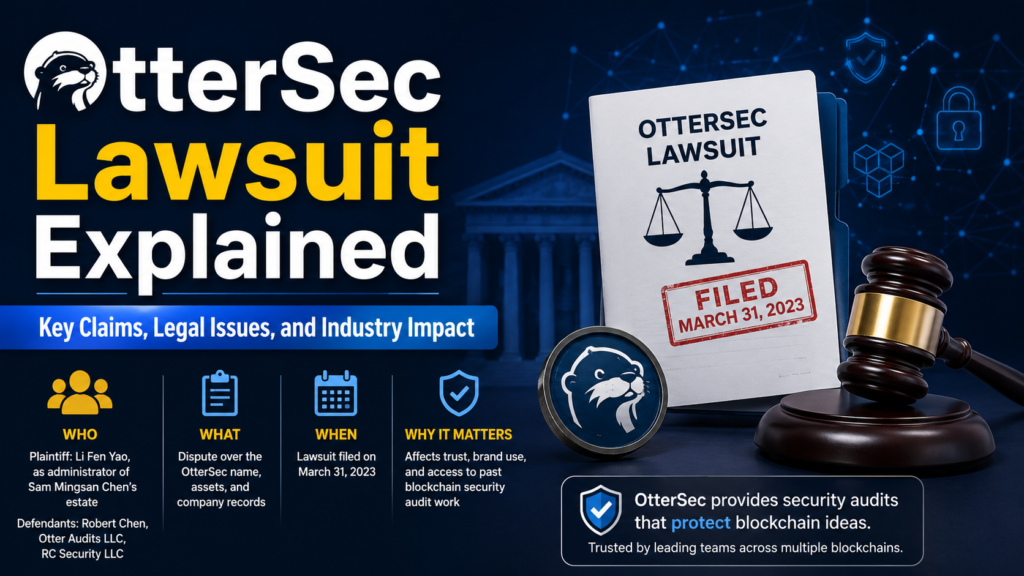
The core dispute began after the breakup of the OtterSec business and the later fight over its name, assets, and company records. Court materials identify Li Fen Yao, as administrator of Sam Mingsan Chen’s estate, as the plaintiff in the Maryland case, and Robert Chen, Otter Audits LLC, and RC Security LLC as defendants. The court record also shows that the litigation was filed on March 31, 2023.
OtterSec worked in blockchain security audits. Its official site says it provides “security audits that protect blockchain ideas” and works with leading teams across multiple blockchains. That matters because a dispute over ownership and control in this kind of business can affect trust, brand use, and access to past audit work.
You can read it’s also: WIAA Arrowhead High School Waiver Lawsuit Updates | Legal Battle and Impact
Who the parties are
The dispute centers on Robert Chen and the Chen family’s interests in the company. WIPO’s 2025 domain decision says Robert Chen founded Otter Audits LLC and RC Security LLC, and co founded OtterSec LLC with the late Sam Chen, who acted on behalf of his minor son David Chen at the start of the business. The same decision says OtterSec LLC was later dissolved and that its assets were auctioned on September 24, 2022.
The WIPO panel also recorded that Robert Chen said he bought OtterSec LLC’s assets in that auction, including the domain name, website, social media accounts, code, and computers. The panel further noted that those assets were later transferred to RC Security LLC, which licensed the intellectual property rights to Otter Audits LLC.
Main claims in the Maryland case
The Maryland case is not a simple one claim lawsuit. The court and later WIPO materials describe a wider set of claims tied to the dissolution of OtterSec LLC. Those claims included a Lanham Act claim, breach of contract, breach of fiduciary duty, fraud, misappropriation and conversion, tortious interference, a request for declaratory relief, and an accounting.
The strongest legal idea behind the case is that the estate argued Robert Chen handled the breakup of the company in a way that harmed Sam Chen’s interests and the company’s value. WIPO’s summary says the case arose out of activities leading up to and during Robert Chen’s dissolution of OtterSec LLC. It also notes that the estate sought damages and other relief tied to the alleged improper dissolution and asset handling.
Another important part of the dispute is the trademark side. WIPO explains that RC Security LLC claimed rights in the OTTERSEC mark and said the brand had been used on audit reports since early 2022. It also recorded the claim that the mark had built goodwill through public use, testimonials, and visibility in the blockchain security space.
Key legal issues
One major issue is company control. The dispute asks who had the right to manage OtterSec, dissolve it, and control what happened to its property. That kind of issue is common in LLC fights, especially when ownership, voting power, and operating agreements are disputed. The WIPO record shows that the timing of the dissolution, the auction, and the later transfer of assets all mattered to the parties’ arguments.
A second issue is fiduciary duty. The estate’s claims included breach of fiduciary duty, which usually turns on whether an owner or manager acted loyally and fairly toward the company and other owners. WIPO’s summary says some fiduciary duty claims were later dismissed, while others continued. That tells readers the court did not treat every fiduciary claim the same way.
A third issue is trademark and false association. The Lanham Act claim shows that the case was not only about internal company fights. It also touched brand ownership and public use of the OtterSec name. The WIPO panel later found that the disputed domain name <ottersec.io> should be transferred to RC Security LLC after deciding that the registration was in bad faith.
A fourth issue is whether the dispute involved genuine criticism or improper use of the brand. The WIPO panel described a website that said it was a non profit site sharing public court records about OtterSec, but the panel still found the domain itself falsely signaled affiliation and supported bad faith registration. The panel also noted that the site appeared to contain selected pleadings and exhibits from the litigation.
What the courts have ruled so far
The litigation has already produced several important rulings. A March 11, 2024 memorandum opinion denied a motion to dismiss for lack of personal jurisdiction, which meant the case could continue in Maryland. Court docket materials also show that the judge later entered another memorandum opinion on January 27, 2025.
The January 27, 2025 ruling was partly in favor of the defendants and partly in favor of the estate. WIPO’s summary says the court granted the motion for judgment on the pleadings in part and dismissed the Lanham Act claim, some fiduciary duty claims against the company defendants, certain claims against Robert Chen tied to duties owed to OtterSec LLC and the estate, a misappropriation and conversion claim, and a tortious interference claim. The same summary says the motion was denied in part, so some claims remained alive.
The most current public docket entry visible in the court monitoring record shows that the matter was still moving in May 2026. On May 15, 2026, the magistrate judge stayed the scheduling order because discovery dispute spreadsheets, a sanctions motion, and a spoliation sanctions motion were still under review. That is a strong sign that the case had not ended.
The domain name fight
The domain dispute became a separate but related part of the story. WIPO case DIO2025-0008 dealt with the domain ottersec.io and was decided on July 14, 2025. The panel said the disputed domain name was registered on September 21, 2022, shortly before the company’s assets were put up for auction. It also said the later website content appeared to be tied to the wider litigation.
The panel found that the domain was registered in bad faith and ordered that ottersec.io be transferred to RC Security LLC. That result matters because it shows that the name and online identity of the business were treated as valuable assets, not just branding.
Industry impact on blockchain security firms
This lawsuit matters beyond one company because blockchain security firms rely on trust, public reports, and a stable brand. OtterSec’s own site says it secures blockchain projects and supports teams across many chains. The WIPO decision also notes that OtterSec brand visibility was used in public audit reports and in the wider crypto market as a sign of reliability and security.
That makes the legal dispute important for the industry. If a security audit company goes through an ownership fight, questions can arise about who controls the trademark, who owns old reports, who can use the brand, and whether clients can rely on the public face of the firm. In OtterSec’s case, the court record and the WIPO decision show that these issues were not abstract. They affected company assets, web identity, and the public record around the business.
The case also shows how public court records can shape a company’s reputation. The WIPO panel noted that blockchain companies often use audit reports as proof of reliability and security in their own marketing. In a field like this, a legal dispute over control of the audit brand can affect how clients, partners, and the wider market read past work.
You can read it’s also: Edward Jones Kingsview Advisors Lawsuit Update | Allegations, Response, and Impact
Why the case is still important
The OtterSec lawsuit remains important because it brings together several issues at once. It involves an LLC breakup, family and estate interests, asset transfers, trademarks, and internet identity. It also shows how a blockchain security brand can become part of a broader legal fight over control and ownership. Court records show that some claims were dismissed, some remained active, and the docket was still open in 2026.


