


Software testing has changed dramatically over the past decade. Teams are releasing software faster than ever, and traditional manual testing alone often cannot keep up with modern development cycles. At the same time, automation has become a necessity rather than a luxury.
For many manual testers, however, learning automation has traditionally meant months of studying programming languages, test frameworks, debugging techniques, and CI/CD pipelines. That steep learning curve has discouraged countless talented QA professionals from making the transition.
Artificial intelligence is changing that equation. Instead of requiring testers to become software developers first, AI-powered testing tools allow them to apply their existing testing knowledge directly to automation. While becoming an experienced automation engineer still takes time, AI dramatically shortens the path by removing many of the technical barriers that once stood in the way.
The Traditional Road to Test Automation
Not long ago, a manual tester who wanted to automate tests typically had to learn:
- One or more programming languages such as Java, Python, or JavaScript
- Test automation frameworks
- Element locators and selectors
- Version control systems like Git
- Build tools and package managers
- Continuous Integration platforms
- Debugging and troubleshooting automation scripts
Only after mastering these technical skills could they begin creating reliable automated tests.
For professionals whose strength lies in understanding user behavior, exploratory testing, and product quality, this often felt like changing careers rather than simply expanding their skill set.
AI Removes the Programming Barrier
Modern AI-powered automation platforms focus on the tester’s intent rather than their coding ability.
Instead of writing dozens or hundreds of lines of code, testers describe user actions in natural language. AI interprets these instructions, identifies the appropriate UI elements, and generates executable automated tests.
For example, instead of writing Selenium code to locate a login button, wait for it to become clickable, and perform an action, a tester can simply describe the expected behavior.
This shift allows testers to spend their time validating business requirements instead of learning programming syntax.
Existing Testing Skills Become More Valuable
One of the biggest misconceptions is that AI replaces manual testers.
In reality, AI amplifies the skills they already possess.
Manual testers already understand:
- User workflows
- Business requirements
- Edge cases
- Risk analysis
- Exploratory testing
- Customer expectations
These are exactly the skills required to design effective automated tests.
AI handles much of the technical implementation, allowing testers to focus on creating meaningful test scenarios instead of worrying about framework architecture.
Faster Test Creation
Creating automation scripts traditionally required substantial development effort.
A single end-to-end workflow could take hours or even days to automate, especially for someone new to coding.
AI significantly reduces this effort by:
- Generating tests from plain English descriptions
- Suggesting missing validation steps
- Reusing existing test components
- Automatically identifying page elements
- Producing executable test cases with minimal manual configuration
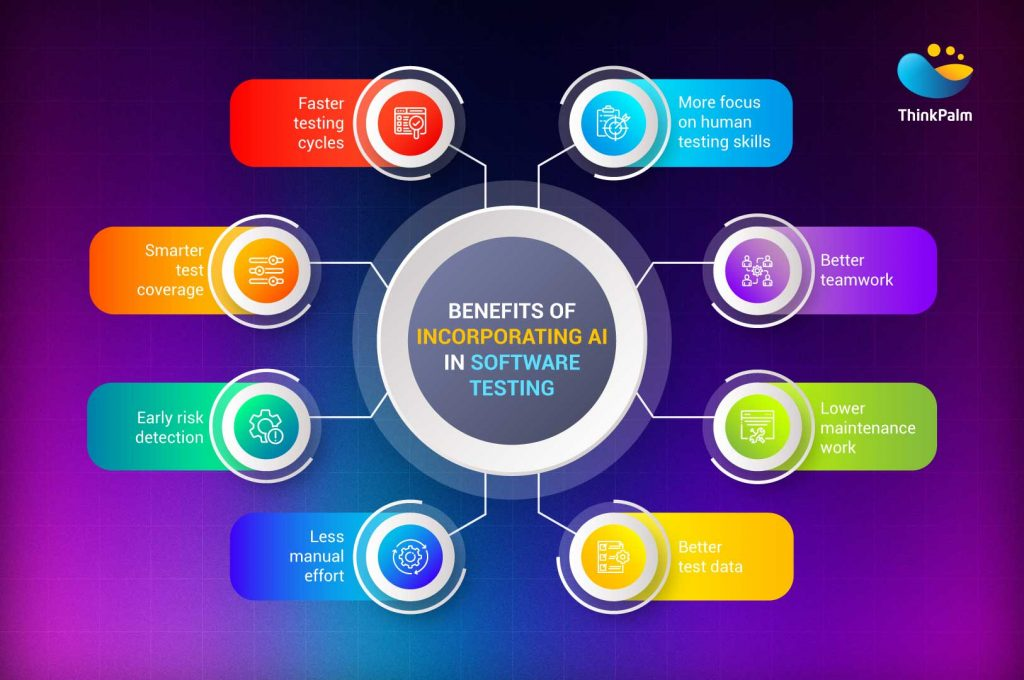
As a result, testers can automate larger portions of their regression suite in a fraction of the time.
Easier Test Maintenance
One of the biggest challenges in automation has always been maintenance.
Small UI changes frequently break traditional automation because element locators become invalid. Teams often spend more time fixing tests than creating new ones.
AI improves this process by recognizing application context instead of relying exclusively on brittle locators. Many modern platforms can automatically adapt when interface elements move, change labels, or receive updated identifiers.
This means fewer broken tests and more stable regression suites.
AI Assists Throughout the Testing Process
Automation is only one part of software testing.
AI also helps manual testers by:
- Generating test cases from requirements
- Identifying missing test coverage
- Suggesting negative test scenarios
- Detecting duplicate test cases
- Prioritizing high-risk areas
- Creating realistic test data
- Explaining failed test results
- Recommending likely root causes
These capabilities reduce repetitive work while improving overall test quality.
Learning Automation Through Practice
Rather than spending months studying automation frameworks before writing a single test, AI enables testers to learn by doing.
As they build automated tests, they naturally become familiar with concepts such as:
- Test design
- Assertions
- Data-driven testing
- Reusable test components
- Continuous testing
- Regression strategies
Over time, many testers develop a strong understanding of automation principles without first becoming expert programmers.
Collaboration Improves Across Teams
Traditional automation often created a divide between manual testers and automation engineers.
AI helps bridge that gap.
Because tests are easier to read and understand, developers, product managers, business analysts, and QA professionals can collaborate using a common language.
This improves communication, reduces misunderstandings, and allows quality to become a shared responsibility across the development team.
AI Does Not Replace Automation Knowledge
Although AI dramatically accelerates automation, it is important to maintain realistic expectations.
Experienced automation engineers still provide valuable expertise in areas such as:
- Framework architecture
- Performance optimization
- Complex integrations
- API automation
- Custom scripting
- Advanced debugging
AI makes automation far more accessible, but understanding testing principles, application behavior, and quality engineering remains essential.
Choosing the Right AI Automation Platform
Several AI-powered testing solutions are helping organizations modernize their QA processes. For example, testRigor enables teams to create automated tests using plain English, making automation more accessible to manual testers without requiring extensive programming knowledge.
When evaluating AI-based testing tools, organizations should look for capabilities such as:
- Natural language test creation
- Self-healing automation
- Cross-platform testing support
- Easy maintenance
- Integration with CI/CD pipelines
- AI-assisted test generation
- Comprehensive reporting and diagnostics
The right platform should reduce technical complexity while allowing testers to focus on delivering high-quality software.
Conclusion
The idea that manual testers must spend years becoming programmers before contributing to automation is rapidly becoming outdated.
Artificial intelligence is transforming test automation by removing many of the technical obstacles that previously limited adoption. Manual testers can now leverage the expertise they already possess, automate repetitive work more quickly, and contribute to faster software delivery.
While AI does not eliminate the need for testing knowledge or automation best practices, it significantly lowers the barrier to entry. Instead of replacing testers, AI empowers them, enabling experienced QA professionals to become productive automation contributors much faster than ever before.
As AI continues to reshape software testing and software development, staying informed about the latest advancements is becoming increasingly important. Whether you’re exploring AI-powered testing, prompt engineering, AI agents, or practical ways to apply artificial intelligence in your daily work, NeuroBits AI offers educational content, guides, and insights to help QA professionals deepen their understanding of AI and keep pace with the rapidly evolving technology landscape.


