


What is a food grade FIBC?
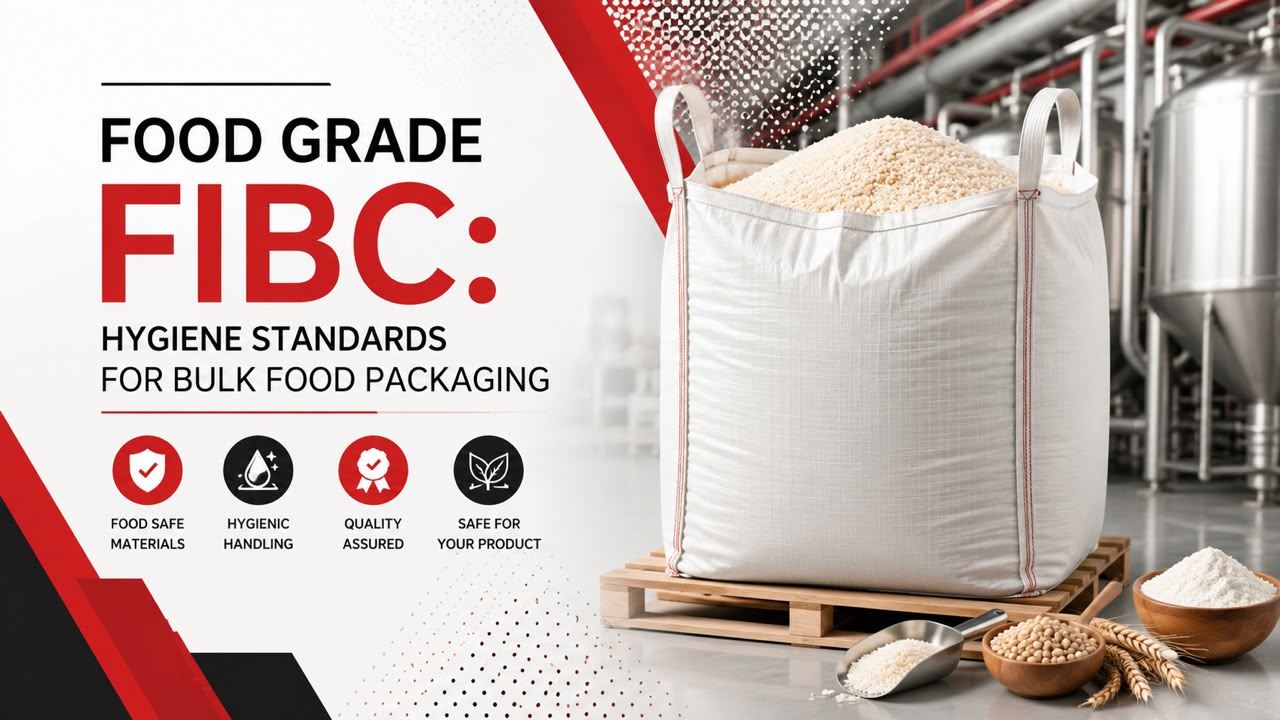
A food grade FIBC is a bulk bag produced under documented hygiene control for contact with food powders and granules. FIBC stands for flexible intermediate bulk container, the woven polypropylene big bag carrying 500 to 2,000 kg of dry product. The classification rests on Regulation (EC) No 1935/2004, the European framework rule for food contact materials. Sugar, flour, milk powder, starch and salt all move through the UK and Europe inside these bags.
Food grade and standard bags look almost identical from the outside. The difference sits in four places: the production environment, the resin, the liner and the documentation. A buyer comparing only fabric weight and safe working load sees none of them on a sample.
Which resin qualifies for food contact: virgin or recycled?
Virgin polypropylene is the default resin for food grade bulk bags because its input history is fully documented. Virgin resin arrives with a Declaration of Compliance, the supplier statement confirming that the material meets food contact law. Batch numbers on the same document link the resin back to the polymer producer. Regulation (EU) 2022/1616 allows recycled plastic in food contact only from an authorised recycling process, so unauthorised post-consumer material moves to industrial applications.
Additives carry the same obligation as the base resin. Colour masterbatch, ultraviolet stabiliser and slip agent each need food contact clearance. Migration, the transfer of substances from packaging into the product, is measured on the finished fabric rather than on the raw polymer. Testing under Regulation (EU) No 10/2011 uses food simulants, and dry bulk foods are assessed with the simulant for dry foodstuffs.
What does a 100,000 class cleanroom control?
A 100,000 class cleanroom limits airborne particles to 100,000 particles of 0.5 micron or larger per cubic foot of air. The class matches Class 8 under ISO 14644-1, the international standard for cleanroom air classification. Filtered air, positive pressure and a separate gowning entrance keep dust, insects and loose fibres out of the cutting and sewing area. Cesur has operated a 100,000 class cleanroom since 2003 and groups its food grade FIBC range under a dedicated food sector page.
Cleanroom production changes operator behaviour as much as air quality. Gowns, hairnets, gloves and shoe covers are mandatory, and personal items stay outside. Bags leave the room sealed in polyethylene film, so the clean condition survives transport and warehousing.
How do liners create a moisture and oxygen barrier?
Liners form the second hygiene layer inside a food grade bulk bag. A polyethylene inliner, the separate bag fitted inside the woven shell, keeps fine powder away from seams and stitching. Inliner thickness runs from 50 to 150 micron in tubular, bottle and baffle shapes. Glued liners hold their shape on automatic filling lines, while loose liners suit manual filling.
Barrier liners handle products that react to moisture or oxygen. Aluminium or EVOH (ethylene vinyl alcohol) layers cut oxygen transmission well below plain polyethylene and protect milk powder, whey and vitamin premixes. Moisture vapour transmission rate, the water passing through the film in 24 hours, is the figure quality managers compare between liner grades. Heat sealed spouts close the system from filling to discharge.
Standard versus food grade specification
Standard and food grade bulk bags separate across five measurable points, set out below as they appear in European food packaging audits.
| Criterion | Standard FIBC | Food grade FIBC |
| Production environment | General workshop, no air classification | Classified cleanroom, filtered air, gowning entrance |
| Material | Virgin or recycled resin, additives unrestricted | Virgin polypropylene, additives food contact cleared |
| Liner | Optional, often none | Standard inliner or aluminium and EVOH barrier |
| Documentation | Delivery note and dimensional data sheet | Declaration of Compliance, migration reports, certificate scope |
| Traceability | Order level, no lot linkage | Lot code linked to resin batch, line and shift |
Which certifications prove what?
Certifications answer different questions, so quality managers read them as a set. BRCGS Packaging Materials, the Brand Reputation Compliance Global Standards scheme for packaging, audits hygiene zoning, product safety culture and site security. HACCP (Hazard Analysis and Critical Control Points) records where a hazard enters the process and which control stops it, following Codex Alimentarius principles. ISO 9001 covers the quality management system, which proves process consistency rather than food safety itself.
ISO 21898 is the product specification for FIBCs carrying non-dangerous goods and defines the test methods behind the safe working load marking. Cesur holds BRCGS and HACCP alongside ISO 9001, ISO 14001 and ISO 50001. Certificate scope matters more than the logo: an audit checks whether the certified site and product family match the ordered item.
How do traceability and batch records work?
Traceability links every finished bag to its resin lot, its production line and its operator shift. A printed lot code on the label carries the production date and batch number. That code traces a complaint back to the extrusion run in hours instead of days. Batch records hold resin certificates, cleanroom logs, needle control sheets and metal detection results for the retention period set in the quality manual.
A supplier audit for food grade bulk packaging covers this document set:
- Declaration of Compliance for fabric, liner and sewing thread
- Migration test reports against the relevant food simulant
- BRCGS and HACCP certificates with a scope covering the ordered product
- Cleanroom air classification and routine monitoring records
- Needle control procedure and metal detection logs
- Resin batch certificates and personnel hygiene training records
Where contamination enters the process
Contamination in FIBC manufacturing enters at a small number of predictable points. Each point carries a recognised control, checked from resin intake to the loading bay.
- Resin intake: closed conveying lines and covered hoppers
- Weaving: loom oil and tape fragments, held down by cleaning schedules
- Cutting: offcuts and blade debris removed before the clean area
- Sewing: broken needle fragments, controlled by needle logs and metal detection
- Printing: outer surface only, keeping inks away from the product side
- Packing: sealed polyethylene overwrap and inspected pallets
- Loading: trailer check for odour, moisture and previous cargo
Can food grade bulk bags be stored and reused?
Food grade bulk bags carry a single trip or multi trip designation set by the safety factor. A ratio of 5:1 marks a single trip bag, and 6:1 marks a multi trip bag built for documented reuse. Food applications rarely reuse bags, because a cleaning routine for the inner surface is hard to validate. A used food bag normally moves to a non food second life or to recycling.
Storage protects the hygiene status the cleanroom created. Bags stay indoors on pallets, off the floor, with the overwrap intact until the filling line opens it. Sunlight degrades polypropylene, so covered storage preserves tensile strength. First in, first out rotation moves the oldest sealed pack first, and scented or chemical goods sit in a separate area.
Which specification fits your food application?
Food grade specification follows the sensitivity of the product rather than the size of the order. Free flowing, stable powders such as sugar and salt run on a cleanroom produced bag with a standard inliner. Moisture or oxygen sensitive powders, including milk powder and vitamin premixes, need a barrier liner and a heat sealed spout. Direct food contact points to virgin polypropylene with cleared additives.
Certificates and records decide the audit outcome. BRCGS, HACCP and ISO 9001 answer three separate questions, and a scope missing the ordered product family weakens all three. Lot level traceability then sets how quickly a complaint closes.
This content is for informational purposes only. Certificate scope, regulatory references and product specifications change over time, so current validity and food contact documentation should be confirmed with the supplier before an order is placed.
Frequently Asked Questions
What should be checked before ordering a food grade FIBC?
Four items define a food grade order: the production environment, the resin, the liner and the documentation. A classified cleanroom, virgin polypropylene and a liner matched to the product sensitivity form the technical minimum. A Declaration of Compliance covering fabric, liner and thread completes the file.
Is recycled polypropylene allowed in food contact bulk bags?
Recycled polypropylene is allowed in food contact only when it comes from an authorised recycling process under Regulation (EU) 2022/1616. Post-consumer material outside that authorisation stays out of the food chain. Recycled content remains a practical option for industrial packaging, where food contact migration limits do not apply.
What does BRCGS Packaging Materials certification cover?
BRCGS Packaging Materials audits a packaging site for hygiene zoning, product safety management, traceability, site security and staff training. It confirms that the site runs a controlled process, not that one specific bag is compliant. Certificate scope must include the ordered product family for the result to apply.
Which documents should arrive with each food grade batch?
A food grade batch travels with a Declaration of Compliance, resin batch certificates and migration test reports against the relevant food simulant. The lot code links the delivery to a single production run. Cleanroom monitoring records, needle sheets and metal detection logs stay at the plant for audit review.
Can a food grade bulk bag be used more than once?
A multi trip bag with a 6:1 safety factor is built for reuse, yet food applications treat most bags as single trip. Validating a cleaning method for the inner surface is difficult, and residue from the first fill creates an allergen risk. Used food bags usually move to non food handling or recycling.


