

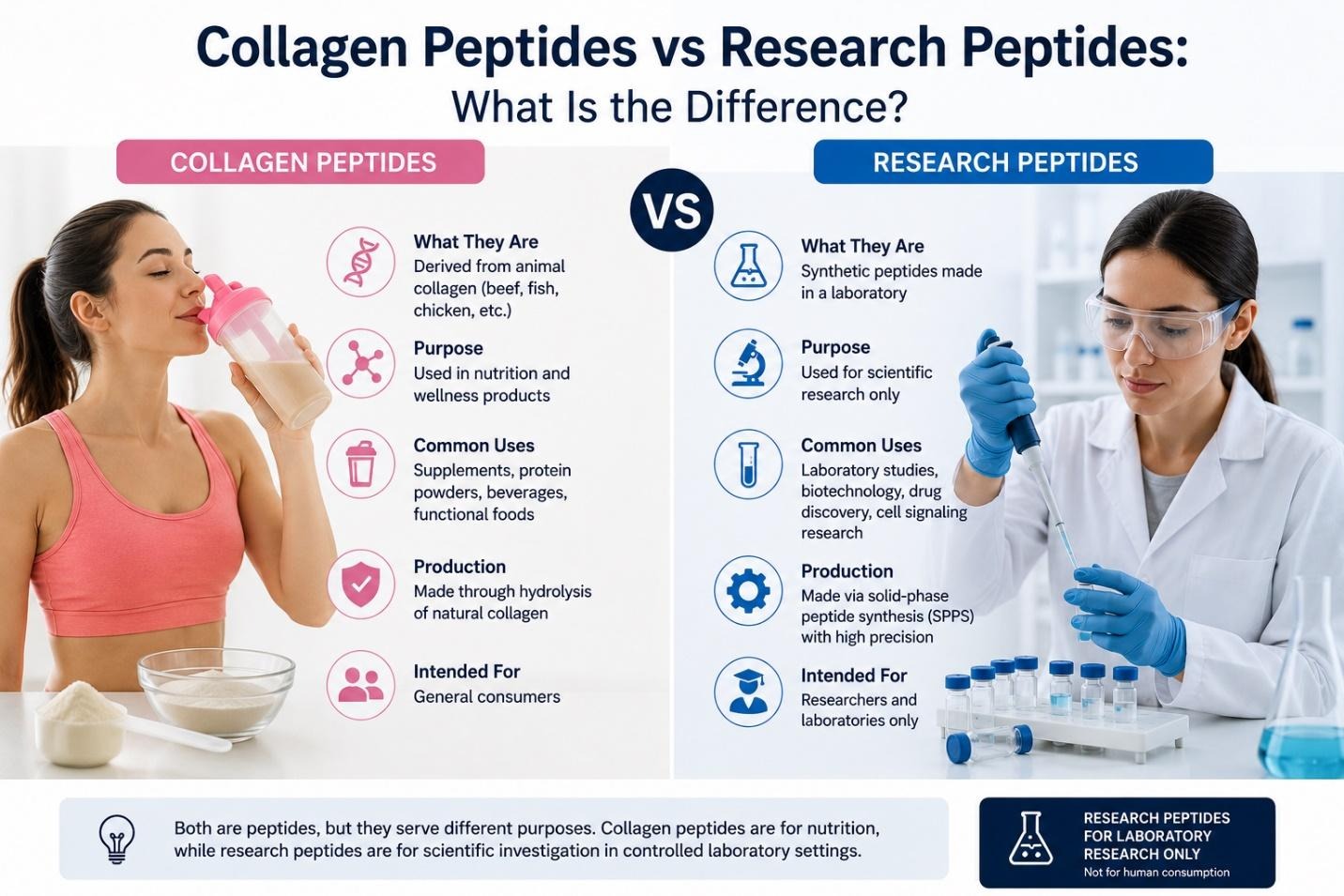

Peptides have become a popular topic across both the wellness and scientific communities. However, the word “peptides” is often used to describe two very different categories of products: collagen peptides and research peptides. Although they share a similar name and are both made up of amino acids, their purpose, production methods, and applications are entirely different.
Understanding these differences is important for anyone exploring peptide science, whether you’re interested in nutrition, biotechnology, or laboratory research. Core Power Peptides is committed to supporting scientific education by providing high-quality research peptides for laboratory use and reliable information for the research community.
In this article, we’ll compare collagen peptides and research peptides, explain how each is produced, and discuss their distinct roles.
What Are Peptides?
Peptides are short chains of amino acids connected by peptide bonds. They are smaller than proteins and naturally occur throughout the body, where they participate in numerous biological processes such as cell signaling, hormone regulation, and enzyme activity.
Scientists also manufacture peptides in laboratories for research purposes. While all peptides share a similar chemical foundation, not all peptides are created or used in the same way.
The two most commonly discussed categories are collagen peptides and research peptides.
What Are Collagen Peptides?
Collagen peptides are small protein fragments produced by breaking down collagen, the most abundant structural protein found in the human body.
Collagen is naturally present in:
- Skin
- Bones
- Tendons
- Cartilage
- Ligaments
- Connective tissues
Manufacturers produce collagen peptides through a process called hydrolysis, which breaks large collagen molecules into smaller peptide chains.
Because these peptides dissolve easily in liquids, collagen peptide products are widely available in powders, beverages, and nutritional supplements.
Common Characteristics of Collagen Peptides
Collagen peptides are generally:
- Derived from animal collagen
- Produced through enzymatic hydrolysis
- Easily soluble in water
- Commonly used in food and nutrition products
- Available as dietary supplements in many countries
Their production focuses on nutritional applications rather than scientific experimentation.
What Are Research Peptides?
Research peptides are laboratory-manufactured peptide compounds created for scientific investigation.
Unlike collagen peptides, research peptides are synthesized with precise amino acid sequences designed to support controlled laboratory studies.
Researchers use these peptides to investigate biological pathways, molecular interactions, receptor activity, and cellular processes.
Research peptides are commonly studied in fields such as:
- Molecular biology
- Biotechnology
- Cell signaling
- Endocrinology
- Pharmacology
- Neuroscience
- Regenerative medicine
These products are manufactured specifically for laboratory environments and are not intended for nutritional use.
How Research Peptides Are Manufactured
Modern research peptides are typically produced using solid-phase peptide synthesis (SPPS).
This highly controlled manufacturing process allows scientists to:
- Create precise amino acid sequences
- Achieve high purity levels
- Maintain batch consistency
- Produce custom peptide structures
- Scale production for laboratory needs
After synthesis, peptides undergo purification and analytical testing to verify identity and quality before distribution to research laboratories.
Key Differences Between Collagen Peptides and Research Peptides
Although both consist of amino acids, they differ significantly in their intended use.
| Feature | Collagen Peptides | Research Peptides |
|---|---|---|
| Primary Purpose | Nutritional products | Scientific research |
| Production Method | Collagen hydrolysis | Laboratory synthesis |
| Source | Animal collagen | Synthetic manufacturing |
| Users | Consumers and food industry | Researchers and laboratories |
| Applications | Food and nutrition | Biotechnology and laboratory studies |
| Customization | Limited | Highly customizable |
| Manufacturing Precision | Moderate | Very high |
These distinctions highlight why the two categories should not be confused.
Differences in Manufacturing Standards
The manufacturing process is another important distinction.
Collagen peptide production focuses on producing nutritional ingredients suitable for food applications.
Research peptide manufacturing emphasizes:
- High purity
- Analytical verification
- Batch consistency
- Scientific quality standards
- Laboratory-grade production
Because research experiments require consistent materials, manufacturers often apply more rigorous quality control procedures throughout production.
Why Purity Matters for Research Peptides
In laboratory research, product purity directly influences experimental reliability.
Impurities may interfere with biological studies, making results more difficult to reproduce.
For this reason, researchers often select peptide suppliers that provide:
- High-purity products
- Batch consistency
- Certificates of Analysis (COAs)
- Independent laboratory testing
- Transparent quality documentation
These quality measures help support reproducible scientific investigations.
Applications of Collagen Peptides
Collagen peptides are commonly incorporated into products within the nutrition and food industries.
Examples include:
- Protein powders
- Functional beverages
- Nutritional supplements
- Health foods
- Sports nutrition products
Their primary role is nutritional rather than experimental.
Applications of Research Peptides
Research peptides are used exclusively within controlled scientific environments.
Laboratories may study research peptides in investigations involving:
- Cellular communication
- Hormone signaling
- Protein interactions
- Molecular biology
- Drug discovery
- Biotechnology
- Regenerative medicine research
These products help scientists better understand complex biological systems through carefully designed laboratory experiments.
Choosing the Right Product
Understanding the intended purpose of each peptide category is essential.
Researchers conducting laboratory investigations require research-grade peptides manufactured according to rigorous scientific standards.
Individuals seeking nutritional protein products may encounter collagen peptides within food or supplement markets.
Although both products contain amino acids, they serve completely different scientific and commercial purposes.
Choosing a Trusted Research Peptide Supplier
For laboratories using research peptides, supplier selection plays a critical role in research quality.
Experienced researchers often evaluate suppliers based on:
- High product purity
- Consistent manufacturing
- Transparent quality control
- Third-party testing
- Certificates of Analysis
- Reliable customer support
- Secure packaging and storage
Working with a supplier committed to scientific quality helps researchers obtain dependable materials for their investigations.
Conclusion
Collagen peptides and research peptides may sound similar, but they are designed for entirely different purposes.
Collagen peptides are produced from natural collagen and are commonly used in nutritional and food products. Research peptides, on the other hand, are carefully synthesized in laboratories to support scientific investigations across biotechnology, molecular biology, pharmacology, and many other research disciplines.
Understanding these differences allows researchers, educators, and consumers to make informed decisions based on the intended application of each product. As peptide science continues advancing, both collagen peptides and research peptides will remain valuable within their respective fields, each contributing to innovation in its own way.
Disclaimer: Research peptides are intended for laboratory research purposes only. They are not intended for human consumption, veterinary use, diagnosis, treatment, cure, or prevention of any disease. All laboratory work should be conducted by qualified professionals in accordance with applicable laws and safety guidelines.


