

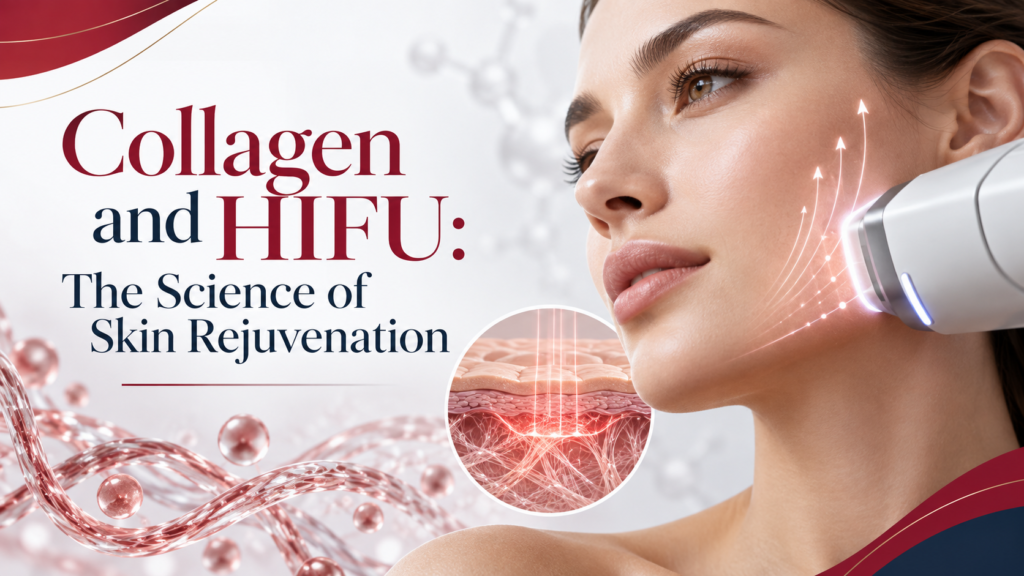

The firmness of youthful skin comes down to one protein: collagen. It forms the scaffolding of the dermis, and when that scaffolding thins and loosens, the face begins to look softer and less defined. High-intensity focused ultrasound, usually shortened to HIFU, has become a common non-surgical answer to that problem because it works on the collagen layer directly rather than on the surface of the skin.
Many of the facial rejuvenation devices now sold for at-home and clinic use rely on this same principle: deliver controlled heat to the deeper support tissue and let the body rebuild its own collagen in response. Understanding how that rebuilding happens explains why the firming effect of HIFU is gradual rather than immediate, and why the results depend so much on the starting condition of the skin.
What collagen does, and why skin loosens
Collagen is the most abundant structural protein in the body, and more than ninety percent of it is type I and type III. In the skin, type I collagen dominates the dermis and gives it tensile strength, while elastin lets the tissue recoil after it is stretched. Both are produced by fibroblasts, the working cells of the dermis.
With age, this system shifts in two directions at once. Fibroblasts produce less new collagen, and enzymes that break collagen down become more active, a process accelerated by ultraviolet exposure. The net result is a slow loss of density in the dermis and in the deeper fibrous support layer beneath it. Skin that once held its shape starts to sag, fine lines deepen, and the jawline and cheeks lose definition. HIFU is designed to intervene in exactly this layer.
How focused ultrasound reaches the deep support layer
Ultrasound is sound energy above the range of human hearing. When a focused beam passes through tissue, most of it travels harmlessly, but at the precise point where the beam converges, the mechanical energy converts to heat. That is the core trick of HIFU: it concentrates energy at a chosen depth below the surface while leaving the outer skin, the epidermis, essentially untouched.
At the focal point, tissue temperature rises sharply. Research on focused ultrasound shows that tissue heated above sixty degrees Celsius for even a second is irreversibly altered, and focal temperatures in this range denature collagen at that spot. Rather than heating a broad area, the device creates small, separated zones of controlled thermal change, often called thermal coagulation points, arranged in a grid beneath the skin.
Aesthetic systems place these points at set depths. A deeper focus, on the order of several millimeters, targets the fibrous support layer and deep dermis, while shallower settings work within the dermis itself. This layered targeting is why microfocused ultrasound is used for lifting rather than only for surface texture: it can act on the same deep tissue that a surgeon addresses in a facelift, without an incision.
From controlled heat to new collagen
The immediate effect of that focal heat is contraction. Collagen fibers tighten when they are heated to the denaturation threshold, which produces a small, early firming that some people notice soon after treatment. The more important effect, though, is what the heat sets in motion.
Each thermal coagulation point is treated by the body as a tiny injury. This triggers the ordinary wound-healing response: an inflammatory phase, then activation of fibroblasts, then a rebuilding phase in which those cells lay down fresh collagen and elastin. The new collagen is remodeled over time, with type III collagen laid down early in healing and type I collagen accumulating as the tissue matures. The practical outcome is a denser, better-organized support layer than the skin had before.
This is the reason HIFU firming builds slowly. Collagen synthesis is a biological process that unfolds over weeks, and it depends on healthy fibroblasts and adequate nutrients, including vitamin C, which the body needs to build stable collagen. There is no way to rush the remodeling; the skin firms as the new tissue forms and reorganizes.
What the firming timeline actually looks like
Most people see the clearest change over the first two to three months after a session, as the newly formed collagen matures. Some continued improvement can appear beyond that as remodeling completes. Because the effect relies on the body renewing its own collagen, a person with more active fibroblasts and less severe laxity tends to respond better than someone with heavily sun-damaged or very lax skin.
The realistic result is a modest lift and tightening, not a dramatic transformation. HIFU can sharpen a softening jawline, lift the brow slightly, and firm the neck and under-chin area, and these are the regions where focused ultrasound lifting has been most studied and cleared for use. It does not remove significant excess skin, and it is not a substitute for surgery when sagging is advanced.
Who is a good candidate, and who is not
The best candidates have mild to moderate skin laxity and want a non-invasive option with little downtime. People with early jowls, a slightly heavy brow, or loosening along the neck often see worthwhile firming. Those with substantial sagging, deep folds, or a large amount of loose skin are more likely to be disappointed, because the technique tightens existing tissue rather than removing surplus.
- Well suited: early to moderate laxity, defined goals, willingness to wait for gradual change.
- Less suited: advanced sagging, very thin or heavily photodamaged skin, or an expectation of surgical-level results.
Because this is a medical procedure that affects living tissue, an assessment by a qualified practitioner matters. Treatment settings, the depth used, and the number of passes should be matched to the individual, and expectations should be discussed honestly before any session.
What to expect during and after treatment
Treatment is typically done in a single session per area, though some plans repeat it. During the procedure many people feel brief heat or a prickling sensation at each point, which reflects the energy reaching the target depth. Afterward the skin may look flushed and feel slightly swollen or tender, and these effects usually settle within hours to a few days.
Less common effects include temporary bruising, small areas of numbness, or short-lived nerve irritation, which is why placement and settings should be handled by someone trained in the device. Serious complications are uncommon when the procedure is performed correctly, but no energy-based treatment is entirely without risk, and results vary from person to person.
The takeaway on collagen and HIFU
HIFU works because it speaks the skin’s own language. Instead of filling or resurfacing, it prompts the deep support layer to rebuild the collagen it has been steadily losing. That mechanism explains both its appeal and its limits: the firming is real and comes from the body’s own tissue, but it is gradual, moderate, and best suited to skin that still has the biological capacity to respond.


