


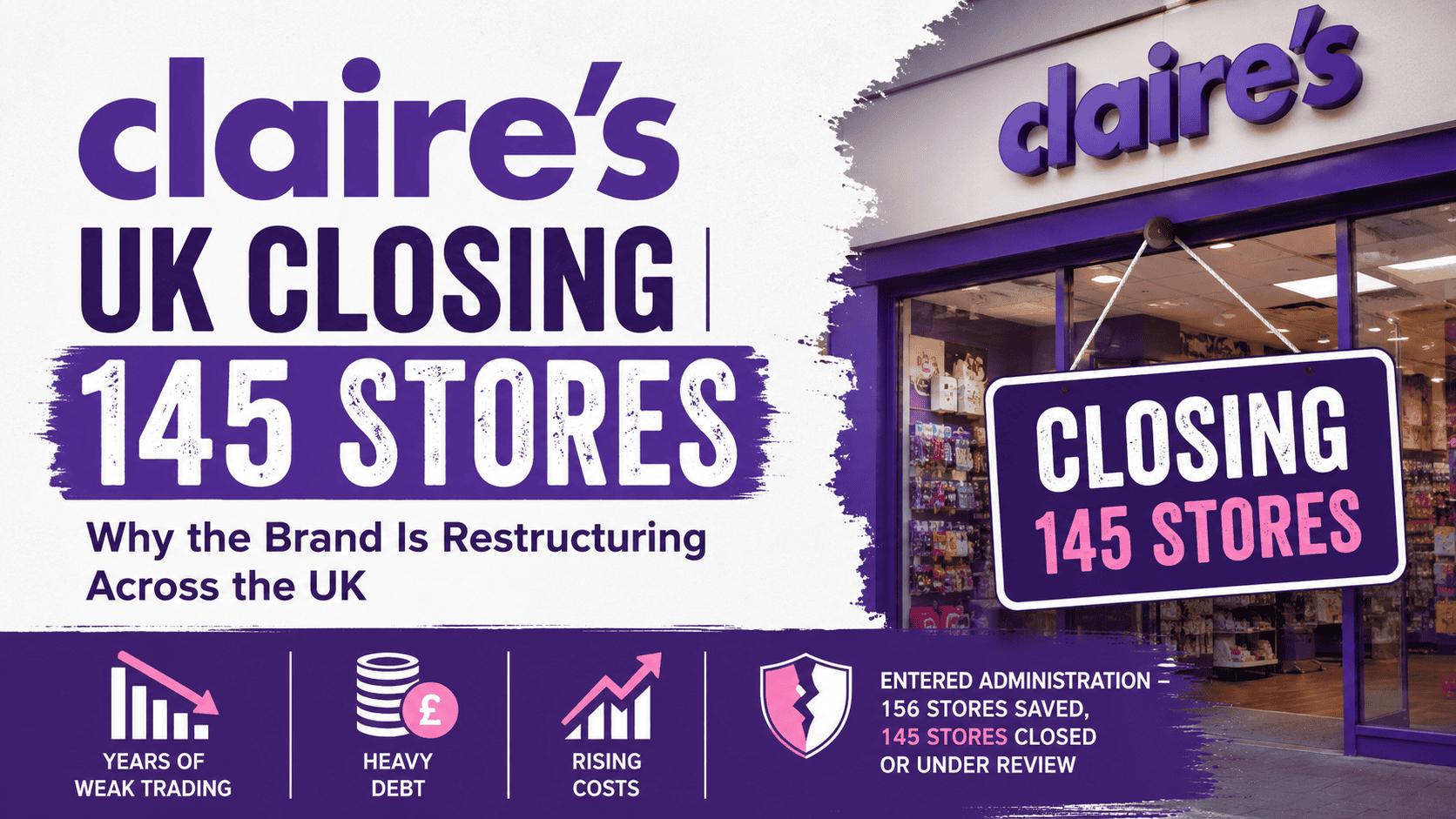
Claire’s UK is restructuring because the business entered administration after years of weak trading, heavy debt, and rising costs. A rescue deal saved 156 stores, but 145 stores were left outside the sale and are being closed or reviewed by the administrators.
Claire’s UK entered administration first
Claire’s Accessories UK Ltd entered administration on 13 August 2025, after its U.S. parent company, Claire’s Holdings LLC, began Chapter 11 proceedings in the United States. At that point, the UK and Ireland business operated 306 stores and more than 2,150 jobs were at risk. Interpath was appointed as joint administrator and said stores would keep trading while it looked for a buyer or other solution. Online orders were suspended during the process.
Another example of retail change in the UK includes Partridges, where the closure of its store near royal shopping areas created attention due to its long-standing connection with traditional British retail culture.
Why Claire’s UK needed restructuring
The main reasons were clear. Reuters reported that Claire’s had about $690 million in debt and had been hit by increased competition, high rent costs, and tariffs on imports from countries such as China, Thailand, and Vietnam. Those pressures weakened cash flow and made it harder for the company to support a large store estate across the UK and Ireland.
Claire’s also faced a harder retail market. The brand sells fashion jewellery, accessories, and ear piercing services, but that business model depends on steady footfall in shopping centres and busy high street locations. When stores are costly to run and customer traffic softens, a chain with many physical shops can become difficult to support. Reuters and Interpath both showed that the company was searching for a way to preserve the brand while cutting back on the parts of the business that no longer worked.
What the rescue deal changed
On 29 September 2025, Modella Capital agreed to buy 156 Claire’s stores in the UK and Ireland from Interpath. The deal protected about 1,000 jobs and gave the brand a new owner for a large part of its retail estate. Interpath said the 145 stores not included in the transaction would remain open for the time being while it assessed the next steps.
That meant the restructuring was not a simple full rescue. It was a split outcome. One part of the business moved to a new owner, while the rest stayed with the administrators. For staff, landlords, suppliers, and customers, that created two different paths. Some stores had a future under the new deal. The rest faced closure, further review, or a more limited wind down.
Why 145 stores were left out
The 145 stores were left out because the rescue deal only covered part of the estate. Interpath did not say that every remaining store was immediately unsalvageable. Instead, it said those stores were not included in the transaction and would continue to trade while options were reviewed. That is a normal step in administration when a buyer only wants part of a company. The administrator then tries to work out whether the leftover stores can still be sold, restructured, or closed in an orderly way.
The split also reflects the value of different store locations. Some Claire’s shops may have had stronger sales, better lease terms, or more strategic locations. Others may have been losing money or had rents that no longer matched their trading levels. In a retail rescue, the buyer often takes the stores that fit the new plan and leaves the weaker sites behind. That appears to be what happened here. This is an inference based on how the deal was structured and on the company’s reported financial strain.
What happened to customers and store operations
When Claire’s UK went into administration, the stores stayed open while the administrators reviewed the business. Customers could still shop in stores, but online orders were paused. Interpath said it wanted to keep the business running as a going concern for as long as possible while it looked for a future for the brand. That approach is designed to protect value, keep staff working for longer, and give the company a better chance of finding a buyer for some or all of the business.
After the rescue deal, the 156 stores sold to Modella Capital moved into a new ownership structure. The 145 stores outside that deal stayed with the administrators. According to Interpath, those stores were still open after the sale announcement while further options were considered.
The numbers behind the restructuring
Claire’s UK restructuring can be understood through a few key figures.
| Item | Number | What it means |
|---|---|---|
| UK and Ireland stores at administration | 306 | Size of the business before the rescue process began |
| Jobs at risk in August 2025 | 2,150+ | Scale of the workforce exposed to the administration |
| Stores sold to Modella Capital | 156 | Part of the chain rescued in the September deal |
| Stores left out of the sale | 145 | Remaining stores that were not part of the transaction |
Why the brand still matters in the UK
Claire’s remains a well known name in youth accessories and ear piercing. Interpath described it as one of the UK’s most recognisable retail brands, and Claire’s own corporate site says it serves customers across a large global store network. That brand strength is one reason investors were willing to step in, even though the business needed a major reset.
The UK restructuring shows a common pattern in retail. A strong brand does not always mean a strong store base. When debt is high, rents are heavy, and competition is intense, a retailer can still struggle even if customers know the name. In that situation, the business often has to shrink, sell off part of the estate, and focus on the stores that can still make money. That is the position Claire’s UK reached in 2025.
Why this happened across the UK
The restructuring happened across the UK because the business was too large for its financial position. Claire’s had 306 stores across the UK and Ireland when it entered administration, but only 156 stores were taken in the rescue deal. The rest were left outside the sale. That gap shows that the company needed a smaller and more selective store base to continue trading.
The wider pressure was not only local. Claire’s U.S. parent had already filed for bankruptcy protection, which added more strain to the international business. Reuters reported that the American business also faced debt pressure and weak trading, and later sold its North American operations to Ames Watson. That broader collapse made a UK rescue more complicated and increased the need to split the estate into separate pieces.
What the restructuring means for the remaining stores
For the 145 stores left out of the rescue, the future depends on whether they can be sold, kept open under new terms, or closed in an orderly way. Interpath said it would continue to assess options for those sites. The most likely next step in cases like this is a review of leases, trading performance, and buyer interest. If a store cannot be kept viable, closure becomes the final option.
The restructuring also affects landlords and suppliers. Stores that are not profitable can be costly to keep open, especially when rent levels are high. Administrators usually try to reduce those losses fast, which is why store closures often follow shortly after an administration process begins. In Claire’s case, the store sale to Modella handled one part of the estate, but it did not remove the need to deal with the remaining sites.
How Claire’s UK fits into the wider retail market
Claire’s UK is part of a wider trend in British retail. Chains with many physical stores have been under pressure from online shopping, higher running costs, and weaker footfall in shopping areas. Claire’s had the added challenge of a very specific model built around accessories and ear piercing, which depends on customer visits and repeated store use. When that model slows, a large store network becomes harder to support.
The Claire’s case also shows how rescue deals often work in modern retail. A buyer may step in to save part of the chain, protect some jobs, and keep the brand alive, but the full business may still shrink sharply. That is what happened here. The 156 store deal kept a large part of the brand in play, but the remaining 145 stores were left to be handled separately.
Poundland also faced a similar retail adjustment in the UK, where the brand moved forward with a restructuring plan that included store closures and cost cuts across underperforming locations.


