



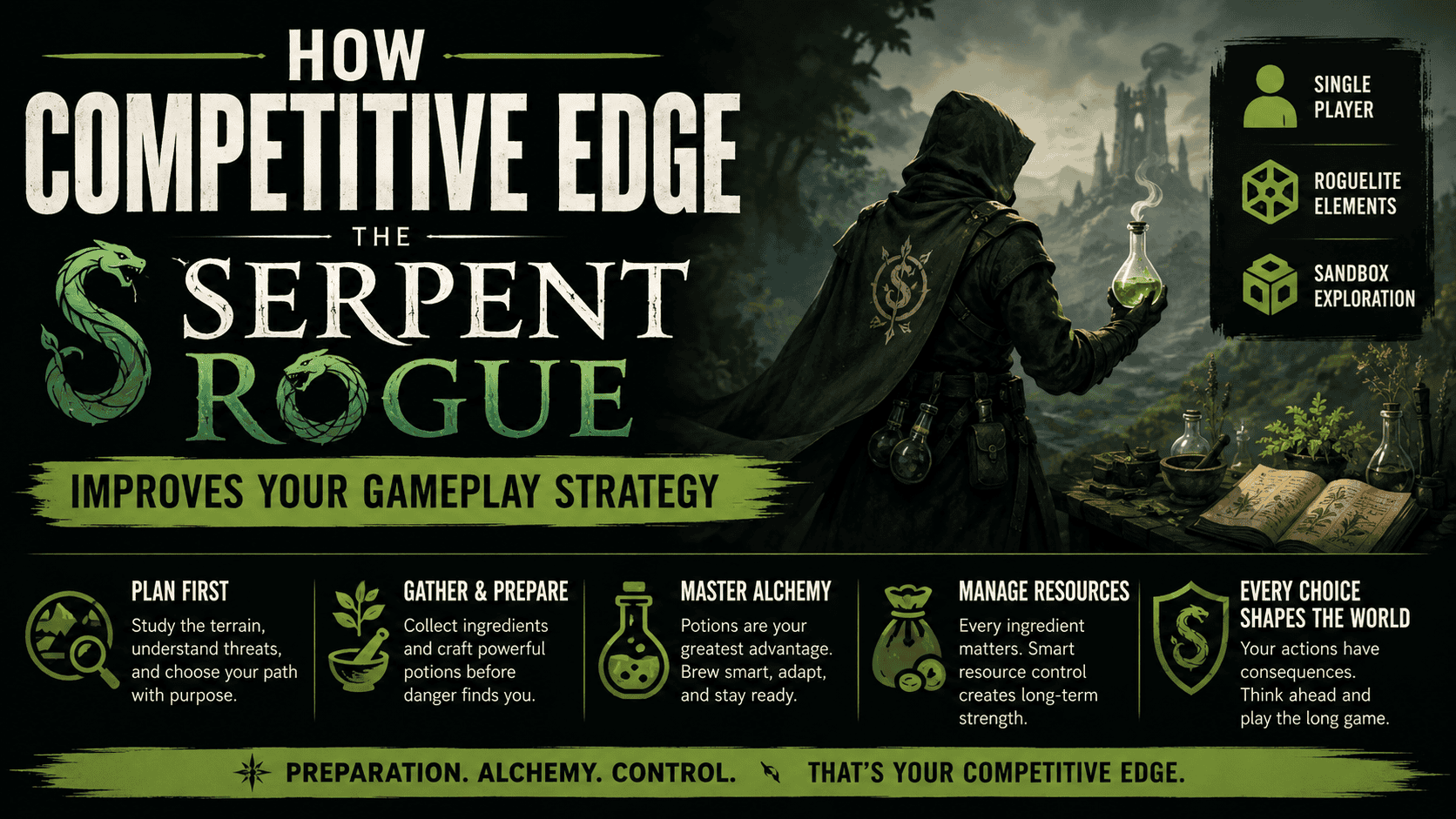
Competitive Edge in The Serpent Rogue comes from planning, alchemy, and careful resource control. The game rewards players who treat every move as part of a bigger strategy.
Competitive Edge Starts With the Game’s Core Loop
The Serpent Rogue is built as a botanical action adventure with alchemy, exploration, and creature taming at its center. It is also listed as a single player game with roguelite elements and sandbox style play, so the strongest approach is not fast reactions alone. It is steady decision making. Players gain an edge by understanding that the game is designed around preparation, item use, and the way each action changes the world.
That core loop changes how strategy works. Instead of moving straight into combat, a smart player first studies the terrain, gathers ingredients, and builds useful potions. The official game description makes it clear that the Warden protects the realm by crafting, brewing, boiling, and concocting potions. That means the player who masters preparation will usually have more control than the player who only reacts after danger appears.
Alchemy Decides Most Outcomes
Alchemy is the main strategic tool in The Serpent Rogue. Team17 describes the game as a potion crafting ARPG where players research, combine, and craft potions for use in battle. Steam also says players can craft and experiment with different ingredients to create potions with unique effects. This means the real advantage comes from knowing which ingredients matter and how those ingredients affect a plan.
A strong player uses alchemy for more than damage. The official description says potions can be swallowed to transform the character, used on the environment, or used against enemies. That creates several strategic layers. One potion may help with movement. Another may change the body. Another may support a fight. Competitive play here means choosing the right potion for the right problem instead of wasting rare materials on random experiments.
The best strategy is to research before mixing. Team17 specifically mentions researching ingredient properties. That detail matters because it shows the game rewards knowledge, not guesswork. A player who learns ingredient behavior can build safer routes, stronger combat options, and better support tools. In practice, this reduces waste and makes each run more efficient.
Players who want a deeper breakdown of mechanics, potion systems, and tactical planning can also read our detailed guide on Theserpentrogue Competitive Edge for more advanced gameplay tips.
Exploration Builds a Stronger Route
Exploration is not only for finding the map. It is part of the power system. Steam says players should explore every inch of the map, unearth secret passages, and expand their knowledge. Team17 adds that ingredients can be scavenged from forests, swamplands, and wastelands, and that random loot drops may contain rare materials. This makes route planning one of the clearest ways to improve gameplay strategy.
A player with competitive edge does not move through the world without purpose. Each area can be treated as a supply source. Forests, swamplands, and wastelands are not just scenery. They are places where useful ingredients can be found. Rare materials from loot drops can also change what is possible in later fights. The more deliberately a player explores, the more likely it is that later decisions will have strong options behind them.
Exploration also supports long term safety. Steam says quests from inhabitants of the cursed land provide resources for future progress. That means movement across the map is tied to practical gains, not just story progress. The player who balances route choice, side tasks, and material gathering will usually enter dangerous areas with better preparation than a player who rushes forward.
If you enjoy comparing different survival strategies and environments, you may also like our guide to Compare Corbett and Ranthambore, which explains how planning and terrain awareness affect decision making.
Creature Management Changes Risk
Creature handling is a major part of strategy in The Serpent Rogue. The official pages say players can tame wild beasts, tame and befriend creatures, and recruit companions for scavenging and combat. This turns creature management into a strategic layer, not just a support feature. The player who uses creatures well can gather more resources and handle fights more efficiently.
Team17 also explains that companions can range from chickens to wolves and even stronger beings. That variety matters because it suggests different creatures can support different goals. Some may help with scouting or gathering. Others may be more useful in combat. A competitive approach means choosing companions based on the task, not only on preference.
Creature control also helps reduce pressure in difficult areas. Since the game includes enemies that require skill and strategy to outsmart, allies can help shape safer encounters. The better a player understands when to travel alone and when to bring companions, the stronger the overall strategy becomes. In a game built on preparation and consequences, creature choice is part of the battle plan.
Cause and Effect Must Guide Every Move
One of the most important strategic ideas in The Serpent Rogue is cause and effect. Steam states that every action creates interesting sequences of cause and effect. It gives clear examples. Too many creatures in one place can attract reapers. Unburied bodies can attract corpse eating ghouls. Too many items in one location can attract plague spreading vermin. These are not small details. They define how the game punishes careless play.
This means competitive edge comes from good habits. A player who keeps track of creature density, body disposal, and item storage will avoid unnecessary danger. A player who ignores those systems may create extra enemies without meaning to. The strategy lesson is simple. In The Serpent Rogue, the safest path is often the most organized one.
This also changes how players should think about risk. A strong run is not only about winning fights. It is about avoiding the conditions that create avoidable fights. Because the game responds to player behavior, small decisions have large effects. That makes planning more valuable than speed. It also makes awareness one of the most useful skills in the game.
Combat Works Best as a Planning Problem
The Serpent Rogue is not framed as a simple action game. Team17 describes it as an ARPG with roguelite elements, and Steam says some enemies can be outrun while others require skill and strategy to outsmart. That tells players that combat is not meant to be solved by force alone. The better approach is to prepare the field before the fight begins.
Potion use is central here. Because potions can alter the body, affect the environment, or damage enemies, combat strategy should start before contact with an enemy. A player can enter a fight with the right transformation, the right support item, and the right escape option. That is how alchemy improves gameplay strategy. It widens the number of safe answers in a dangerous moment.
The game also encourages flexible play. Team17 says players can combine ingredients, synergize potions, and conquer enemies in any way they wish, while also being vigilant about consequences. This gives a clear competitive lesson. The best combat plan is flexible but controlled. It should give room for adaptation without creating chaos in the world state.
Resource Control Creates Safety
Resources decide how far a player can push. Steam says quests can earn resources to further progress, while Team17 says rare materials may come from loot drops and ingredients can be scavenged from multiple environments. The player who manages these resources carefully will always have more room to adapt. That is the real competitive edge in this game.
Good resource control starts with storage discipline. Since hoarding too many items in one location can attract vermin, organization has direct gameplay value. The safest strategy is to keep supplies spread in a controlled way and to avoid creating conditions that trigger new threats. This is a rare case where inventory management is not boring background work. It is part of survival.
Material control also affects experimentation. Because the game rewards research and combination, players need enough resources to test ideas without collapsing their supply chain. That is why gathering, storage, and potion planning belong together. A better strategy is not just finding materials. It is making sure those materials are available when the next challenge appears.
Practical Strategy Habits That Improve Performance
The strongest gameplay habits in The Serpent Rogue are simple. Learn ingredient properties before mixing. Explore every area with a purpose. Keep creature numbers under control. Remove bodies quickly. Avoid crowding items in one place. Use potions for more than combat. These habits follow directly from the game’s official systems and they help a player reduce risk while increasing options.
The official design supports this style of play from the start. The world is built around alchemy, taming creatures, scavenging, and reacting to consequences. Because of that, the player who stays organized will usually perform better than the player who acts randomly. In simple terms, competitive edge in The Serpent Rogue comes from knowing how the game changes when you act, then using that knowledge to stay one step ahead.