

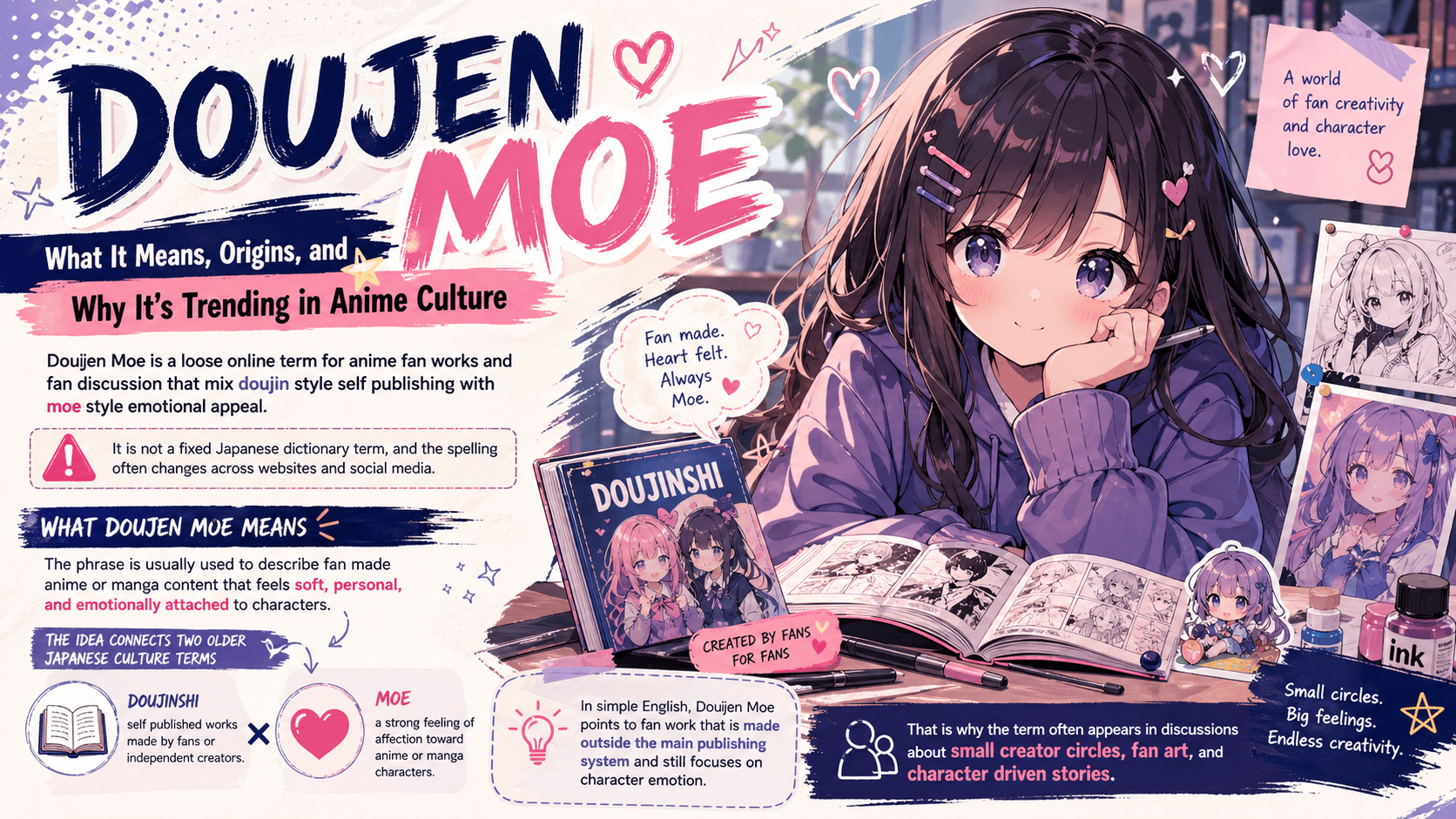

Doujen Moe is a loose online term for anime fan works and fan discussion that mix doujin style self publishing with moe style emotional appeal. It is not a fixed Japanese dictionary term, and the spelling often changes across websites and social media.
What Doujen Moe Means
The phrase is usually used to describe fan made anime or manga content that feels soft, personal, and emotionally attached to characters. The idea connects two older Japanese culture terms. Doujinshi means self published works made by fans or independent creators, while moe refers to a strong feeling of affection toward anime or manga characters.
In simple English, Doujen Moe points to fan work that is made outside the main publishing system and still focuses on character emotion. That is why the term often appears in discussions about small creator circles, fan art, and character driven stories.
Main Terms Behind the Phrase
| Term | Simple meaning | Why it matters |
|---|---|---|
| Doujinshi | Self published comics and related fan works | It shows the independent side of the culture |
| Moe | Strong affection for anime or manga characters | It shows the emotional side of the culture |
| Doujen Moe | A loose combined online phrase | It points to fan works that mix both ideas |
Doujinshi has a long history in Japan. Britannica says fans of Space Battleship Yamato created self published comics to exchange drawings and ideas, and it also notes that Comic Market, or Comiket, opened in 1975 as a marketplace for doujinshi.
Moe has also been widely discussed in anime studies. Cambridge sources describe it as an affective response to fictional characters, and the word became popular in Japanese fan spaces in the early 1990s.
Where The Idea Comes From
The roots of the phrase come from two separate parts of fan culture. Doujinshi grew from fan publishing, especially among anime and manga fans who wanted to create their own stories and drawings. Moe grew from the language of fan affection, where people used the word to describe strong emotional attraction to fictional characters.
Over time, these two ideas started to overlap in online spaces. Fans began using the language of moe to describe characters in self published works, and they used doujinshi to describe the works themselves. That overlap is what makes Doujen Moe easy to understand even if it is not a formal term.
The spelling also shifts a lot. Search results show Doujen Moe, Doujin Moe, Dojen Moe, and similar forms in recent blog posts and social pages. That variation suggests the phrase is spreading online as a loose label rather than as a fixed standard term.
How Doujen Moe Fits Anime Culture
Anime culture often grows through fan made activity, not only through major studios and publishers. Britannica notes that doujinshi helped build fan communities around anime, and Cambridge sources show that moe shaped the way fans talk about fictional characters. Doujen Moe sits in the middle of those two traditions.
This matters because many anime fans do more than watch shows. They draw characters, write side stories, remix scenes, and share their work in small communities. Doujen Moe is a useful phrase for that kind of creative fan behavior because it combines independent creation with emotional character appeal.
The phrase also fits the wider history of otaku culture. Britannica explains that otaku culture developed around manga and anime fandom, and that doujinshi and Comiket played a major role in that growth. So when people use Doujen Moe, they are usually talking about a part of anime culture that values fan creation and shared taste.
If you are interested in how users manage multiple identities and apps in digital spaces, Parallel Space Akun Berganda explains the tools and behavior behind multi account usage.
Why It Is Trending Online
Doujen Moe is trending mainly because online fan culture moves fast. Recent search results show new blog posts in 2025 and 2026 using the phrase, and social pages also surface it in popular searches. That kind of repeated online use helps a niche term spread much faster than before.
Another reason is search behavior. People often look for short, simple labels when they want to understand a fan trend, and Doujen Moe sounds like a clear category even when the term is not official. That makes it easy for writers and social creators to reuse it in headlines, tags, and summary posts. This is an inference from the repeated use of the phrase across recent web pages and social search results.
The term also spreads well because it blends two familiar ideas. Doujinshi already has a strong place in anime fan history, and moe is already a known word in anime discussion. When a phrase joins two familiar ideas, readers often accept it quickly, even if the exact wording is new.
For readers exploring niche online trends and unique names, you can also check out Christina Kebbit Monkfish, a topic that highlights how unusual terms gain attention across digital platforms.
Common Ways People Use The Term
People usually use Doujen Moe in a few broad ways. They may use it for fan drawn manga, for character focused fan art, or for works that aim for a soft emotional tone instead of a loud action style. Recent blogs describing the phrase use it in that general sense, even though the exact wording differs from site to site.
It can also show up as a tag for online content about anime characters, fan communities, and creative sharing. A GitHub topic using the phrase has existed since 2018, which shows that the term has circulated online for several years, not only in 2026.
How It Differs From Standard Anime Terms
Doujen Moe should not be treated as the same thing as mainstream anime production. It is closer to fan driven culture than to studio led content. Doujinshi refers to self published works, while moe refers to a feeling toward characters. Doujen Moe is the blended online phrase that tries to capture both at once.
That difference matters for clear writing. If a reader wants the formal Japanese term, doujinshi is the safer choice. If a reader wants the emotion related term, moe is the safer choice. Doujen Moe is best understood as an informal combined label used in online anime culture.
Why Readers Search For It
Many people search for Doujen Moe because the phrase sounds like a real cultural category and often appears beside anime art, fan manga, and character based posts. Search results show that readers are finding it through blogs, Instagram pages, and trend style articles, which makes the phrase feel more common than it may be in formal writing.
Some readers also search for it because they have seen different spellings. Since the phrase is not standardized, one site may write Doujen Moe, another may write Doujin Moe, and another may write Dojen Moe. That spelling drift is one reason the term keeps showing up in search.
What Makes The Term Easy To Misunderstand
The phrase can be confusing because it sounds official even though it is not a settled academic term. The two parts behind it have real meaning in Japanese fan culture, but the combined phrase is mostly an online label. That is why it is better to explain the separate parts first and then use the combined phrase as a modern fan culture shortcut.
It can also be misunderstood because some online pages describe it too broadly. Reliable sources on doujinshi and moe support the basic meaning of the two parts, but the exact combined phrase still appears to be a loose internet usage rather than a fixed standard category. That is the most careful way to read it based on current search results.