

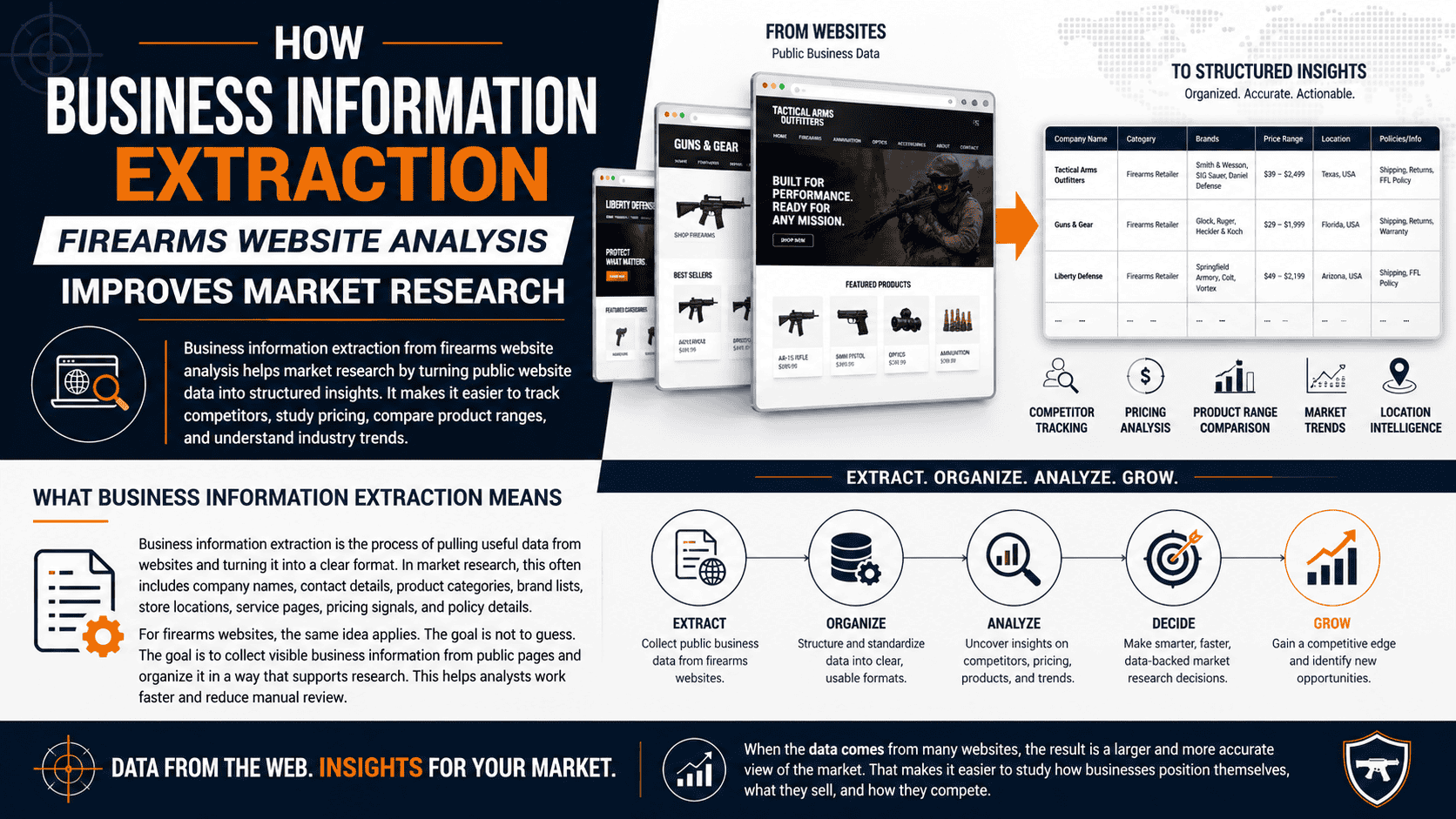

Business information extraction from firearms website analysis helps market research by turning public website data into structured insights. It makes it easier to track competitors, study pricing, compare product ranges, and understand industry trends.
What Business Information Extraction Means
Business information extraction is the process of pulling useful data from websites and turning it into a clear format. In market research, this often includes company names, contact details, product categories, brand lists, store locations, service pages, pricing signals, and policy details.
For firearms websites, the same idea applies. The goal is not to guess. The goal is to collect visible business information from public pages and organize it in a way that supports research. This helps analysts work faster and reduce manual review.
When the data comes from many websites, the result is a larger and more accurate view of the market. That makes it easier to study how businesses position themselves, what they sell, and how they compete.
Why Firearms Website Analysis Matters
Firearms businesses often have detailed websites. These sites may include product listings, dealer information, legal notices, training services, accessories, and support pages. Each part can reveal something useful about the business.
Website analysis helps market researchers see patterns across the industry. It shows which companies focus on sales, which focus on accessories, and which focus on training or service. It also helps identify how businesses present themselves to customers.
This matters because market research works best when it is based on real evidence. Public website data gives that evidence in a simple and scalable way. Instead of reading every site by hand, researchers can extract the same fields from many sites and compare them side by side.
The Main Data Points Market Researchers Extract
A strong research process focuses on business data that can be compared across websites. The most useful data points often include the following.
| Data Point | Why It Matters |
|---|---|
| Business name | Identifies the company clearly |
| Location | Shows market reach and regional coverage |
| Product categories | Reveals what the company sells |
| Brand names | Helps compare supplier relationships |
| Service offerings | Shows added value beyond products |
| Contact details | Supports lead analysis and validation |
| Store hours | Useful for local customer access |
| Policy pages | Helps understand compliance and operations |
| Pricing signals | Supports competitive price research |
| Blog or news content | Shows focus areas and market messaging |
These fields help build a clean profile of each business. They also support deeper comparisons across a group of websites.
How Website Analysis Improves Market Research
Business information extraction improves market research in several direct ways. It makes data collection faster, more complete, and easier to compare.
Faster data collection
Manual research takes time. Analysts often need to open many websites, copy information, and fix formatting problems. Extraction tools reduce this work by gathering the same type of data from each site in a repeatable way.
This speed matters when the research covers many businesses. It allows teams to study more companies in less time and keep reports current.
Better data consistency
Website content does not always use the same format. One site may list a full address. Another may only show a city and state. One may place product names on the homepage. Another may hide them inside a category page.
Extraction systems help normalize that information. They place similar data into the same fields so researchers can compare it more easily. Consistency improves analysis and reduces confusion.
Wider market coverage
Manual review often misses smaller businesses or pages that are hard to find. Automated extraction can scan more sites and more pages. That gives a broader view of the market.
Wider coverage helps identify new entrants, local competitors, specialty sellers, and businesses with different models. It also helps reduce bias that can happen when research only focuses on the most visible brands.
Better competitive comparison
Once business data is structured, it becomes easier to compare competitors. Researchers can review product focus, service mix, geographic reach, and content strategy.
This is valuable in the firearms market because businesses often differ in purpose. Some focus on retail sales. Some focus on training. Some provide accessories or parts. Some emphasize community, safety, or compliance. Website analysis makes those differences visible.

What Researchers Can Learn From Public Website Content
Public website content can reveal many useful market signals when reviewed carefully.
Product and category focus
A business that mainly shows rifles, handguns, optics, or accessories is telling the market where it competes. A company with a large training section may be serving a different audience than a company that mainly shows inventory.
Category focus helps researchers group businesses into segments. That is important for market sizing, competitor mapping, and demand analysis.
Brand partnerships
Many firearms websites list brands they carry. This can show supplier relationships and product strategy. It can also show whether a business aims at premium buyers, budget buyers, or a mixed audience.
Brand coverage helps researchers understand positioning. It can also reveal overlap between competitors.
Location and service area
Website location data is useful for understanding where businesses operate. Some companies serve one city or state. Others support broader regions through shipping or multi location operations.
This information helps researchers study local density, regional competition, and market gaps.
Customer messaging
The language used on a website matters. Some businesses emphasize safety and education. Some focus on product range. Some focus on fast service or expert staff.
This kind of messaging shows how a business wants to be seen. It also helps researchers understand audience targeting.
Compliance and policy content
Public policy pages can reveal how seriously a company handles age restrictions, shipping rules, refunds, and legal compliance. These pages are important because they show how the business manages risk and customer trust.
Researchers use this information to compare operational maturity across businesses.
How Structured Data Supports Better Decisions
Business information extraction is most useful when the data is organized into a clean structure. A structured dataset makes it easier to sort, filter, and analyze.
For example, a research team can group businesses by region, product type, or service model. It can also count how many sites mention certain brands or categories. These simple comparisons often reveal strong patterns.
Structured data also supports long term tracking. A business may change its product mix, update its services, or expand into a new area. When data is collected consistently over time, those changes become easier to measure.
That helps with trend analysis. It also helps with planning, because market movement becomes visible earlier.
For a structured approach to segmenting technical industries, review our detailed guide on Engineering Firms Business Classification Criteria, which explains how businesses are grouped based on services, scale, and specialization.
Common Uses in Market Research
Business information extraction from firearms website analysis supports several common research tasks.
Competitor mapping
Researchers can identify direct and indirect competitors by comparing product categories, service pages, and regional presence. This creates a clearer market map.
Lead generation
Public business information can help sales or partnership teams build target lists. The data often includes contact paths, location details, and business focus.
Category analysis
Teams can study how many businesses sell specific product types or services. This helps with demand evaluation and category planning.
Brand monitoring
Researchers can track which brands appear most often across business websites. This can point to stronger supplier presence or market preference.
Content strategy review
Website blogs, guides, and policy pages can show what topics businesses care about. This helps companies understand how competitors educate or inform their audience.
You can also explore Always Businesses SocialBizMagazine to understand how modern platforms track and present business data trends across different industries.
Best Practices for Clean Research Data
Good market research depends on data quality. If the extraction process is poor, the results will be weak. A strong process follows a few simple rules.
First, use public and visible website data only. That keeps the research clear and easy to verify.
Second, check data fields for accuracy. Business names, phone numbers, and addresses should be reviewed when possible. A small error can affect the whole dataset.
Third, remove duplicates. Many businesses have similar names or multiple web pages with repeated information. Clean records make analysis more reliable.
Fourth, keep a clear field structure. Each data point should have a defined place in the dataset. That improves sorting and reporting.
Fifth, update data regularly. Websites change. Old data can distort trends if it is not refreshed.

Table for Research Workflow
| Step | Purpose |
|---|---|
| Identify target websites | Define the research scope |
| Extract public business data | Collect useful fields |
| Clean and standardize records | Improve consistency |
| Group by category or region | Support comparison |
| Review patterns | Find market signals |
| Refresh data over time | Keep research current |
This workflow keeps the process simple and repeatable. It also helps teams produce more reliable market studies.
Why This Approach Works Well for Long Term Research
Long term market research needs more than one snapshot. It needs data that can be repeated, compared, and updated. Business information extraction supports that need well.
Websites are one of the most stable public sources of business information. They often contain the same core fields over time, even when designs change. That makes them useful for building ongoing datasets.
This approach also scales well. A small research team can study a local set of businesses. A larger team can expand the same method to regional or national research. The structure stays the same.
Because the process is based on public business websites, it is also easy to audit. Researchers can return to the source page and verify the data when needed. That supports trust and transparency.
What Makes the Analysis Useful for Decision Making
The value of business information extraction comes from turning raw website content into practical insight. Market teams use it to answer simple but important questions.
Which businesses compete in the same category. Which regions are crowded. Which brands appear most often. Which companies provide more services. Which websites are more focused on education, products, or support.
These questions matter because they shape strategy. They help teams understand the market before making decisions about pricing, outreach, partnerships, or expansion.
The analysis does not need to be complex to be useful. Clear, structured, and accurate data often gives the best results.
Common Limits of Website Based Research
Website analysis is useful, but it has limits. It shows public information, not the full internal picture of a business. It may not reveal sales volume, profit, inventory depth, or customer retention.
Some websites are also incomplete or outdated. Others may hide important details in images or scripts that need extra processing. This is why validation is important.
Even with these limits, website based extraction remains valuable because it gives a strong starting point. It works well when paired with careful review and a clear research goal.
How It Strengthens Research Quality
Business information extraction improves research quality in four main ways. It adds scale, because more websites can be reviewed. It adds consistency, because fields are structured the same way. It adds speed, because data collection takes less manual effort. It adds clarity, because analysts can compare businesses with less confusion.
In the firearms market, where businesses can differ widely in focus and structure, this clarity is especially important. It helps researchers identify patterns that would be hard to see by manual browsing alone.
When done properly, this method turns public website content into useful market intelligence that supports better research decisions.