

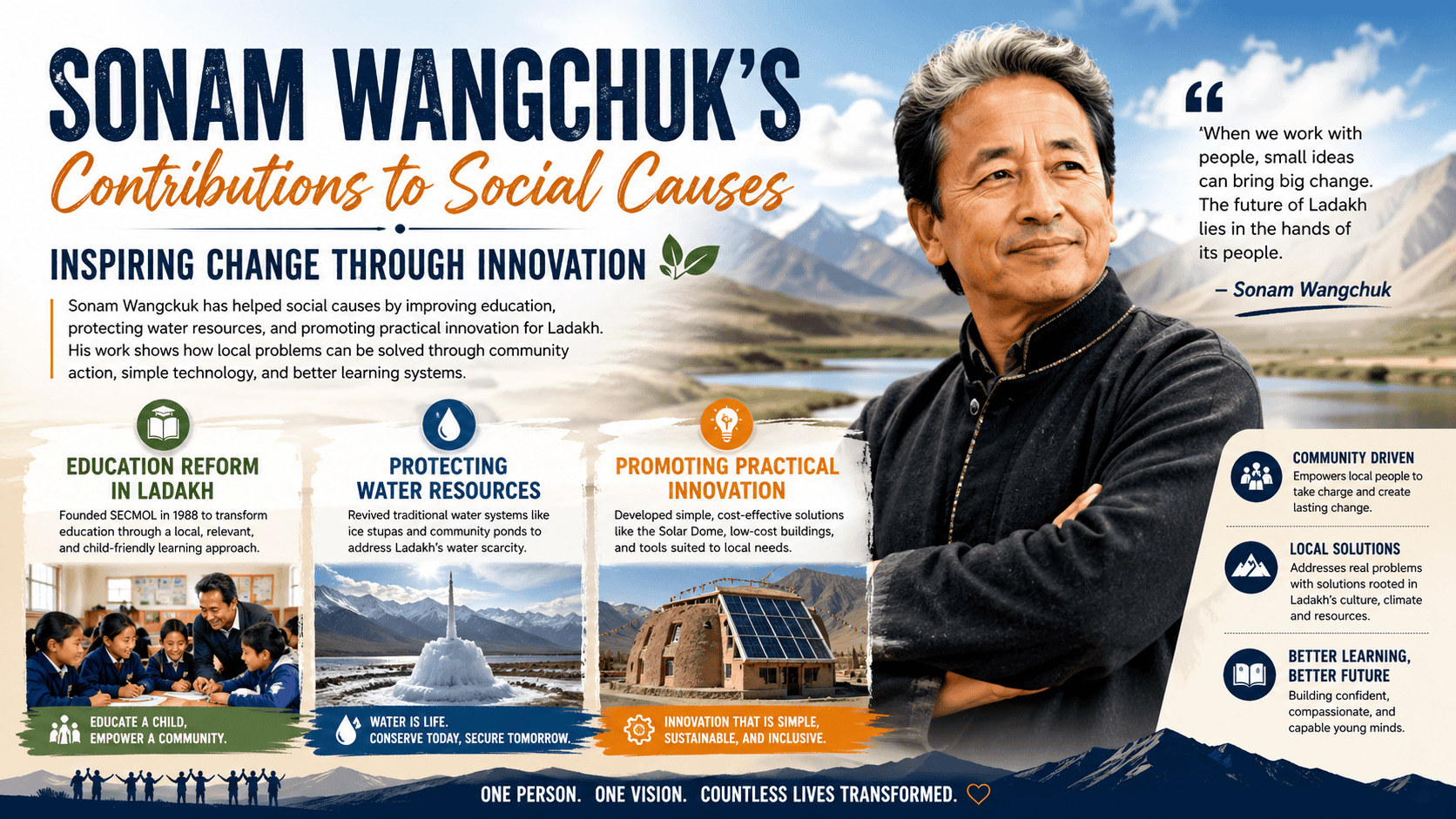

Sonam Wangchuk has helped social causes by improving education, protecting water resources, and promoting practical innovation for Ladakh. His work shows how local problems can be solved through community action, simple technology, and better learning systems.
Education Reform in Ladakh
Sonam Wangchuk is best known for his work in education reform. He founded SECMOL in 1988 to improve the education system in Ladakh, where many students did not find local schools relevant to their lives. SECMOL was created to reform the system and support Ladakhi youth through learning that fits the region’s needs.
His education work focused on making school more useful, more local, and more child friendly. The Ramon Magsaysay Award profile says he used a community driven model that improved life opportunities for young people in remote northern India. The Nobel Prize profile also notes that he has worked in education reform for more than 30 years.
SECMOL and a New Learning Model
SECMOL became the base for many of Wangchuk’s social efforts. The official SECMOL site says the movement was founded by young Ladakhis in 1988 with the aim of reforming Ladakh’s educational system, and that it runs an eco friendly campus near Leh. This campus also supports residential activities for Ladakhi youth and college students.
The school model was not limited to classroom teaching. According to the Ramon Magsaysay Award profile, SECMOL helped rebuild students’ confidence, develop life skills, and offer practical courses, including leadership training and solar power installation. This made education more useful for local life and work.
The Nobel Prize profile adds that SECMOL Alternative School was designed for students who had failed state exams, not for those with top grades. That approach gave second chances to students who needed a different way to learn. It also showed a clear social purpose, because it reduced the shame of failure and created space for growth.
For readers interested in structured learning methods, Student Handout 1.2 Guiding Questions for Historical Case Studies Answers offers a useful framework to analyze real world cases in a clear and practical way.
Operation New Hope and Community Participation
One of Wangchuk’s most important social contributions was Operation New Hope. The Ashoka profile says that in 1996 the Hill Council adopted his participation model as official policy for government schools in Ladakh. It also says he merged Village Education Councils into larger committees so that communities could monitor schools more effectively.
The Nobel Prize profile explains the structure of this reform in simple terms. It describes Operation New Hope as a collaboration between the government, village communities, and civil society. The programme included village education committees, teacher training in child friendly methods, and localised textbooks for Ladakh.
The Ramon Magsaysay Award profile gives more detail on the scale of the work. It says the reform effort trained hundreds of teachers and many village education leaders, and it helped raise exam success rates over time. That change matters because it shows social impact, not just new ideas. It shows results in real schools and real communities.
Sustainable School Design and Solar Energy
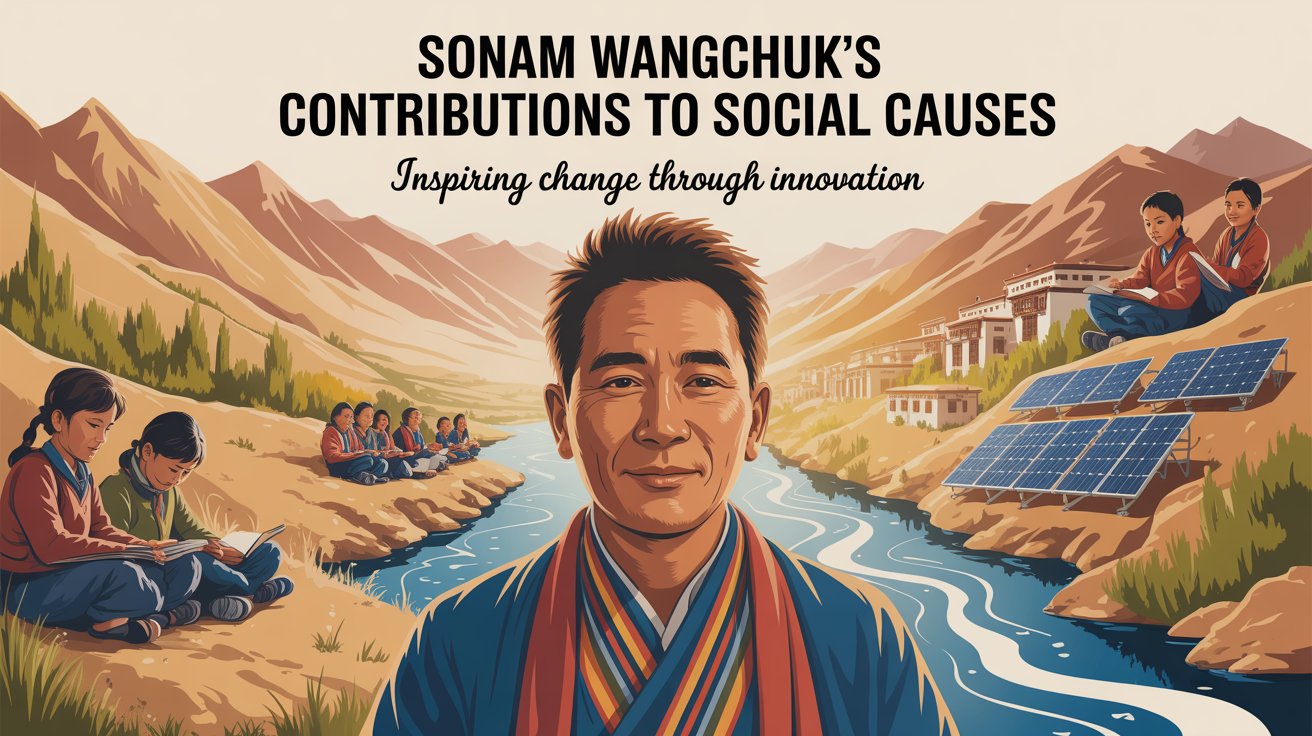
Wangchuk’s social work also includes low cost sustainable building design. The Nobel Prize profile says that at SECMOL he helped design solar heated buildings made of earth and mud that stay warm during Ladakh winters. This matters because it reduces energy use in a harsh mountain climate and makes school infrastructure more practical for local people.
The SECMOL campus is described as eco friendly on the official site, which fits Wangchuk’s wider focus on sustainability. He did not treat environment and education as separate issues. He linked them through simple design, local materials, and community use.
Ice Stupa and Water Security
Another major contribution is the Ice Stupa project. The Nobel Prize profile says Wangchuk invented the Ice Stupa artificial glacier to solve water shortages in mountain regions, and that it stores winter water and releases it when farmers need it in late spring. This is a direct social cause because it responds to water scarcity in farming communities.
The CEEW article explains that the project was built to solve growing water scarcity in Ladakh and make communities more self reliant in water conservation. It says the team worked with the local environment and used a vertical cone design that could be replicated at low cost. This made the idea more practical for villages and other mountain regions.
The Ramon Magsaysay Award profile adds that the idea came from local experience of climate change affecting agriculture. It describes ice stupas as conically shaped ice mountains that store water in winter and release it in summer for irrigation. This is a strong example of innovation built around daily social needs, not around abstract technology.
HIAL and Skills for the Future
Wangchuk later helped develop the Himalayan Institute of Alternatives Ladakh, known as HIAL. The official HIAL site says it is a collaborative exercise between learners and facilitators and that it uses the idea of Bright Head, Kind Heart, and Skilled Hands instead of only the usual three Rs. That shows a strong focus on practical, ethical, and community based learning.
The CEEW article says HIAL grew out of the success of the Ice Stupa work and SECMOL experience. It describes HIAL as an institution that supports higher education, sustainable livelihoods, water conservation, energy saving housing, eco tourism, and other mountain region solutions. This makes HIAL part of Wangchuk’s wider social mission, not a separate project.
Why His Work Matters for Social Change
Wangchuk’s social contribution stands out because it links education, environment, and community leadership. He did not only point out problems in Ladakh. He helped build working systems to address them. SECMOL improved school reform, Operation New Hope brought local participation, Ice Stupa tackled water shortage, and HIAL extended those ideas into higher education and livelihoods.
His work also shows a clear pattern of trust in local people. The Magsaysay profile says his reform was systematic, collaborative, and community driven. The CEEW analysis says the Ice Stupa project worked because it used local knowledge and community ownership. These points are important because social change lasts longer when local people help design it and support it.
He has also shared his ideas beyond Ladakh. The Ramon Magsaysay Award profile says his environmental and educational innovations reached mountain communities across the Himalayan belt and even Switzerland. That shows that his methods are not limited to one place. They can help other regions facing similar problems with education, water, and sustainable living.
If you want to understand how financial support programs help communities grow, you can also explore Gosford Employment Service Wage Subsidy Providers, which explain how wage subsidies support employment and local development.
Recognition for Public Service
Wangchuk’s work has received strong recognition from respected institutions. The Ramon Magsaysay Award named him an education reformist who introduced innovation in the highlands of Ladakh. The Nobel Prize profile also highlights his long work in education reform and his role in developing the Ice Stupa concept.
These honors matter because they reflect more than personal success. They point to the public value of his work. His projects were built to improve school access, support farmers, conserve water, and make mountain communities more resilient. That is why Sonam Wangchuk is widely seen as a social innovator whose work connects knowledge with real world needs.