

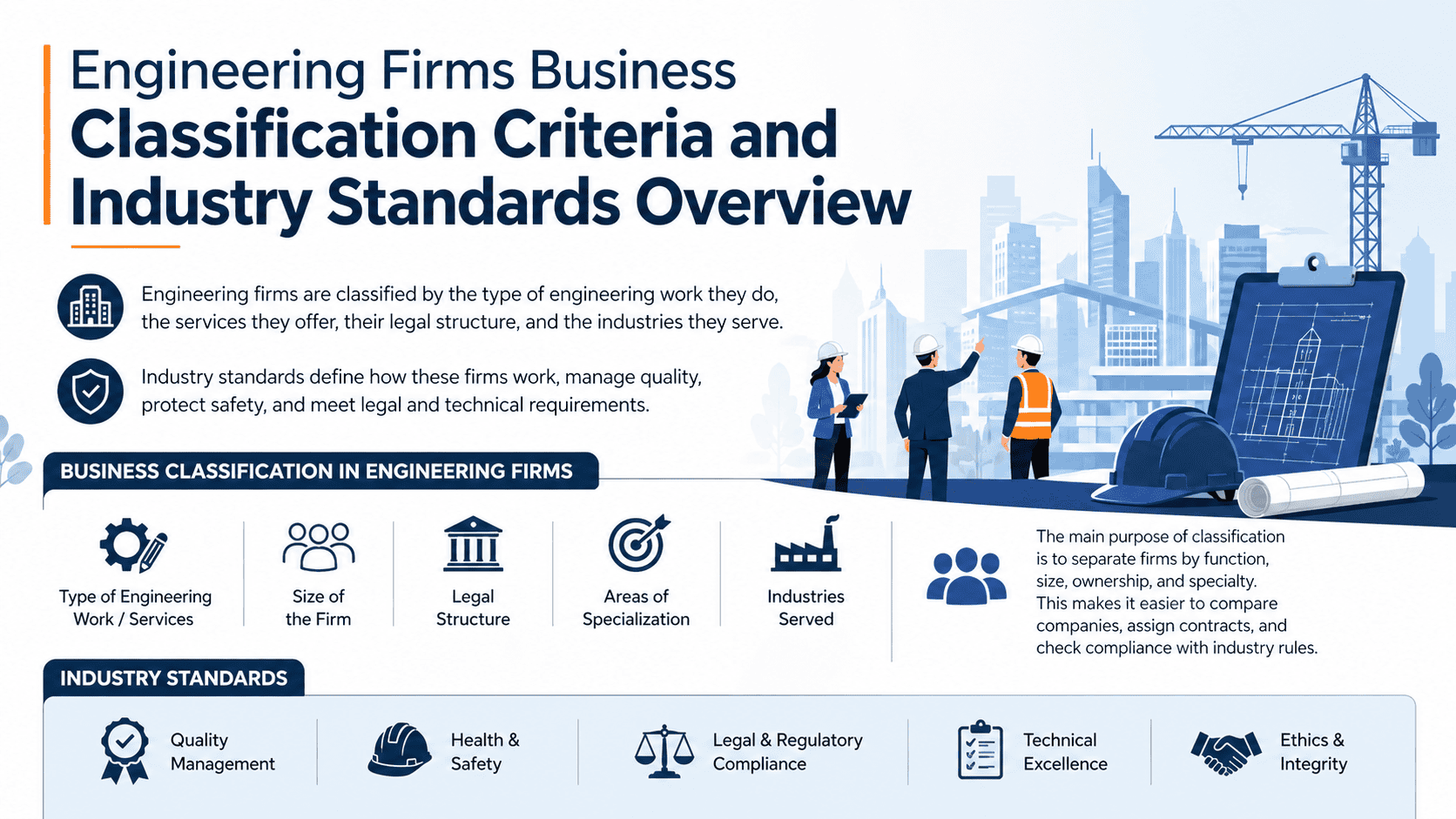

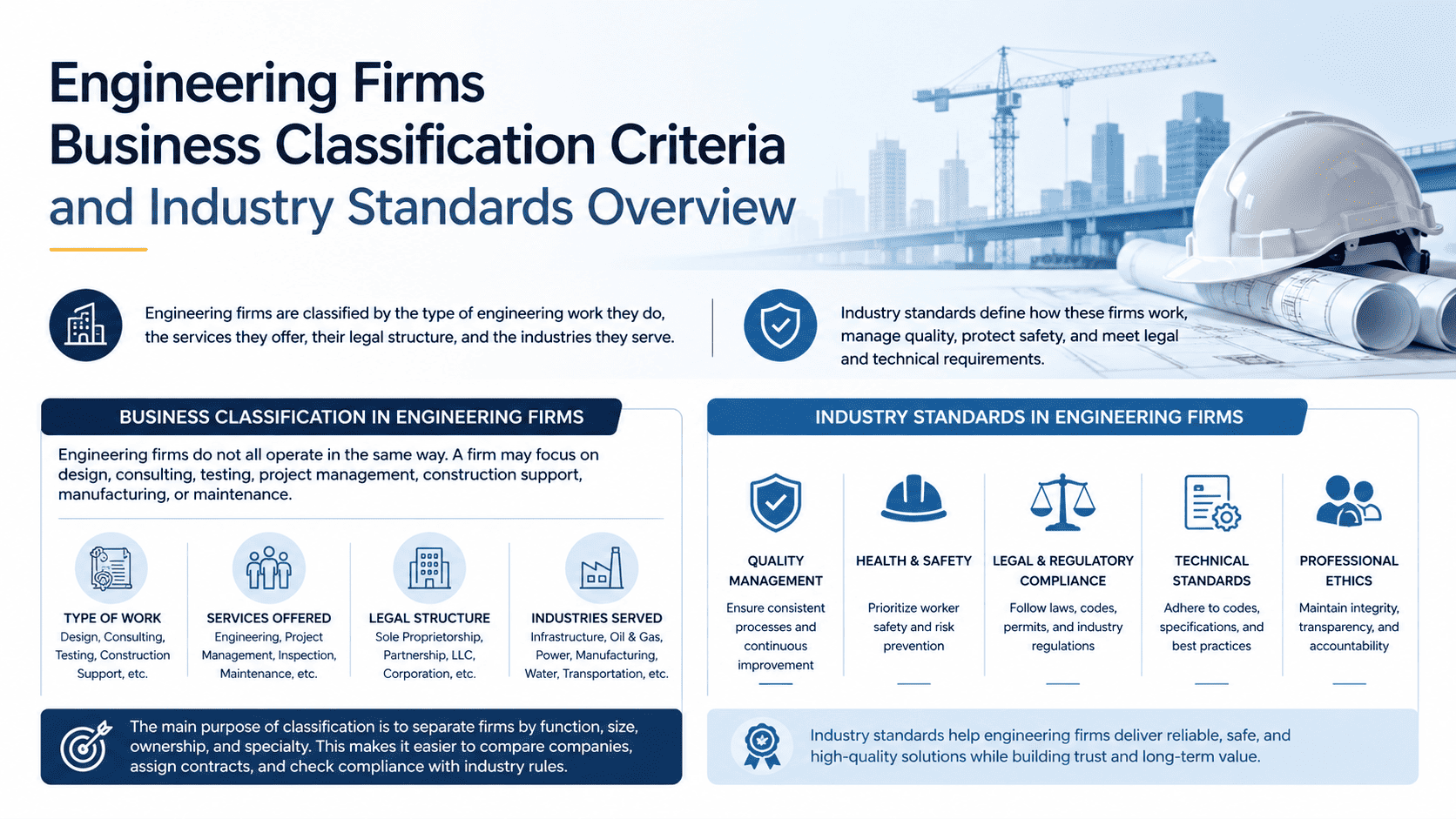
Engineering firms are classified by the type of engineering work they do, the services they offer, their legal structure, and the industries they serve. Industry standards define how these firms work, manage quality, protect safety, and meet legal and technical requirements.
Business Classification in Engineering Firms
Engineering firms do not all operate in the same way. A firm may focus on design, consulting, testing, project management, construction support, manufacturing, or maintenance. Business classification helps clients, regulators, and partners understand what the firm does and how it operates.
The main purpose of classification is to separate firms by function, size, ownership, and specialty. This makes it easier to compare companies, assign contracts, and check compliance with industry rules.
Always Businesses SocialBizMagazine provides detailed coverage of business classification trends and industry updates that support engineering firm evaluation and market understanding.
Main Types of Engineering Firms
Engineering firms usually fall into a few broad groups. Each group has a different role in the market.
| Type of Engineering Firm | Main Work | Common Clients |
|---|---|---|
| Consulting firms | Planning, design, analysis, and advice | Governments, developers, factories, private companies |
| Design firms | Technical drawings, models, and specifications | Builders, manufacturers, public agencies |
| Contracting firms | Construction and field execution | Infrastructure owners, real estate firms, industrial clients |
| Testing and inspection firms | Quality checks, material testing, audits | Construction, energy, manufacturing, transport |
| Specialty firms | One specific engineering field such as civil, mechanical, or electrical | Clients with focused technical needs |
A firm may fit into more than one group. For example, some companies provide both design and testing services.
Classification by Engineering Discipline
Engineering firms are also grouped by discipline. This is one of the most common ways to describe their business type.
Civil Engineering Firms
These firms work on roads, bridges, buildings, water systems, drainage, airports, and public infrastructure. They often handle planning, structural design, site work, and project supervision.
Mechanical Engineering Firms
These firms handle machines, heating and cooling systems, manufacturing equipment, and industrial processes. They often support factories, plants, and product development teams.
Electrical Engineering Firms
These firms focus on power systems, wiring, lighting, control systems, telecommunications, and automation. They serve buildings, utilities, factories, and infrastructure projects.
Chemical Engineering Firms
These firms work with processes that change raw materials into useful products. They often support oil, gas, pharmaceuticals, food production, and materials processing.
Industrial Engineering Firms
These firms improve systems, workflow, production efficiency, quality control, and resource use. They help companies reduce waste and improve output.
Software and Systems Engineering Firms
These firms build digital systems, automation tools, embedded systems, and technical software. Many modern engineering firms now include this service because digital control is common in industry.
Classification by Service Model
Engineering firms can also be classified by how they deliver services.
Full Service Firms
These firms provide end-to-end support. They may handle planning, design, documentation, permitting, implementation support, and quality checks.
Specialized Firms
These firms focus on one service only. For example, a firm may only do structural analysis or only provide geotechnical testing.
Independent Consulting Firms
These firms give expert advice and technical reports. They usually do not manage construction or manufacturing work directly.
Turnkey Firms
These firms handle a project from start to finish. They may design, build, test, and hand over the completed result to the client.
Subcontracted Technical Firms
These firms work under larger companies. They provide specific technical tasks such as surveying, CAD drafting, or inspection.
Classification by Firm Size
Size is another important business classification factor. It affects staffing, project scope, and market reach.
| Firm Size | Common Features |
|---|---|
| Small firm | Few employees, local projects, narrow service range |
| Medium firm | Regional projects, mixed service offerings, stronger internal systems |
| Large firm | Many staff, national or global projects, multiple departments |
Small firms often provide flexible and personal service. Large firms often manage complex projects with large budgets and strict compliance needs.
Classification by Ownership Structure
Engineering firms can also be grouped by ownership.
Sole Proprietorship
One person owns and runs the firm. This structure is common in small consulting practices.
Partnership
Two or more owners share control, profit, and risk. This is common in professional service firms.
Limited Liability Company
This structure separates business risk from personal assets in many cases. It is common for firms that want more legal protection.
Corporation
A corporation has a formal legal structure, larger management systems, and stronger reporting rules. Many large engineering companies use this model.
Public or Government Owned Firms
Some engineering firms work under public ownership. They may serve infrastructure, utilities, defense, transport, or public works.
Classification by Market Focus
The market a firm serves also shapes its classification.
Public Sector Firms
These firms work with government bodies, municipalities, and public utilities. They often handle infrastructure, transport, water, and urban development.
Private Sector Firms
These firms work with commercial companies, property developers, manufacturers, and private investors.
Industrial Firms
These firms support factories, processing plants, energy systems, and production lines.
Infrastructure Firms
These firms focus on roads, bridges, tunnels, water networks, rail systems, and utilities.
Research and Development Firms
These firms develop new technology, prototypes, and advanced engineering solutions.
Classification by Regulatory Status
Many engineering firms must meet licensing and registration rules. Classification often depends on whether a firm is allowed to provide professional engineering services.
A licensed firm may be allowed to sign design documents, approve technical reports, or provide regulated services. A non licensed firm may still provide support work, but not regulated professional engineering tasks.
Some industries require firms to hold special permits, safety approvals, or quality certifications. These rules vary by country and sector.
Core Industry Standards for Engineering Firms
Industry standards set the minimum level of performance, safety, and quality. Engineering firms use these standards to stay consistent and reliable.
Quality Management Standards
Quality management standards help firms control work quality and reduce errors. The most common model is a formal quality system with documented procedures, internal checks, and corrective actions.
These standards help firms:
- Keep design work consistent
- Reduce rework
- Track documents properly
- Improve client confidence
- Support audit readiness
Safety Standards
Engineering work often involves risk. Safety standards protect workers, clients, and the public. Firms must follow rules for site safety, hazard control, training, and emergency response.
Safety systems usually cover:
- Risk assessment
- Protective equipment
- Safe work procedures
- Incident reporting
- Safety training
Environmental Standards
Many engineering firms must manage waste, emissions, water use, and energy use. Environmental standards help firms reduce harm and follow legal rules.
These standards are important in:
- Construction
- Manufacturing
- Energy
- Water treatment
- Chemical processing
Technical Standards
Technical standards define how materials, systems, and designs should perform. They help ensure that engineering work is reliable and repeatable.
Examples include standards for:
- Material strength
- Electrical safety
- Structural design
- Testing methods
- Equipment performance
Ethics and Professional Conduct Standards
Engineering firms must follow professional conduct rules. These rules support honesty, public safety, fairness, and accountability.
Common ethical requirements include:
- Honest reporting
- No false claims
- Protection of client data
- Avoidance of conflicts of interest
- Clear responsibility for technical decisions
Common Standards Used in Engineering Firms
Different firms use different standards depending on their field. Some widely used standards include quality management, environmental management, occupational safety, and sector specific technical codes.
| Standard Area | Purpose |
|---|---|
| Quality management | Improves consistency and process control |
| Environmental management | Reduces environmental impact |
| Health and safety management | Protects workers and the public |
| Technical codes | Sets design and testing rules |
| Document control | Keeps records accurate and traceable |
Engineering firms often combine several standards at the same time. A construction engineering firm may use quality, safety, and environmental systems together.
How Firms Are Evaluated Under Industry Standards
Clients and regulators often check engineering firms using a set of clear criteria.
Competence
The firm must show that its staff has the right education, training, and experience for the work.
Process Control
The firm must show that it follows defined steps for design, review, approval, and delivery.
Documentation
The firm must keep proper records. This includes drawings, calculations, inspection reports, permits, and revision history.
Risk Management
The firm must identify technical, legal, financial, and safety risks before starting work.
Compliance
The firm must follow laws, codes, and contract requirements.
Continuous Improvement
The firm should review mistakes, fix weak points, and improve future work.
Licensing and Certification Requirements
Many engineering firms need formal licenses or certifications to operate. These can apply to the company itself, the technical staff, or both.
Common requirements include:
- Business registration
- Professional engineering licenses
- Sector permits
- Safety certifications
- Quality system certification
- Environmental approvals
These requirements protect the public and help clients trust the firm’s work.
Key Business Documents Used for Classification
Engineering firms often use documents that support their classification and compliance status.
These may include:
- Business registration papers
- Professional licenses
- Insurance documents
- Tax records
- Project portfolios
- Quality manuals
- Safety plans
- Technical capability statements
These documents help show what the firm does and whether it meets required standards.
Company Website Shopnaclo offers structured business resources and company profiling tools that help in understanding how firms present their services and operational standards online.
Why Classification and Standards Matter
Business classification and industry standards are important for several reasons.
- They help clients choose the right firm.
- They help regulators check compliance.
- They help firms compete for contracts.
- They support quality, safety, and accountability.
- They also make project delivery more predictable.
Without clear classification, a client may hire the wrong type of firm. Without standards, technical work may become unsafe, inconsistent, or non compliant.
Criteria Used in Contract Awards
When companies or governments choose an engineering firm, they often review a set of criteria.
| Selection Criterion | What It Shows |
|---|---|
| Technical expertise | Ability to do the work correctly |
| Relevant experience | Past work in similar projects |
| Staffing strength | Availability of skilled professionals |
| Quality systems | Process control and reliability |
| Safety record | Risk management and compliance |
| Financial stability | Ability to complete the job |
| Certification status | Proof of standards and approvals |
These criteria help clients reduce risk before awarding a project.
Industry Standards by Project Phase
Engineering standards apply at every stage of a project.
Planning Phase
The firm studies requirements, risks, budgets, and technical limits.
Design Phase
The firm creates drawings, calculations, and technical specifications.
Review Phase
The firm checks the work for errors, safety issues, and compliance gaps.
Execution Phase
The firm supports construction, manufacturing, or installation work.
Testing and Handover Phase
The firm verifies that the final result meets the required standard.
Maintenance Phase
The firm may continue to support inspections, repairs, and performance checks.
How Digital Systems Affect Classification
Modern engineering firms often use digital tools for design, modeling, project tracking, and reporting. This changes how firms are classified in practice.
A firm with strong digital capability may handle:
- Building information modeling
- Computer aided design
- Simulation
- Remote monitoring
- Data based quality control
These tools do not replace engineering standards. They support better control, faster delivery, and clearer records.
Final Business Meaning of Classification Criteria
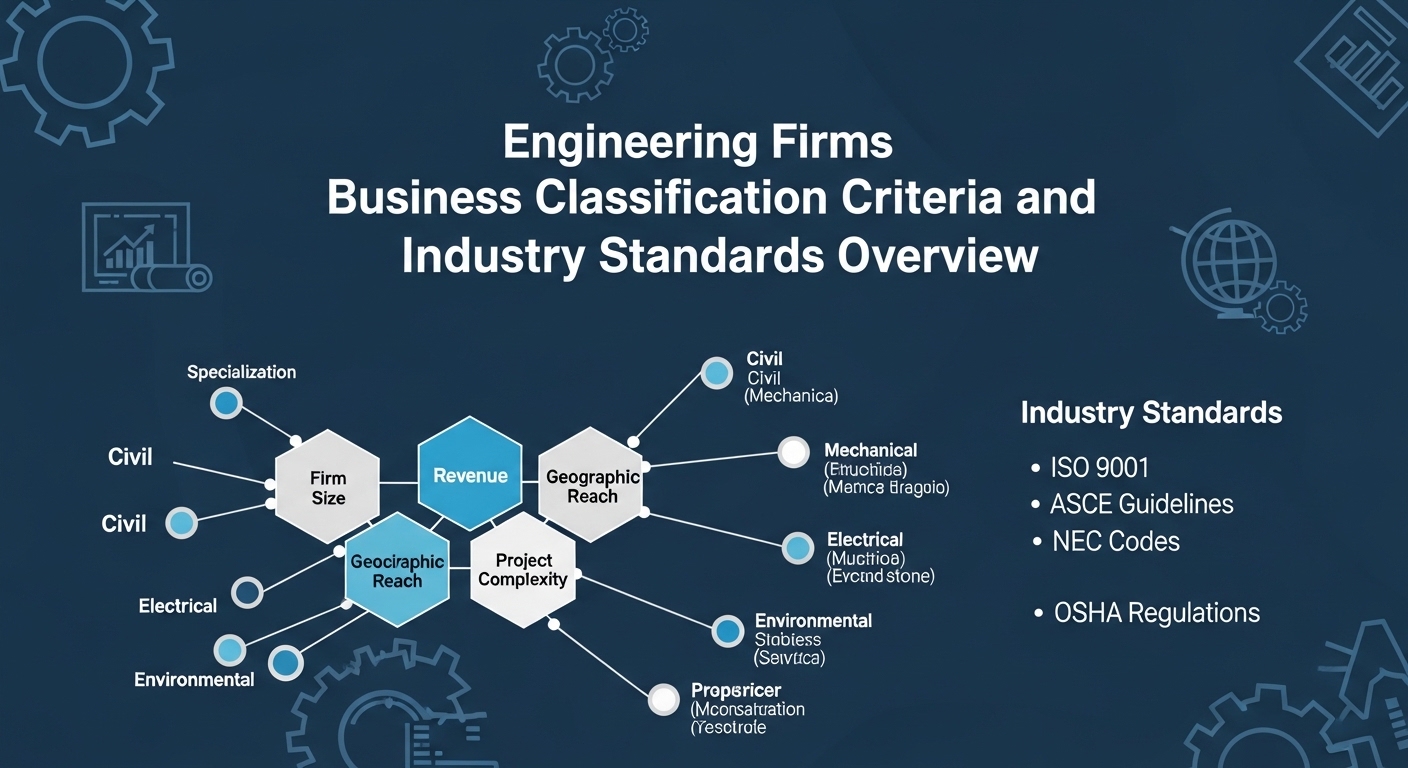
Engineering firms are classified by discipline, service type, firm size, ownership, market focus, and legal status. Industry standards then define how the firm must work in areas such as quality, safety, environment, and technical compliance.
Together, these criteria give a clear picture of what the firm does, how it operates, and whether it can deliver safe and reliable engineering work.
You have not enough Humanizer words left. Upgrade your Surfer plan.