

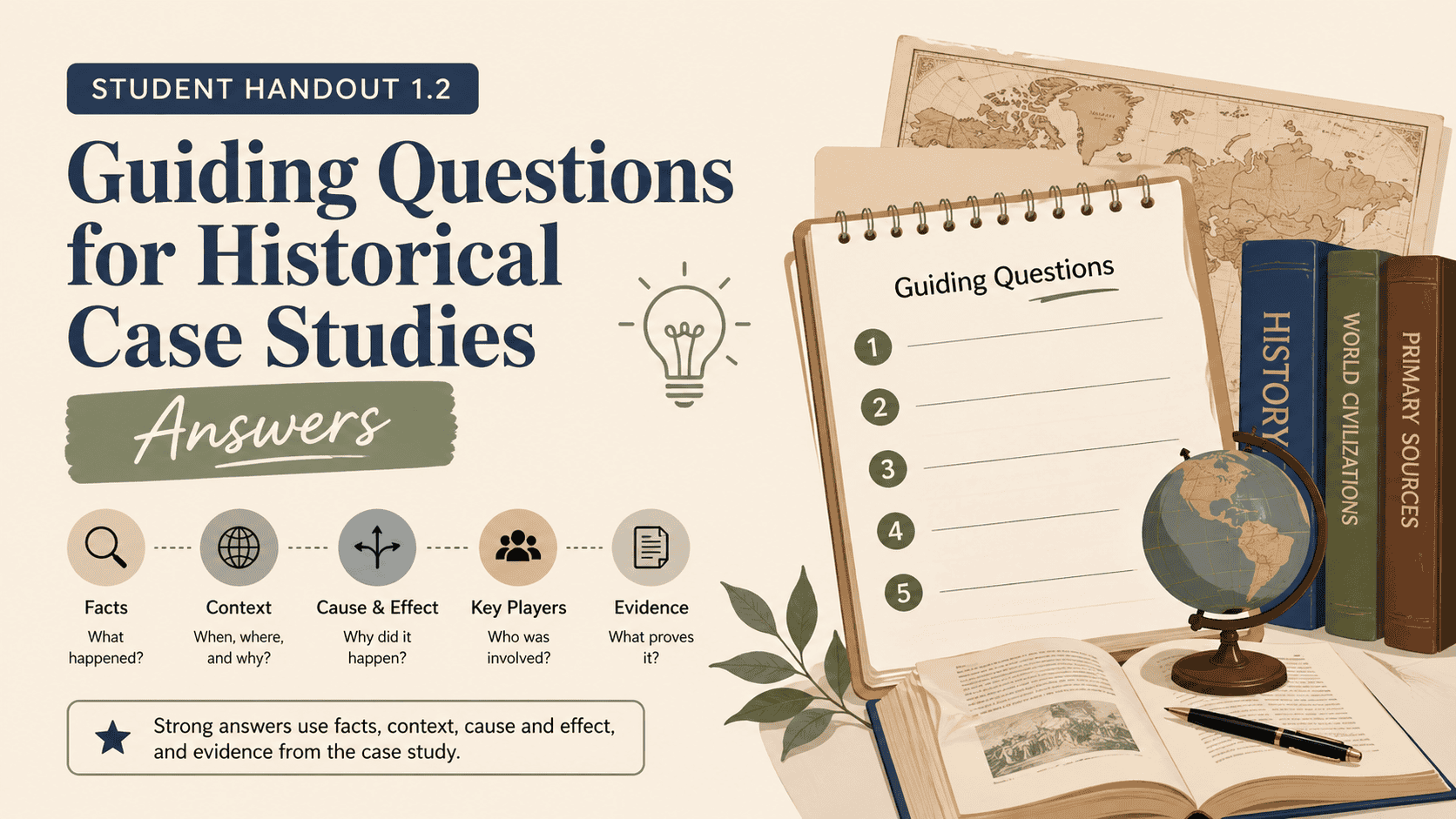

Student Handout 1.2 helps students answer historical case study questions in a clear and structured way. Strong answers use facts, context, cause and effect, and evidence from the case study.
What Student Handout 1.2 Is
Student Handout 1.2 is a learning sheet used in history classes. It usually gives guiding questions that help students study a historical case in an organized way. A case study may focus on a person, event, conflict, policy, movement, or period in history.
The main purpose of the handout is to help students move from reading to writing. Instead of giving random facts, students learn to answer questions in a clear order. This improves understanding and makes the final answer stronger.
Historical case studies ask students to look at what happened, why it happened, who was involved, and what changed because of it. The guiding questions on the handout often support these ideas.
Why These Guiding Questions Matter
Guiding questions help students focus on the most important parts of a historical event. They also help teachers check whether students understand the topic, not just memorized names and dates.
Good answers usually show four things.
- They show knowledge of the event.
- They explain causes and effects.
- They use evidence from the source or lesson.
- They stay clear and directly related to the question.
When students use the handout properly, they can write better short answers, paragraph answers, and longer case study responses.
Students who want real exam practice can also review the 8th Class Social Question Paper 2018 SA1 Government to understand how guiding questions appear in actual tests.
Main Types of Questions in a Historical Case Study
Historical case study handouts often include similar question types. Each one asks for a different kind of thinking. Some questions ask students to describe. Some ask them to explain. Some ask them to compare or judge importance.
| Question type | What it asks | What a strong answer should include |
|---|---|---|
| Factual question | What happened? Who was involved? | Clear facts, names, dates, and events |
| Cause question | Why did it happen? | Main reasons and background |
| Effect question | What happened after it? | Short and long term results |
| Source question | What does the source show? | Evidence from the source and explanation |
| Comparison question | How was it similar or different? | At least two points of comparison |
| Significance question | Why is it important? | Historical impact and wider meaning |
How to Answer the Questions Clearly
A strong answer should always stay close to the question. Students should not write everything they know. They should select the facts that match the guiding question.
A good method is to follow this order.
- First, answer the question directly.
- Then give one or two facts to support the answer.
- Next, explain why those facts matter.
- Finally, keep the language simple and precise.
For example, if the question asks why a historical event happened, the answer should not only describe the event. It should explain the reasons behind it.
If the question asks for effects, the answer should focus on outcomes, changes, or results.
What a Strong Historical Answer Looks Like
A strong historical answer is clear, direct, and evidence based. It does not use vague language. It does not add unnecessary detail.
A strong answer usually has these parts.
- A direct statement that answers the question.
- Relevant evidence from the lesson, textbook, or source.
- An explanation of how the evidence supports the answer.
- Correct use of historical terms.
For example, a weak answer may say, “The event was important because many things happened.”
A stronger answer may say, “The event was important because it changed government policy and affected daily life for many people.”
The second answer gives a clear reason and shows historical understanding.
Step by Step Method for Writing Answers
Students can use a simple process to answer any question on the handout.
| Step | What to do | Purpose |
|---|---|---|
| 1 | Read the question carefully | Find the exact task |
| 2 | Identify the key words | Understand what kind of answer is needed |
| 3 | Find relevant facts | Keep the answer focused |
| 4 | Explain the facts | Show historical understanding |
| 5 | Check for clarity | Make sure the answer is easy to read |
This method works well for short responses and longer written work.
Key Words Students Should Notice
Some words in historical case study questions tell students exactly how to answer. These words matter because each one needs a different response.
- “Describe” means give the main details.
- “Explain” means tell why or how something happened.
- “Compare” means show similarities and differences.
- “Assess” means make a judgment using evidence.
- “Analyse” means break the topic into parts and explain them.
- “Evaluate” means weigh the importance of different points.
Students often lose marks because they answer the wrong type of question. For example, a description is not enough when the question asks for explanation.
Answer Structure for Common Guiding Questions
The table below shows how to shape answers for common questions found in historical case studies.
| Guiding question | Best answer structure |
|---|---|
| What happened in this case study? | State the event, then list the main facts in order |
| What caused the event? | Give the main causes, then explain each one |
| What were the effects? | Separate short term and long term effects |
| Who was involved? | Name the main people or groups and explain their roles |
| Why was it important? | Link the event to bigger historical change |
| What does the source show? | Describe the source, then explain its meaning |
This structure keeps the answer organized and easy to follow.
Using Evidence in the Answer
Evidence is one of the most important parts of historical writing. A case study answer should not rely only on general statements. It should use facts from the lesson, documents, charts, images, or textbook material.
Good evidence may include names, dates, laws, policies, actions, statistics, quotations, or examples from the case study.
Students should not copy everything from the source. They should choose the most relevant details and explain them. Evidence without explanation is weak. Explanation without evidence is also weak.
A strong answer connects both.
For example, if a source shows a rise in protests, the answer should explain what the protests mean and why they matter in the historical context.
Writing About Cause and Effect
Cause and effect is a major part of historical analysis. Many case studies ask students to explain why something happened and what changed after it happened.
- A cause explains why an event started.
- An effect explains what happened because of it.
Some events have many causes. Some causes are short term, while others are long term. Students should separate them when possible.
| Cause type | Meaning | Example use |
|---|---|---|
| Short term cause | A recent trigger | A speech, law, or conflict that sparked action |
| Long term cause | A deeper reason | Economic problems, social tension, or political weakness |
| Immediate effect | What happened right away | A protest, response, or new rule |
| Long term effect | What changed later | New systems, attitudes, or reforms |
This approach helps students write more complete answers.
How to Write About Historical Context
Historical context means the background around an event. It includes the time period, the people involved, the social setting, and the political or economic situation.
Context matters because events do not happen alone. They are shaped by the conditions around them.
A good answer may mention what was happening before the event, what tensions already existed, and why people reacted the way they did.
For example, if the case study is about a reform movement, the answer should explain the problems that made reform necessary.
Common Mistakes in Case Study Answers
Students often make the same mistakes when answering historical guiding questions.
- They write too much without answering the question.
- They include facts that do not matter.
- They forget to explain their evidence.
- They mix up causes and effects.
- They give opinion instead of historical fact.
- They use unclear or incomplete sentences.
These mistakes can make an answer look weak even when the student knows the topic well.
A better answer stays focused, uses full sentences, and gives evidence with explanation.
Simple Checklist for Final Review
Before submitting the answer, students should check the following points.
| Check item | What to look for |
|---|---|
| Direct answer | Does the first sentence answer the question? |
| Relevant facts | Are the facts connected to the question? |
| Evidence | Is there proof from the case study? |
| Explanation | Does the answer explain why the facts matter? |
| Clear language | Are the sentences simple and correct? |
| Historical terms | Are key terms used properly? |
This checklist helps improve accuracy and clarity.
Sample Answer Style for Historical Case Study Questions
A short and effective answer usually follows this pattern.
The event happened because of several connected causes. One main reason was political pressure. Another reason was social conflict. These factors created tension and led to the event. The result was a major change in policy and public response.
This style works because it gives a direct answer, supports it with reasons, and explains the outcome.
Students should keep answers simple and avoid unnecessary wording. History writing is strongest when every sentence has a clear purpose.
How Teachers Usually Mark These Answers
Teachers often look for three main things in historical case study answers.
They want correct facts.
They want clear explanation.
They want evidence that shows understanding.
A response that only repeats facts may get partial credit. A response that explains the importance of those facts usually scores better.
For this reason, students should not treat the handout as a memory task only. It is also a thinking task. The goal is to show understanding of history, not just recall.
How to Improve Answers Over Time
Students improve historical answers by practicing the same skills again and again.
- They should read the question carefully.
- They should underline key words.
- They should match facts to the question.
- They should write in clear sentences.
- They should review teacher feedback and correct weak points.
With practice, answers become stronger, more focused, and more accurate.
A useful habit is to rewrite weak answers into stronger ones. This helps students see the difference between a simple fact and a fully explained historical response.
For digital learning support and structured study tools, many students also use Classroom 80x to practice historical case study questions in a more interactive way.
Useful Terms for Historical Case Studies
| Term | Simple meaning |
|---|---|
| Evidence | Information that supports an answer |
| Context | Background details around an event |
| Cause | Reason something happened |
| Effect | Result of an event |
| Significance | Why something matters in history |
| Source | A document, image, or record used for study |
| Interpretation | A way of explaining the past |
These terms often appear in student handouts and classroom tasks. Understanding them makes the answers easier to write.
What Students Should Remember When Using the Handout
The best answers are not the longest answers. They are the clearest answers.
Student Handout 1.2 works best when students read each question carefully, choose relevant facts, and explain their thinking in simple English. A strong historical case study answer shows facts, context, causes, effects, and evidence in a neat structure.
Students who follow the guiding questions closely usually write better, more complete, and more accurate history responses.