

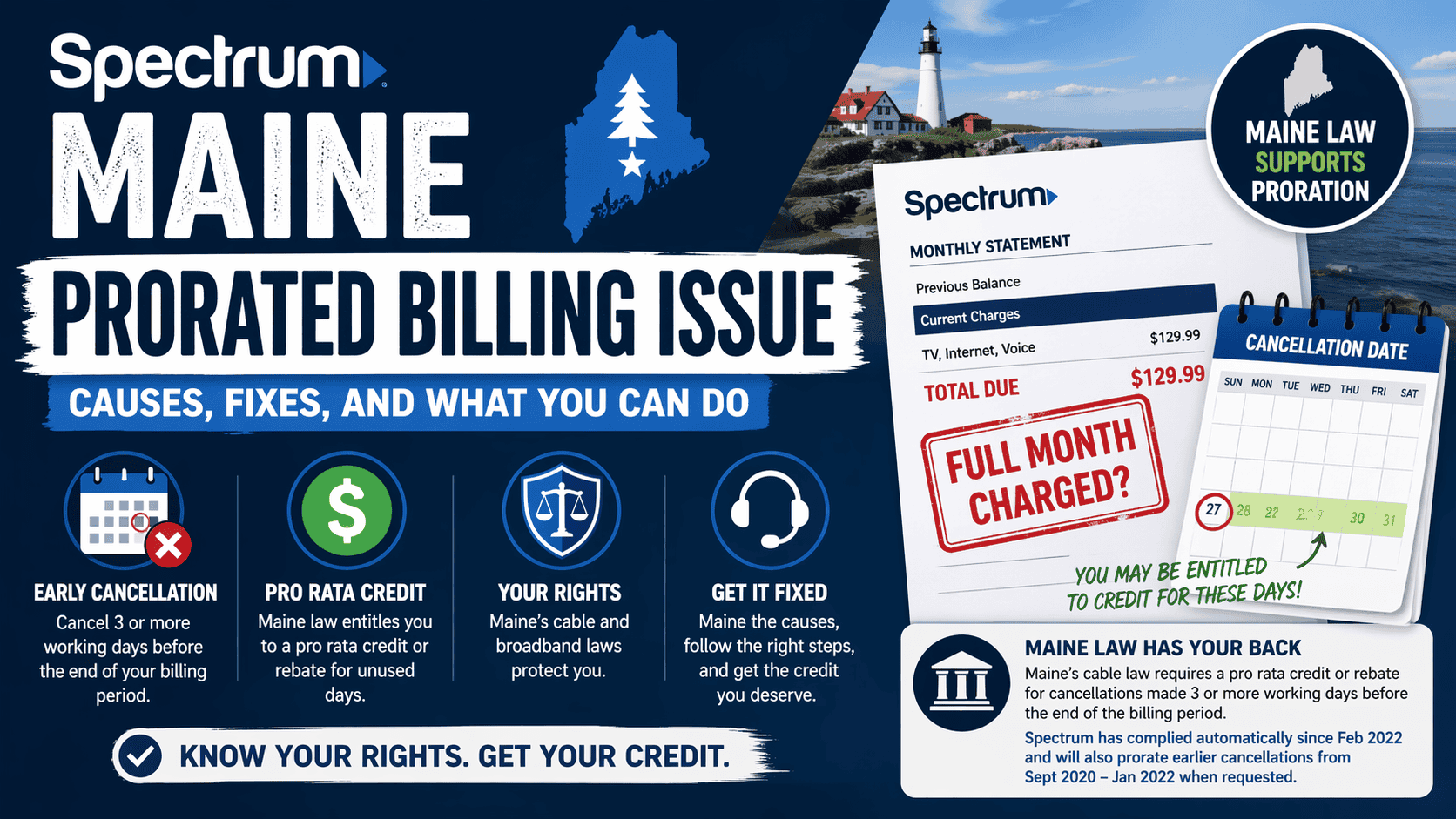

The Spectrum Maine prorated billing issue usually happens when a cancellation date and the billing cycle do not match cleanly. In Maine, cable and broadband customers may be entitled to a pro rata credit or rebate when they cancel service early enough, so a full month charge can create a billing dispute.
What the billing issue means
A prorated bill is a partial charge based on the days you actually used the service. The issue appears when a customer cancels Spectrum service, but the final bill still shows a full billing period or a charge that does not match the cancellation date. In Maine, the cable law says a subscriber should get a pro rata credit or rebate for the days after cancellation if the request is made three or more working days before the end of the monthly billing period. Maine later passed a similar broadband rule for internet service.
Spectrum has also said that its billing runs on a monthly basis and that billing does not stop until the end of the billing cycle. In Maine, the state Attorney General said Spectrum had been complying with the cable proration law automatically since February 2022 and would also prorate earlier cancellations from September 2020 through January 2022 when customers asked.
Main causes of the problem
| Cause | Why it happens | What it usually means |
|---|---|---|
| Cancellation came too close to the billing deadline | Maine proration protection applies when the request is made three or more working days before the end of the monthly billing period | The account may still be billed for the full cycle, even if service ended sooner |
| The account was closed, but the cycle kept running | Spectrum has said service is billed month to month and does not stop until the billing cycle ends | A final bill can show charges beyond the last day of use unless a credit is applied |
| The final statement includes unpaid fees | Spectrum says a final statement may cover outstanding charges after disconnection | The bill may contain more than service charges, such as equipment or other open balances |
| The wrong service type was billed | Maine has separate proration rules for cable and broadband internet service | A customer may need to check whether the service was cable, broadband, or both |
If you want to understand how administrative and policy issues affect organizations, you can also read our detailed guide on Air Force Academy Civilian Faculty Resignations.
How Maine proration rules work
For cable service, Maine law requires a cable system operator to stop billing within a set period after a cancellation request and to grant a pro rata credit or rebate if the cancellation request is made three or more working days before the end of the billing period. The bill must also tell customers about their right to that credit or rebate.
For broadband internet access service, Maine’s enacted law summary says the provider must give a pro rata credit or rebate for the days after cancellation if the customer requests cancellation three or more working days before the end of the monthly billing period. The law summary also says the provider must notify customers about that right.
This means the exact cancellation date matters. A bill can look wrong at first glance, but the legal answer depends on the service type, the day the request was made, and how many working days were left in the cycle.
How to check the bill
Start with the cancellation date. Compare that date with the billing cycle dates on the final statement. Then check whether the request was made at least three working days before the end of the cycle. That timing is the key detail under Maine’s proration rules.
Next, look for any notes about credits, rebates, equipment charges, or other open balances. Spectrum says a final statement after disconnect can include outstanding charges, so not every extra amount is a proration error.
If the bill shows a full month charge after an eligible cancellation, that is the point where the account should be reviewed for a proration correction. In Maine, Spectrum has said it has already been automatically prorating final cable bills under the state law, so the bill should be checked line by line if the amount looks off.
For users facing technical service interruptions, our article on Connectivity Issues HSSGamepad explains common problems and practical fixes.
What you can do to fix it
| Step | Action | Why it helps |
|---|---|---|
| 1 | Save the cancellation date, confirmation number, and final bill | You need proof of when service ended and when the request was made |
| 2 | Compare the bill period with the actual service end date | This shows whether you were charged beyond the time you used the service |
| 3 | Ask Spectrum to review the bill for a pro rata credit or rebate | Maine law gives customers a right to request the correction when the timing qualifies |
| 4 | Ask for the correction in writing | Written records make follow up easier if the dispute stays open |
| 5 | Keep screenshots and copies of any chat, email, or statement | This gives you a clean paper trail if the issue is escalated |
What to say when you contact Spectrum
Keep the message simple and specific. State the cancellation date, the final bill date range, and the amount that looks wrong. Ask whether the account was reviewed under Maine’s proration rule. If the cancellation met the three working day rule, ask for a pro rata credit or rebate for the unused part of the billing period. That language matches the Maine statute and the broadband law summary.
If Spectrum says the bill is correct, ask for the exact reason in writing. A clear written explanation is useful because Maine’s consumer complaint process asks for supporting documents, and the Attorney General’s office tells consumers to attach contracts and other proof when filing a complaint or request for mediation.
When the charge may still be valid
A full billing cycle charge may still be valid if the cancellation request was made too late in the cycle. Maine’s cable and broadband proration rules both use the three working day cutoff. If the request missed that window, the service provider may not owe a prorated credit for the remainder of the month.
A charge may also remain if the final statement covers other unpaid items, such as equipment or past due balances. Spectrum says final statements after disconnection can include outstanding charges, so the service charge and the rest of the bill need to be checked separately.
Where to escalate the dispute
If the bill still looks wrong after you contact Spectrum, Maine’s Attorney General consumer complaint and mediation service is the main place to escalate a business dispute. The Attorney General’s office asks consumers to submit supporting documents with the complaint. Its consumer help pages also say to complain directly to the business first, explain the problem clearly, and keep proof.
For cable and broadband billing issues in Maine, that path is usually more useful than simply paying the bill and hoping for an automatic correction later. The state has already enforced proration rights through its cable law, and the Attorney General has confirmed Spectrum’s compliance with that law since February 2022.
Records to keep
Keep the cancellation confirmation, the final statement, the service end date, the date you made the request, and every message exchanged with Spectrum. Keep any proof that shows the request was sent before the three working day cutoff, because that timing is what decides whether Maine’s proration rules apply.
Keep the account number too. That makes it easier for Spectrum or the Attorney General’s mediation team to match your paperwork to the correct account. Maine’s complaint process specifically asks for supporting documents, so a complete file helps move the review faster.


