

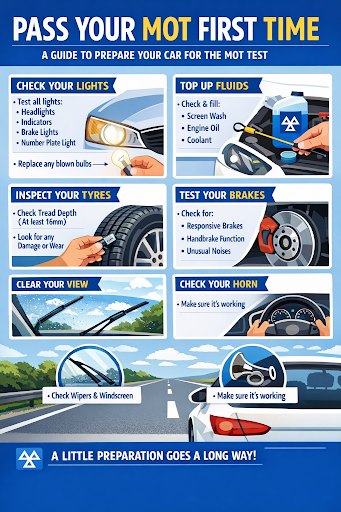

There are few things more frustrating than dropping your car off with confidence and getting a call an hour later to say it has failed. What makes it worse is discovering it failed for something completely avoidable, a blown bulb, empty screen wash, or a tyre that was borderline for months. If your MOT test is coming up in Guildford, the best thing you can do is treat preparation as part of the process, not an afterthought.
The majority of MOT failures come down to basic maintenance that any driver can stay on top of between tests. A full car service before your MOT date puts your vehicle in the strongest possible position, but even without one, a thorough set of checks in the days beforehand can make a significant difference. This guide walks you through exactly what to inspect, what to watch for, and how to give your car the best possible chance of passing for the first time.
Why Cars Fail Their MOT More Often Than You Think
According to data published by the Driver and Vehicle Standards Agency (DVSA), roughly 40% of vehicles fail their MOT on the first attempt each year. That is a significant number, and the majority of those failures are for issues that could have been spotted and sorted before the test even began.
The table below shows the most common failure categories based on official DVSA data:
| Failure Category | Approximate Share of All Defects |
| Lamps, reflectors and electrical equipment | 24% |
| Brakes | 21% |
| Suspension and steering | 14% |
| Tyres | 11% |
| Body, chassis and structure | 10% |
What stands out here is that lights and tyres together account for more than a third of all MOT failures. Both are things you can check yourself, at home, before your test date. The sections below cover each area in plain, practical terms.
The Checks That Make the Biggest Difference
1. Walk Around Every Light on Your Car
Faulty lighting is the single most common reason vehicles fail their MOT, and it is also one of the easiest to fix. Before your test, check every external light on the car, headlights, sidelights, brake lights, indicators, fog lights, reversing lights, and the number plate light. All of them need to be working, correctly aligned, and free from significant damage or condensation inside the casing.
The best way to check brake lights on your own is to reverse up close to a wall or garage door and apply the brakes, you will see the red glow reflected back. For everything else, turn them on one at a time and walk around the car.
A few things to look for:
- Bulbs that have blown or are flickering
- Cracked or heavily fogged light covers
- Indicators that flash too quickly or too slowly, which usually signals a failed bulb
- The number plate light, which is easy to overlook and a common cause of failure
Replacing a bulb costs very little and takes minutes. There is no reason to walk into an MOT with a blown one.
2. Check Your Tyres: Tread, Pressure, and Condition
Tyres are one of the most thoroughly inspected parts of your car during an MOT, and getting them wrong is expensive in more ways than one. The legal minimum tread depth in the UK is 1.6mm across the central three-quarters of the tyre. Driving on anything below that is illegal and dangerous, and it will result in an immediate failure.
Before your MOT, understanding why it pays to check your tyres beforehand can save you both a retest fee and the cost of last-minute replacements under pressure.
The 20p test is the simplest way to check tread at home. Insert a 20p coin into the main tread grooves across the tyre. If the outer band of the coin is visible, your tread is below the legal limit and the tyre needs replacing before the test.
Beyond tread depth, also check:
- Tyre pressure on all four wheels, including the spare if your car has one, the correct PSI is listed on a sticker inside the driver’s door frame
- The sidewalls for any cuts, bulges, or cracking
- Uneven wear patterns, which can indicate a wheel alignment or suspension issue
- Whether your tyre pressure monitoring system (TPMS) warning light is illuminated, this is now checked during the MOT on vehicles fitted with the system
3. Test Your Brakes Before the Tester Does
Brakes account for around 21% of all MOT defects, making them the second most common failure point. You do not need a workshop to get a basic sense of whether your brakes are in good shape. Pay attention to how they feel and sound during normal driving in the days before your test.
Warning signs that suggest your brakes need attention before the MOT:
- A squealing or grinding noise when you apply the brakes
- The car pulling to one side when braking
- A spongy or soft feeling through the brake pedal
- Vibration through the steering wheel when slowing down
- The handbrake failing to hold the car on a slope
Brake fluid is also inspected during the test. Low brake fluid can indicate a leak in the system, which is a serious safety concern. Check the level in the reservoir under the bonnet, it should sit between the minimum and maximum markers. If it is consistently dropping, get it looked at before your test date.
4. Top Up All Your Fluids
Fluid checks during an MOT are straightforward, but failing for something like an empty screen wash reservoir is the kind of failure that stings. It takes under two minutes to prevent. The fluids inspected include engine oil, coolant, brake fluid, and windscreen washer fluid.
Use the dipstick to check your engine oil level, it should sit between the two markers on the stick. If the oil looks very dark or gritty, it may be worth having a service done before your MOT rather than after.
Coolant should be checked when the engine is cold. Look at the reservoir and ensure the level sits within the marked range. Never open the coolant cap on a warm engine.
Screen wash is worth keeping full at all times, not just before an MOT. Running out is an offence in itself, and a tester will record it as a failure if the reservoir is empty.
5. Inspect Your Windscreen and Wiper Blades
Your windscreen does not need to be perfect to pass, but there are clear boundaries. A crack or chip larger than 10mm within the driver’s direct line of sight is an automatic failure. Damage larger than 40mm anywhere else on the screen will also cause a failure. Smaller chips outside these zones may result in an advisory rather than an outright fail.
Check your windscreen in good light before the test, chips can be easy to miss on a dull day. If there is any doubt, get it assessed by a glass specialist ahead of your MOT.
Wiper blades are inspected for effectiveness, not just condition. If the blades smear, skip, or leave streaks across the screen, they are likely to fail. Torn or split rubber on the blade edge is a clear sign they need replacing. Wiper blades are inexpensive and straightforward to swap out at home.
6. Clear Any Dashboard Warning Lights
An illuminated engine management light is a major defect under MOT regulations. If it is showing when you arrive at the test centre, the tester may refuse to carry out the test entirely, or it will result in an automatic failure. The same applies to any warning light that relates to a system covered by the MOT, brake warning lights, steering system warnings, and TPMS alerts all fall into this category.
Do not make the mistake of assuming the light will clear on its own, or that it is something minor that can wait. Get it diagnosed before your test date. Modern diagnostic tools can read the fault code and tell you exactly what is triggering the light, which helps avoid unnecessary guesswork or expense.
7. Check Mirrors, Horn, and Number Plates
These checks take less than five minutes and are regularly overlooked by drivers preparing for their MOT.
Both door mirrors and the interior rear-view mirror must be securely attached, undamaged, and provide a clear, unobstructed view. A cracked or loose mirror is a fail waiting to happen.
Your horn must produce a consistent, audible sound. Give it a quick test, it rarely fails, but it does happen.
Number plates must be clean, clearly visible, securely fixed, and display lettering in the correct legal font and spacing. The number plate light must also be working. A plate that is faded, cracked, or displaying non-standard characters is a failure point.
Do Not Ignore Last Year’s Advisory Notice
This is the section most drivers skip, and it is one of the biggest reasons cars fail year after year. An MOT advisory is not a pass with a footnote. It is a warning from the tester that a component is approaching the point of failure. When your car goes back for its next MOT twelve months later, that advisory item will be inspected again, and this time it may have crossed into failure territory.
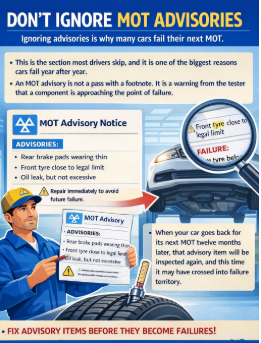
If your previous MOT certificate lists any advisories, treat them as a maintenance list, not background noise. Common advisory items that become failures include:
- Brake pads approaching minimum thickness
- Suspension components showing early wear
- Tyre tread that was borderline at the last test
- Corroded brake pipes or bodywork
Addressing advisories between tests is far cheaper than dealing with a failure, a retest, and an urgent repair under time pressure.
Go in Confident With a Pre-MOT Check
If you want to remove as much uncertainty as possible before your test, a professional pre-MOT inspection is the most reliable way to do it. A trained technician will work through every area the tester will examine, flag anything that needs attention, and give you the opportunity to have it sorted before the official test date.
For drivers in and around Guildford, this kind of preparation is particularly worthwhile if your car has higher mileage, has not had a recent service, or had advisories on its last certificate. You can check exactly what the MOT covers by reviewing the MOT test checklist so you know what to expect.
The table below gives you a quick reference to run through in the days before your test:
| Check | What to Look For | Can You Do It Yourself? |
| All lights | Working, clean, no damage | Yes |
| Tyre tread and pressure | Min 1.6mm, correct PSI, no sidewall damage | Yes |
| Brake response | No noise, pulling, or soft pedal | Partly: garage for fluid check |
| Fluid levels | Oil, coolant, brake fluid, screen wash all topped up | Yes |
| Windscreen | No chips over 10mm in driver’s sightline | Yes |
| Dashboard warning lights | All clear before test day | Garage if any are showing |
| Wiper blades | No streaking, smearing, or torn rubber | Yes |
| Mirrors and horn | Secure, clear, audible | Yes |
| Number plate and light | Clean, legal font, light working | Yes |
Conclusion
Passing your MOT for the first time is not about luck. It is about knowing what the tester looks for and making sure your car is in good shape before it arrives at the bay. The checks in this guide are not complicated, most take minutes and require no specialist tools. The drivers who fail are usually the ones who assumed everything was fine rather than taking the time to check.
If your MOT is coming up in Guildford, run through this guide a few weeks before your test date. Give yourself time to act on anything you find. A small amount of preparation now is far less stressful, and far less expensive, than dealing with a failure on the day.
Frequently Asked Questions
What are the most common reasons for failing an MOT? According to DVSA data, the most common failure categories are lights and electrical equipment, brakes, suspension, and tyres. Most of these failures are preventable with basic checks carried out before the test.
Can I drive to my MOT with the engine management light on? An illuminated engine management light is classed as a major defect and will result in an automatic MOT failure. Have the fault diagnosed and resolved before booking your test.
How do I check my tyre tread depth at home? Use a tread depth gauge, or try the 20p coin test. Insert a 20p coin into the main tread groove, if the outer band of the coin is visible, your tread is below the legal 1.6mm minimum and the tyre must be replaced before your MOT.
Does a cracked windscreen automatically fail an MOT? Not always. A crack or chip larger than 10mm within the driver’s direct line of sight is an automatic failure. Damage larger than 40mm elsewhere on the screen also fails. Smaller chips in lower-risk areas may only result in an advisory notice.
What fluids are checked during an MOT? The tester will inspect engine oil, coolant, brake fluid, and windscreen washer fluid. Low or empty screen wash is one of the most easily avoided failure points and takes seconds to fix.
What is an MOT advisory notice? An advisory is a note from the tester highlighting a component that is showing wear but has not yet reached failure standard. Advisories should be addressed between tests, ignoring them is one of the leading causes of failure at the following year’s MOT.