



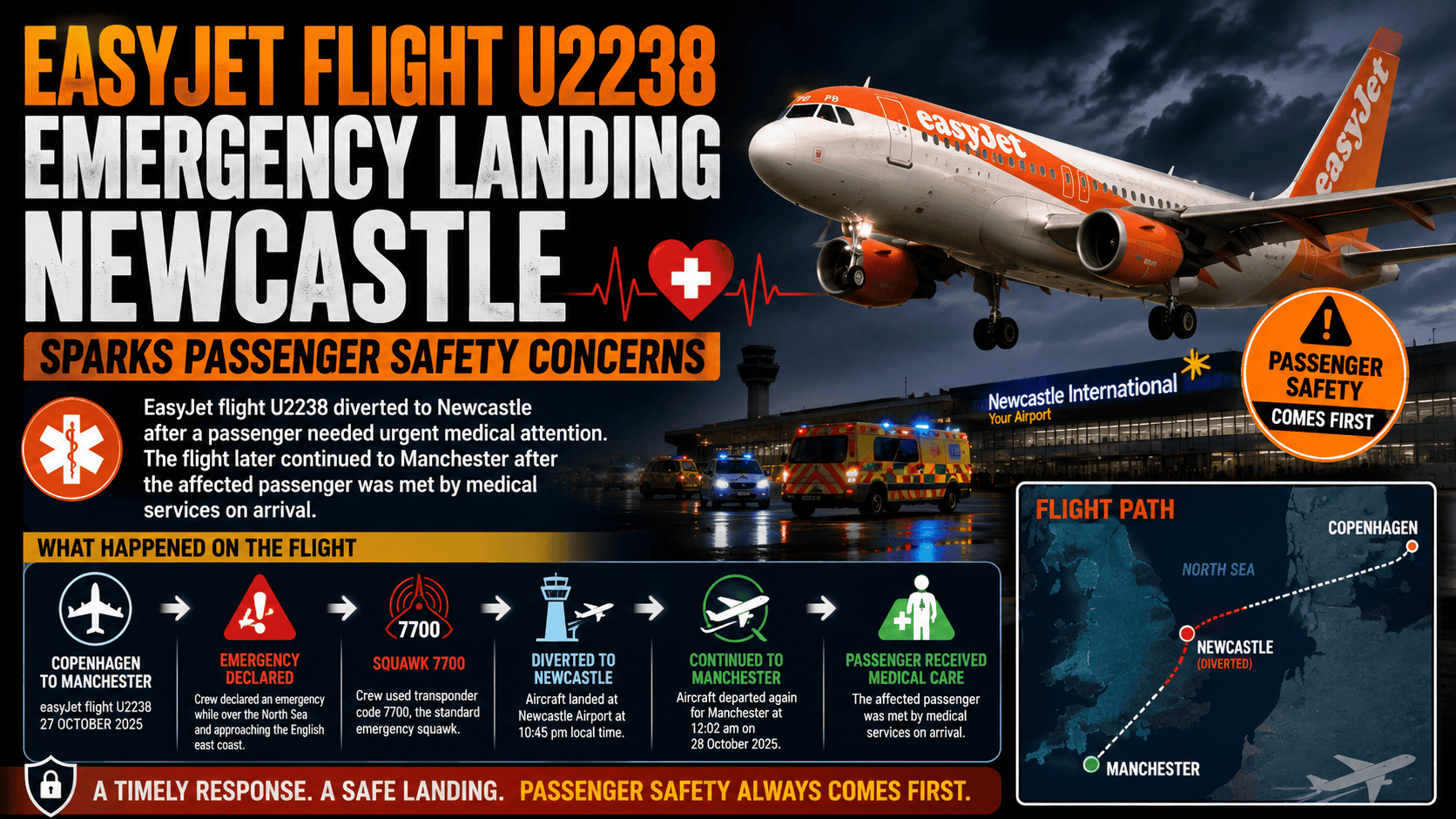
EasyJet flight U2238 diverted to Newcastle after a passenger needed urgent medical attention. The flight later continued to Manchester after the affected passenger was met by medical services on arrival.
What Happened on the Flight
Reports on the incident describe an easyJet service from Copenhagen to Manchester that diverted to Newcastle on 27 October 2025. AviationSource said the aircraft was an Airbus A320-200, registered G-EZPB, and that the crew declared an emergency while the plane was over the North Sea and approaching the English east coast. GB News also reported that the flight made an unscheduled landing at Newcastle Airport after a passenger needed urgent medical attention.
AviationSource said the crew used transponder code 7700, which is the standard emergency squawk, before turning toward Newcastle. The same report said the aircraft landed at Newcastle at 10:45 pm local time and then departed again for Manchester at 12:02 am on 28 October. GB News reported that the flight later resumed its journey after the passenger was handed over to medical services.
Why the Flight Diverted to Newcastle
The reason for the diversion was a medical issue on board. GB News said the passenger developed a condition that required immediate medical assistance, and easyJet stated that the customer was met by medical services on arrival. AviationSource also described the event as an onboard passenger medical issue.
easyJet said the safety and wellbeing of customers and crew remain its highest priority. That point matters because a diversion is usually not treated as a delay problem first. It is treated as a safety response that allows the crew to get the passenger to medical care as quickly as possible.
Why Passenger Safety Concerns Rise After an Emergency Landing
An emergency landing can worry passengers because it changes a normal flight into an urgent situation very quickly. People on board may hear an emergency announcement, see the crew move fast, and then watch the plane change course without warning. That kind of disruption can feel serious even when the aircraft remains under control and the crew is following procedure.
Medical events in flight are not common, but they do happen. The CDC says medical emergencies occur on about 1 in every 604 commercial flights, and about 10 percent of those cases lead to a diversion to another landing site. The same CDC guidance says most flights continue to their destination, which shows that a diversion is used when the crew and ground medical support decide that a different landing point is the safer choice.
That is why this Newcastle landing drew attention. A diverted flight can raise questions about how quickly help reaches the passenger, how serious the issue was, and whether the rest of the cabin was ever at risk. In most cases, the answer is that the diversion is the risk control measure, not the failure.
Recent transport disruption reports such as the Arkleston Road Renfrew Emergency Fault also show how emergency responses and safety measures can quickly affect travel operations and public movement.
How Airlines Handle a Medical Emergency in the Air
The CDC says flight attendants are certified in CPR and AED use, and they are trained to assist while the cabin crew coordinates the response. The guidance also says crews may use the first aid kit, emergency medical kit, and any available onboard medical help from passengers or ground-based medical services.
The CDC further explains that the pilot and the ground-based emergency medical service contracted by the airline make the final diversion decision. That is important because a medical landing is not usually a snap judgment made by one person alone. It is a coordinated decision based on the passenger’s condition, the aircraft’s location, and the nearest suitable airport.
In the case of easyJet flight U2238, the aircraft diverted to Newcastle rather than continuing straight to Manchester. AviationSource said the plane was already cruising and then turned directly toward Newcastle Airport after the emergency was declared. GB News reported that medical personnel were waiting when the aircraft landed, which fits the usual handling pattern for this kind of event.
What This Incident Shows About Airline Safety
This event shows how quickly an ordinary passenger flight can change into an emergency response. Even when the problem is not mechanical, the airline still needs a safe airport, medical support on the ground, and a crew that can keep the cabin calm while the aircraft diverts. Newcastle Airport served that role here by receiving the aircraft and the passenger before the flight moved on to Manchester.
It also shows why emergency reports often spread fast. A diverted aircraft affects more than the passenger who needs help. Other passengers may face a delay, and nearby traffic can also be affected while the aircraft lands and clears the runway. The Sun reported that another aircraft was briefly put into a holding pattern while the easyJet flight landed, which shows how one medical diversion can affect wider airport operations.
Readers who follow aviation safety updates may also want to check the latest details about the TUI Flight BY6754 Emergency Landing and how the crew handled the unexpected situation during the journey.
What Passengers Should Know During a Similar Event
When a flight diverts for medical reasons, passengers should follow crew instructions and keep aisles clear. The CDC says crew and ground medical support may need access to the person in distress, and it also notes that moving the person to a better space is only done if it can be done safely. That is why cabin crew often ask other passengers to stay seated unless they are needed.
Passengers should also keep essential medication in their carry on bag, not in checked luggage. The CDC advises travelers not to fly while acutely ill and says they should carry medications, medical devices, and supplies with them on the plane. That guidance is useful because many in flight emergencies start with a pre existing health issue that becomes worse in the air.
If a medical event happens on board, the best response is usually calm cooperation. Flight crews are trained to ask for medical help, use available equipment, communicate with the pilot, and work with ground medical teams. In this easyJet case, that process ended with a safe landing in Newcastle and the flight continuing to Manchester after the passenger was handed over to medical services.


