


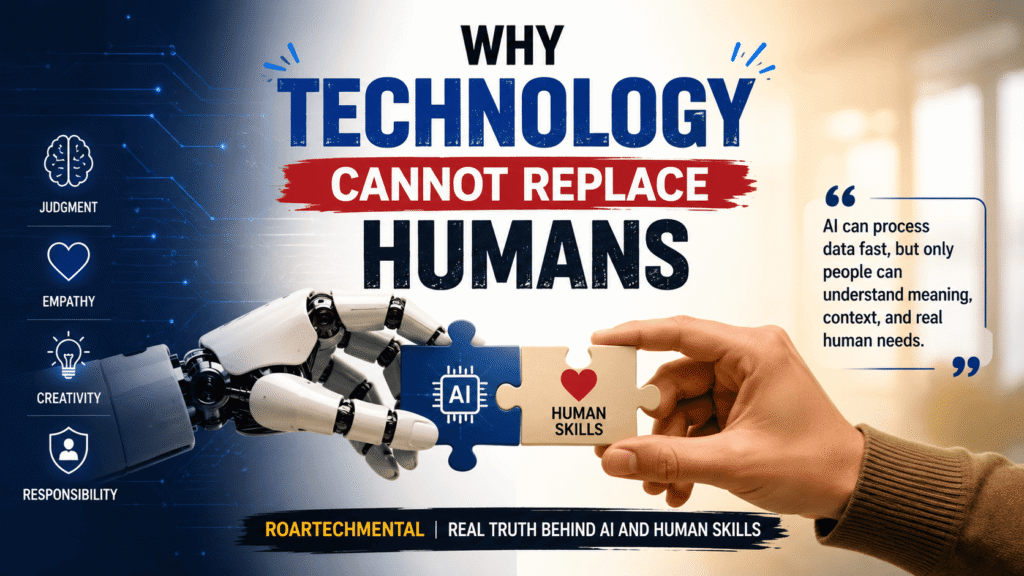
Technology can support human work, but it cannot fully replace human judgment, empathy, creativity, or responsibility. AI can process data fast, but only people can understand meaning, context, and real human needs.
Human Judgment Remains Essential
Technology works from patterns, rules, and data. It can sort, predict, and automate many tasks. But it does not understand life the way people do.
Human judgment is needed when facts are unclear, goals conflict, or a decision affects real people. A machine can give a result, but it cannot truly weigh values, ethics, trust, and long term impact in the same way a person can.
This matters in business, healthcare, education, law, media, customer service, and leadership. In each of these areas, the final decision often depends on human judgment, not just technical output.
AI Follows Data, Humans Understand Context
AI systems depend on training data. If the data is incomplete, biased, old, or limited, the output can be weak or misleading. Technology does not naturally understand culture, emotion, social pressure, or hidden meaning.
Humans read context. They notice tone, urgency, hesitation, and intent. They understand when a situation is sensitive and when a strict answer is not enough.
For example, a support chatbot may solve a simple question. But when a customer is angry, confused, or in distress, a human agent can respond with care, patience, and flexibility. That difference is very important.
Emotional Intelligence Cannot Be Automated
One of the biggest reasons technology cannot replace humans is emotional intelligence. People need to feel heard, respected, and understood. Machines can imitate polite language, but they do not feel concern or responsibility.
Emotional intelligence helps in many ways. It supports teamwork, leadership, negotiation, teaching, sales, conflict resolution, and management. A person can detect tension in a meeting and adjust the conversation. A machine cannot truly sense the room.
Human beings also build trust through empathy. Trust is not built only by correct answers. It comes from timing, tone, care, and accountability. These are human strengths that technology cannot fully copy.
Creativity Needs More Than Pattern Matching
AI can generate text, images, music, and ideas by using patterns from existing material. That is useful, but it is not the same as human creativity.
Real creativity often starts with a purpose, a feeling, a problem, or a vision. Humans create with intent. They combine knowledge, experience, and emotion to make something new and meaningful.
Technology can assist creative work. It can speed up drafts, offer options, and reduce repetitive tasks. But it does not replace the human mind that chooses the idea, shapes the message, and gives it direction.
Creative work also depends on taste. Human taste changes with culture, time, and audience. A machine can suggest what is common, but humans decide what is original, useful, and worth sharing.
Human Skills Adapt Faster in Unpredictable Situations
Technology works best in stable conditions. It performs well when the problem is clear and the rules are known. Human skills become more important when conditions change quickly.
People adapt when plans fail, tools break, or new problems appear. They can think across different areas, ask new questions, and respond without waiting for a fixed program.
This is why human workers remain important in emergencies, negotiations, field operations, management, and care work. A person can improvise, reason, and change direction in real time. That flexibility is difficult for technology to match.
Ethics and Responsibility Belong to People
Technology does not carry moral responsibility. It does not know right from wrong. It cannot be blamed in the same way a person can. The people who design, use, and supervise technology are the ones responsible for its effects.
This is a major reason humans cannot be removed from important decisions. When a choice affects privacy, safety, fairness, or rights, someone must take responsibility.
Humans also understand that not everything efficient is acceptable. A system may be fast, but it can still be unfair. It may be accurate in one narrow sense, but harmful in a wider sense. Ethical thinking requires human conscience, not just computation.
Communication Is More Than Information
Technology can deliver messages quickly. It can translate words, summarize text, and automate replies. But real communication is more than moving information from one place to another.
People communicate to persuade, reassure, connect, lead, and resolve problems. They adjust their language based on the audience. They know when to be direct, when to be careful, and when to listen instead of speaking.
Good communication also involves trust. A human speaker can notice confusion and explain again in a better way. A machine may repeat information, but it does not truly understand whether the message has landed.
Human Work Carries Values, Not Just Output
Many jobs are not only about completing tasks. They are about serving people, protecting standards, and building relationships. Technology can improve speed and efficiency, but it cannot replace the values behind the work.
A teacher does not only deliver facts. A doctor does not only process symptoms. A manager does not only assign tasks. These roles require responsibility, care, and judgment.
When human values matter, human involvement matters too. Technology can support the work, but people give it meaning and direction.
Technology Is Strongest as a Tool, Not a Replacement
The smartest approach is not to treat technology as a human replacement. It is better to use it as a tool that strengthens human ability.
AI can help with data entry, search, scheduling, forecasting, drafting, and other repetitive tasks. This gives people more time for higher value work. When used well, technology increases productivity without removing the human role.
The best results come from human and machine cooperation. The machine handles speed and scale. The human handles meaning, judgment, and accountability. That balance is practical and sustainable.
To understand how AI and systems are evolving further, see What New Technology Is Coming Scookietech for a deeper look at upcoming innovations.
Human Skills That Technology Cannot Fully Copy
Some human skills remain difficult or impossible to replace completely. These include empathy, leadership, moral reasoning, cultural understanding, and deep trust building.
Human decision making also includes uncertainty. People can make sense of incomplete information and still act responsibly. They can consider long term effects, relationships, and social impact.
Another important skill is lived experience. People bring personal knowledge from real work, real pressure, and real consequences. That experience shapes better choices in ways data alone cannot.
For a broader view of evolving digital systems, check Major Trends in Technology Togtechify which explains how technology is reshaping industries.
Why Businesses Still Need Humans
Businesses often adopt technology to reduce cost and improve speed. That makes sense. But successful businesses still depend on people.
Customers want clear communication, reliable service, and real understanding. Teams need leaders who can make decisions, solve conflict, and keep people aligned. Brands need human insight to stay relevant and trusted.
Automation can cut repetitive work. It cannot fully replace human connection, creative strategy, or responsible leadership. Businesses that understand this tend to use technology better and serve people better.
Human Oversight Protects Quality
Even when technology is highly advanced, human oversight is still necessary. Systems can fail silently, repeat mistakes, or produce confident but wrong answers.
Human review helps catch errors, protect quality, and keep standards high. This is especially important in health, finance, education, publishing, law, and public communication.
Quality control is not just about checking accuracy. It is about checking whether the result is appropriate, fair, safe, and useful. That level of review requires people.
Education Still Needs Human Teachers
Technology has changed education, but it has not replaced teachers. Learning is not only about receiving content. It is about motivation, guidance, correction, and encouragement.
A teacher notices when a student is lost, shy, distracted, or discouraged. A digital platform can track progress, but it cannot fully replace the human ability to inspire confidence and build understanding.
Students also learn by asking questions, making mistakes, and receiving personal feedback. These are human learning experiences, and they remain important even in a digital classroom.
The Real Truth Behind AI and Human Skills
The real truth is simple. AI is powerful, but it is limited. It can process more than humans in many areas, but it cannot replace the full range of human ability.
Human skills are broader than technical output. People understand purpose, values, emotion, context, and consequences. They can build trust, lead change, and make thoughtful choices under pressure.
Technology will continue to grow. It will become faster, smarter, and more useful. But growth does not mean replacement. In most important areas, human skill stays essential because human life is complex, and human needs are personal.
What Human Work Will Always Be Needed For
Human work will remain necessary in places where judgment, empathy, creativity, and responsibility matter most. That includes caring for people, making ethical decisions, leading teams, teaching, building trust, and solving new problems.
Technology can support all of these areas. It can make work faster and more efficient. But the core human role remains.
The future belongs to people who know how to use technology well while protecting the value of human skill. That balance is the most practical way forward.


