


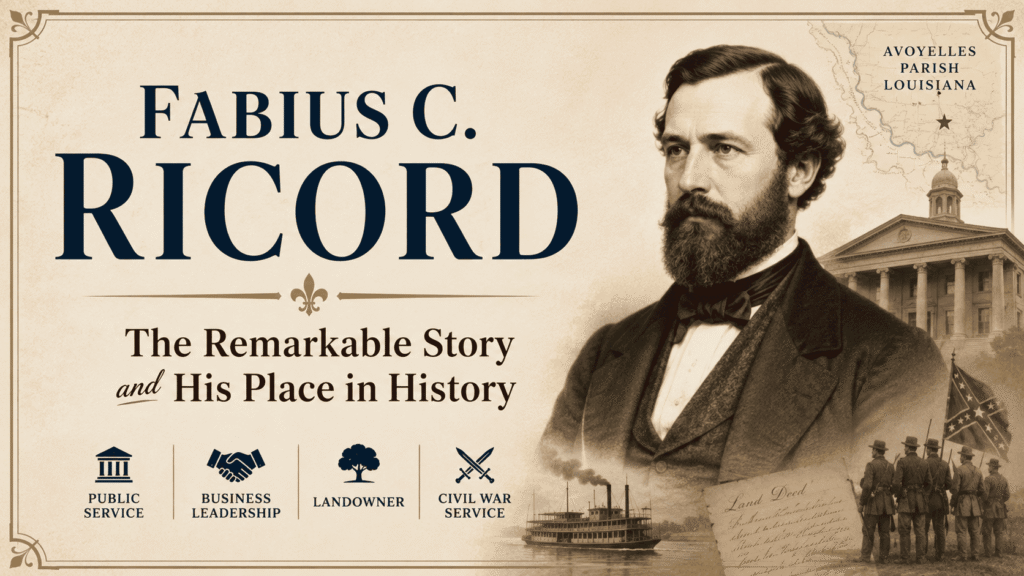
Fabius C. Ricord was a local public figure in 19th century Avoyelles Parish, Louisiana. Historical sources usually record his name as Fabius Ricord and link him to public office, business activity, land ownership, and Civil War era service.
Fabius Ricord in the Historical Record
The surviving record for Ricord is local, not national. A parish history page describes him as one of the most active people in early Avoyelles Parish and lists him as a notary public, postmaster, merchant, sheriff, clerk of court, and landowner. The same page also notes that his name appears in more than one form, including F. Ricord and Fabien Ricord. That matters because old parish records often used spellings loosely, so researchers need to compare several versions of the name.
Holmesville and His Early Public Work
Ricord first appears in the local record as postmaster at Holmesville in 1838. A Holmesville history page says he later served as sheriff, and the Avoyelles history page says records held by the General Services Administration and National Archives and Records Research list him as postmaster at Holmesville in July 1838. These references place him in the public life of the parish at an early stage, when Holmesville was still an important local center.
Holmesville was not a minor stop in the parish story. The community pages show it as a place where trade, travel, and daily administration mattered. Ricord’s position there suggests that he worked close to the core of local life, where mail, records, and public contact were all part of the same network. In small Louisiana communities of the period, a postmaster often stood near the center of local communication and commerce.
Clerk of Court and Parish Government
The parish record also places Ricord in formal government work. One source says he was sheriff of Avoyelles Parish in 1843 and 1874, and clerk of court from 1856 to 1859 and again from 1864 to 1865. That pattern shows a man who stayed useful to parish administration over a long span of time. He did not appear in the records for one short term only. He returned again and again to jobs that required trust, order, and knowledge of local law.
This part of his story also shows how parish government worked in 19th century Louisiana. A clerk of court handled records that mattered to land, property, court work, and legal transactions. A sheriff held duties that touched public order and enforcement. Ricord’s repeated presence in these roles suggests that he was not only known in one village. He was part of the larger machinery of Avoyelles Parish government.
Business, Land, and Property
Ricord also appears in land records. A Holmesville history page says that on August 23, 1841, Taylor, Garrigues & Co. sold him land and buildings on Bayou Boeuf for $16,564.11. The same source says he later sold the tract on April 13, 1849, and it gives the recorded details of that sale as well. The page also notes that boards marked “F. Ricord & Company” were later found at the site, which supports the idea that he had an active business presence there.
The land record is important because it shows Ricord as more than a name in office listings. He owned property, moved land through legal channels, and operated in a place where ownership and trade were closely connected. In a parish built around waterways, roads, and settlement lines, land was not only real estate. It was part of local power and long term planning. Ricord’s property record shows that he took part in that world directly.
If you are researching digital finance and banking solutions, check out our complete RBLcashrbl resource that explains its features, benefits, and practical uses for modern financial management.
His Role in Holmesville Life
Local histories present Ricord as a steady figure in Holmesville’s early development. One page says he had a store there, and another says he lived in the Holmesville area from 1837 until at least 1856, when the record places him in Marksville as clerk of court. That kind of movement is useful for understanding his place in history. It shows that he worked in both the village economy and the parish government structure, which often overlapped in early Louisiana communities.
The Holmesville pages also list other names tied to the village, which helps show the setting around Ricord. These histories make clear that Holmesville was a place of merchants, officials, landowners, and local families. Ricord belongs in that group. He was part of the village’s public and commercial life, not an isolated figure. His store, office work, and property all point to the same kind of local leadership that held small communities together.
The Civil War Period
The clearest wartime detail in the record is the use of one of Ricord’s buildings for a Confederate hospital. The Avoyelles history page says a Marksville newspaper notice described the hospital as being located in Mr. Ricord’s building on Monroe Street. That is a strong local clue about his role during the Civil War era. It shows that his property served a public need at a time when military injury and illness placed pressure on local communities.
This detail does not prove a formal military rank or battlefield role, and the source does not claim that. Instead, it shows something more grounded in local history. Ricord’s property was part of the wartime response in Marksville. For historians, that kind of record matters because it links a private citizen to public need. It also explains why later local writers remembered him as a humanitarian figure in the parish story.
Family and Background
The available record does not give a full birth file for Ricord. One Avoyelles history page says it does not have his birth record, but it recalls reading that he was born in France and came to Avoyelles Parish in the early 1830s. That statement should be treated carefully because the source presents it as a recollection rather than a fully verified record. Even so, it gives a useful clue about where he may have come from before he entered parish life in Louisiana.
That same lack of complete personal data is common in older parish history. Many people who played important local roles in the 1800s left a paper trail through land, court, and postal records rather than through detailed biographical files. Ricord fits that pattern. His life is visible through deeds, office listings, and local notices, even when the family record is thin.
His Place in History
Ricord’s place in history comes from steady local service. The record ties him to Holmesville and Marksville, to office work and business, and to land and wartime use of property. He appears in the story of Avoyelles Parish at a time when local leaders needed to manage mail, records, trade, and community needs at the same time. That makes him a useful example of how parish life functioned in 19th century Louisiana.
He stands out because several different records point to the same general picture. He was a postmaster in Holmesville, a sheriff, a clerk of court, a landowner, and a man with a store and property in the parish. The surviving evidence does not present him as a national celebrity. It presents him as an important local figure whose work touched government, commerce, and community life across many years.
For readers interested in modern workplace engagement strategies, our detailed guide on Xendit Work GamificationSummit explores how organizations use gamification, employee motivation programs, and collaborative learning to improve performance and team productivity.


