

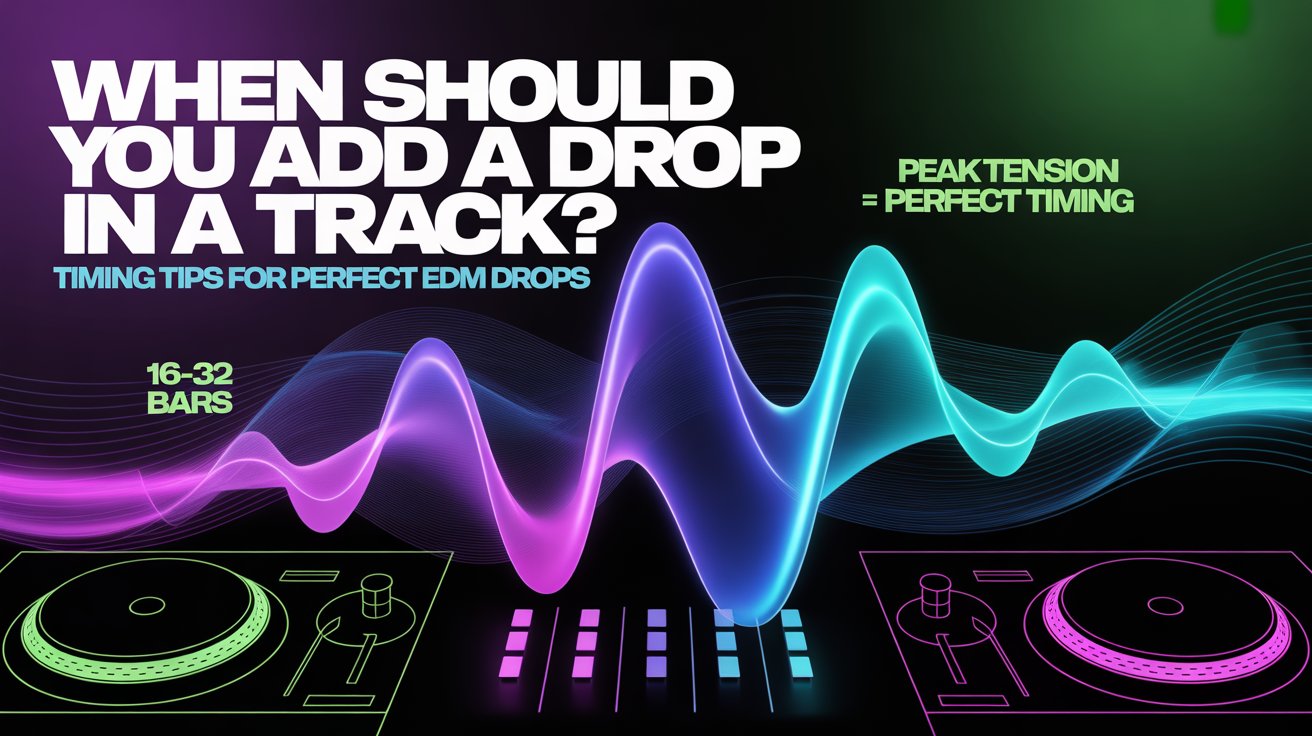

Add a drop when the build-up reaches its peak and the listener expects release, commonly after 16 to 32 bars. Choose the exact moment based on genre, tempo, and the energy you want to deliver.
When to add the drop
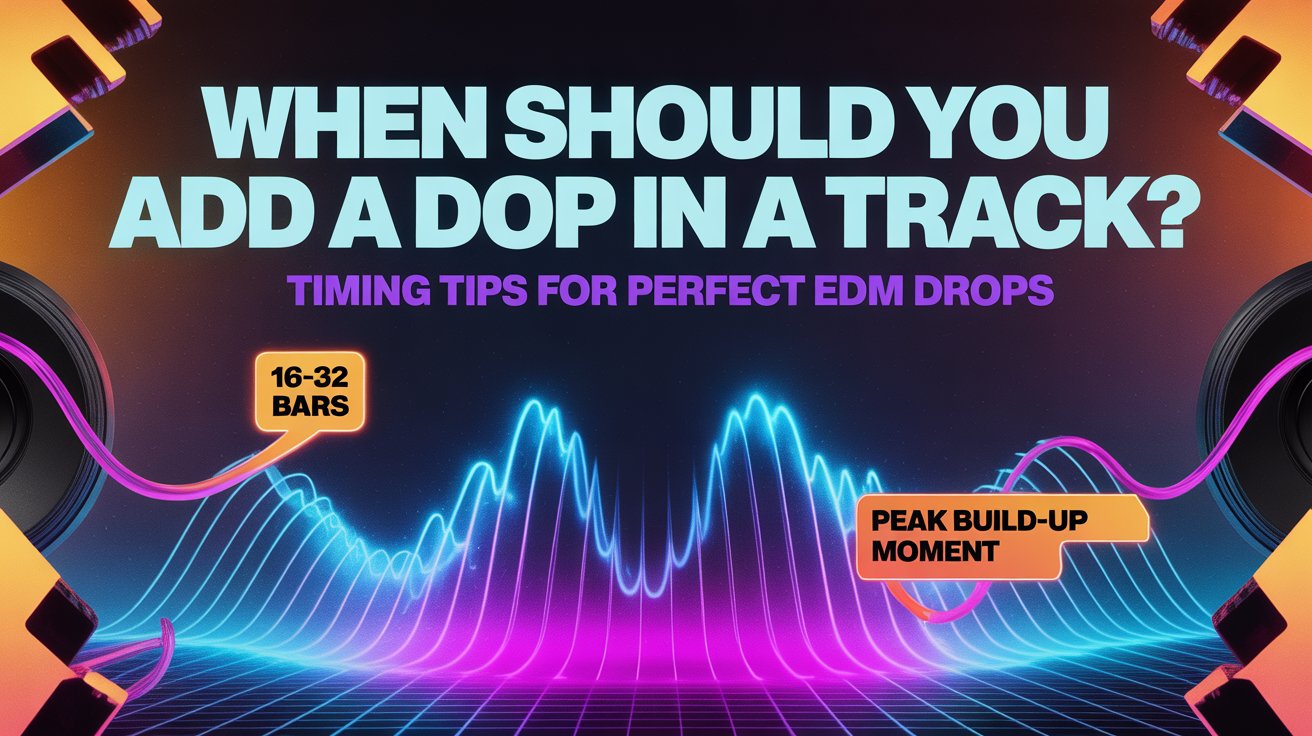
Place the drop right after the strongest moment of the build-up. That moment is when tension, rhythmic elements, and melodic cues point to an imminent release. In most EDM tracks this falls between 16 and 32 bars from the track start. For radio or pop formats you may place the first drop earlier. For club-focused productions a slightly longer build-up can work better.
Common positions in song structure
Keep song sections standard and predictable for listeners.
- Intro: 8 to 32 bars. Use this to set tempo and groove.
- Verse or breakdown: 8 to 32 bars. Reduce energy here.
- Build-up: 8 to 32 bars. Increase tension gradually.
- Drop: the release after the build-up.
- Post-drop: 8 to 32 bars. Return to groove or variation.
Most commercial EDM tracks use a build-up of 8 to 16 bars that leads into a 16-bar main drop. Variations happen, but these ranges are industry standard and safe for DJs and playlists.
Counting bars and converting to seconds
A bar in common EDM is usually 4 beats in 4/4 time. To find seconds per bar do this:
- Seconds per beat equals 60 divided by BPM.
- Seconds per bar equals four times seconds per beat.
For example at 128 BPM: - Seconds per beat = 60 / 128 = 0.46875
- Seconds per bar = 0.46875 × 4 = 1.875
- A 16-bar build-up lasts 30 seconds at 128 BPM
Use this method when you need exact timing for sync with visuals, radio edits, or DJ mixes.
Genre and tempo guide
Different subgenres use different tempos and drop timings. Use these as a reference when planning the drop.
| Genre | Typical BPM | Common drop position (bars) | Approximate time for 16 bars |
|---|---|---|---|
| House, Deep House | 120 | 16 to 32 | 32 seconds |
| Progressive House | 125 to 130 | 16 to 32 | 29 to 30 seconds |
| Electro House | 125 to 130 | 16 to 32 | 29 to 30 seconds |
| Trance | 128 to 138 | 16 to 32 | 28 to 30 seconds |
| Dubstep | 140 | 8 to 16 | 27 seconds (for 16 bars) |
| Drum and Bass | 170 to 175 | 8 to 16 | 22 to 24 seconds |
| Techno | 120 to 132 | 16 to 32 | 29 to 32 seconds |
This table gives practical ballpark values. Adjust to taste and market requirements.
Signals that the drop should come now
Producers use arrangement cues to tell the listener the drop is coming. Watch for these elements.
- Percussion simplifies or cuts out on the downbeat before the drop.
- Snare rolls or risers increase in speed or intensity.
- Low frequencies fade or are filtered out to create space.
- Vocal phrases end on a held note or a gap that creates anticipation.
- White noise or sweep effects rise in volume and frequency.
When several of these appear together the drop will feel natural and satisfying.
Build-up design and timing tips
Plan the build-up with intention. Do not rely on one element to create tension.
- Automation: automate low-pass or high-pass filters across 8 to 16 bars. Increase cutoff gradually to add energy.
- Dynamics: reduce overall level in the last bar to make the drop punchier. A short mute or half beat rest works well.
- Rhythm: increase rhythmic activity with faster percussion or triplet hits in the last 4 bars.
- Melody: move from complex harmony to a single motif that resolves at the drop.
- FX: add risers, reverse cymbals, and snare rolls to signal transition.
Time these changes so the peak of tension lines up with your intended drop point.
Practical timing strategies
Here are clear, repeatable rules for deciding exactly when to drop.
- Rule 1: For club tracks place main drop between 30 and 60 seconds in. This usually equals 16 to 32 bars.
- Rule 2: For streaming-friendly or radio edits consider placing the first drop sooner, between 20 and 40 seconds.
- Rule 3: If the track uses a vocal hook, align the drop so the hook either resolves into the drop or pauses just before it.
- Rule 4: For high-tempo genres use shorter builds. For low-tempo or melodic tracks you can extend the build.
These rules offer a starting point. Use them with the genre and arrangement context.
Drop length and variation
The drop does not have to be one static block. Consider structure and DJ use.
- Typical main drop length 8 to 32 bars. Most common is 16 bars.
- Variations inside a drop add interest. For example, change bass pattern after 8 bars.
- Include a “second drop” or variation later to keep the listener engaged.
- Reserve a stripped-down version for verse re-entry or radio edits.
Shorter drops can work in fast, high-energy sets. Longer drops work well in progressive or trance contexts.
Mixing and transitional techniques
Timing is only part of a successful drop. Mix decisions affect perceived impact.
- Low-end management: cut conflicting sub frequencies during build-up to create contrast at drop.
- Sidechain compression: duck elements under the kick to give the drop clarity.
- Reverb and delay: reduce reverb on percussive elements right before the drop so the dry drop feels immediate.
- Stereo width: narrow certain elements before the drop, then widen on release for greater perceived size.
- Volume automation: small level dips before the drop increase perceived loudness when it returns.
These mixing moves make the drop land with more power regardless of exact timing.
Drop types and when to use them
Match drop style to purpose and audience.
- Full spectrum drop Uses full bass, lead, and drums. Use when you need maximum energy for clubs.
- Minimal drop Focuses on one element like a bass stab or vocal chop. Use for radio or dramatic effect.
- Double drop Two elements hit together, such as bass and vocal. Use for musical novelty or remixes.
- Half-time drop Slows the perceived groove while retaining tempo. Use for halftime dubstep or certain trap-influenced EDM.
Choose the type before setting exact timing. The type informs length and placement.
Timing for live performance and DJ sets
If DJs will play your track, think about mixing needs.
- Give DJs a clear intro and outro of 16 or 32 bars for easy mixing.
- Avoid abrupt changes that make beatmatching hard.
- Place the drop at predictable points to help DJs cue and transition.
- Include an optional extended intro or extended break for club use.
Producer-friendly structure increases the chance your track will be played live.
Measuring impact with test listens
Use controlled listening to validate drop timing.
- Listen on studio monitors.
- Listen on headphones.
- Test on small speakers and club-like systems.
- Note listener reactions to the build-up length and drop clarity.
Record feedback and make small adjustments. If listeners lose interest before the drop, shorten the build-up. If the drop feels rushed, lengthen the build-up or add more cues.
Checklist before finalizing drop timing
Use this short checklist every time you set a drop.
| Item | Action |
|---|---|
| Bar count | Verify drop position in bars and convert to seconds |
| Tension cues | Confirm risers, snare rolls, and filter automation align with drop |
| Low-end space | Ensure sub frequencies are cleared before drop |
| DJ-friendly sections | Provide 16 or 32 bar intros/outros for mixing |
| Variation | Add a mid-track variation for listener retention |
| Testing | Play on multiple systems and note reactions |
Common mistakes and how to avoid them
Avoid predictable errors that weaken the drop.
- Mistake 1: Too many elements in the final bar. Fix by simplifying the last bar so the drop has contrast.
- Mistake 2: Wrong tempo mapping. Fix by confirming tempo and bar grid before automating.
- Mistake 3: No clear cue. Fix by adding one unmistakable signal, such as a vocal hit or bar-length riser.
Fixing these issues often improves the drop more than complex sound design.
Health and safety issues also affect many industries today. A recent case described in Mounjaro Pharmacy Theft Harrogate shows how medication theft incidents are raising concerns about pharmacy security and public safety.
Quick formulas and examples
Use these to quickly check timing.
- Seconds per bar formula: 240 divided by BPM.
- Example at 128 BPM: 240 / 128 = 1.875 seconds per bar.
- Example time for a 16-bar build-up at 128 BPM: 1.875 × 16 = 30 seconds.
- To place a drop at 45 seconds in a 128 BPM track, solve bars = 45 / 1.875 ≈ 24 bars.
These quick calculations help you align drops with visuals, promos, or radio spots.
Metadata and release considerations
Think about how your timing affects metadata and playlists.
- Radio edits often need a drop within 30 to 45 seconds.
- Streaming playlists sometimes favor tracks that reach a hook or drop earlier.
- Club releases can use longer builds if they include DJ-friendly intros.
Label versions clearly. Provide both original and radio edits when needed.
Many financial experts also recommend staying updated on regulatory changes that affect personal finances, such as the recent developments explained in How the Tax Crackdown on Savings Accounts, which highlight how government policies can impact savings and income management.
Final technical tips
Be precise with grid and automation.
- Set your DAW grid to bars and beats.
- Quantize only where musical feel allows.
- Use tempo maps if the track tempo changes.
- Lock risers and key automation to the same bar grid you use for the drop.
This prevents timing drift and keeps transitions tight.